- Capital: Kigali [1]
- Population: about 13.6 million [2]
- Area: 26,338 square kilometers (about the size of Maryland) [1]
- Official languages: Kinyarwanda, English, French, Swahili [1]
- Currency: Rwandan franc (RWF) [1]
- Nickname: "Land of a Thousand Hills" - and the count is honestly low [3]
I grew up thinking of Montana as hilly. Then I read about Rwanda and had to recalibrate the whole concept. This is a country where the flat parts are the exception, where roads don't really go straight because the land won't let them, and where you can stand in one valley and count seven distinct ridgelines fading into the haze. Rwandans call their home "Le pays des mille collines" - the land of a thousand hills. Whoever named it was being modest.
A Small Country with Huge Geography
Rwanda is tiny. At 26,338 square kilometers it would fit inside Maryland with room to spare, and the whole place is landlocked in the middle of East Africa, sharing borders with Uganda, Tanzania, Burundi, and the Democratic Republic of the Congo. But what it lacks in horizontal sprawl it more than makes up for in vertical drama [1].
The lowest point sits along the Rusizi River at around 950 meters above sea level. The highest, Mount Karisimbi, climbs to 4,507 meters - a dormant volcano in the Virunga chain that shares its slopes with mountain gorillas and the occasional brave climber [4]. The whole country tilts and folds and rises. Every kilometer of road feels like it was negotiated, not engineered.
Here's the thing about all those hills: they made Rwanda one of the most densely cultivated places on earth. Farmers terrace the slopes the way Andean farmers terrace the Andes, and you can fly over the country and watch the patchwork of bean fields, banana groves, and tea plantations climb right up to the tree line. Tea, in fact, grows better at altitude, which is why Rwandan tea consistently ranks among the world's best at auction [5].
Kigali, the Cleanest Capital in Africa
Most capital cities in the world feel like they're being slightly outpaced by their own growth. Kigali isn't. Visitors land there and immediately say the same thing: it's clean. Sidewalks swept. No litter in the gutters. No plastic bags drifting across intersections - because there are no plastic bags, period.
Rwanda banned single-use plastic bags in 2008, well before that became a global trend. Customs officers at Kigali International Airport will go through your luggage and confiscate any plastic bags you brought with you. They'll hand you a paper or cloth bag in exchange. I had to look this up twice the first time I read it, because it sounded like a travel-blog exaggeration. It isn't [6].
On the last Saturday of every month, the country observes Umuganda - a national community work morning where citizens spend roughly three hours cleaning streets, repairing public spaces, and helping neighbors. Businesses close. Traffic empties. Even the president has been photographed sweeping streets. It's the kind of civic ritual that sounds idealistic on paper and somehow actually happens.
Mountain Gorillas and the Diane Fossey Story
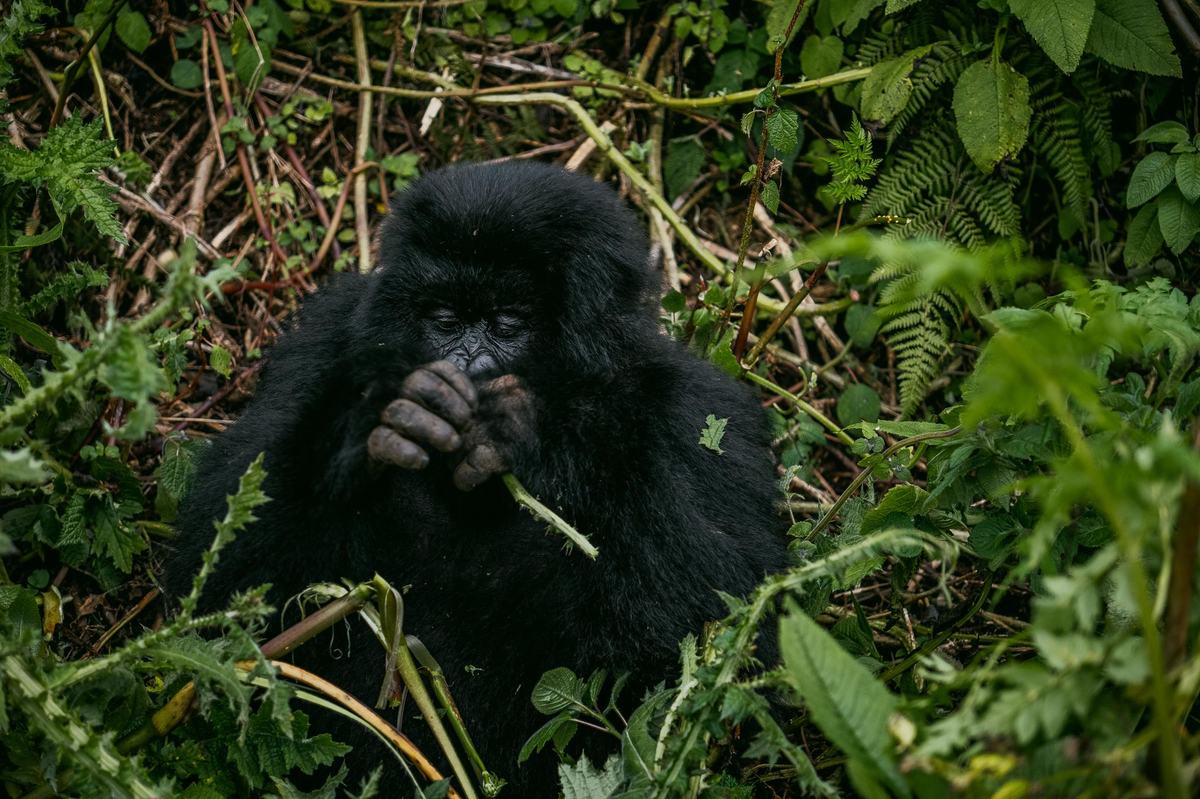
If you've ever seen the 1988 film "Gorillas in the Mist", you've seen Rwanda - or at least the slopes of the Virunga Mountains where Dian Fossey did her research. Volcanoes National Park, in the country's northwest corner, protects roughly a third of the world's remaining mountain gorillas. The population is small, around 1,000 individuals split between Rwanda, Uganda, and the DRC, but it's growing. Mountain gorillas are the only great ape species whose numbers are actually trending up [7].
Gorilla trekking is now one of Rwanda's biggest sources of foreign revenue. A permit costs $1,500 per person for a single hour with one of the habituated families. That's not a typo. The money funds park rangers, anti-poaching patrols, and community projects in the villages around the park. The pricing keeps visitor numbers low, which keeps the gorillas calm. The model works. Other countries have started copying it.
Every September, Rwanda holds Kwita Izina - a public ceremony where newly born baby gorillas are formally named, like a christening. It's part conservation outreach, part national celebration. People line up to watch.
A Language and Cultural Mosaic
Rwanda has four official languages: Kinyarwanda, the indigenous Bantu language spoken by virtually everyone; French, a holdover from Belgian colonial administration; English, adopted as official in 2008 when the country pivoted toward the East African Community and the Commonwealth; and Swahili, added in 2017 [1].
That last switch is fascinating. Rwanda formally joined the Commonwealth in 2009 despite never having been a British colony - one of only a handful of countries with that distinction. The shift from a French-speaking education system to an English-speaking one happened essentially overnight, and a generation of Rwandan teachers had to retrain on the fly.
Kinyarwanda itself is a wonderfully complex language with proverbs for nearly every situation. "Akebo kajya iwa mugarura" - the basket goes to those who give back - captures a lot about how community is supposed to work here.
The 1994 Genocide and What Came After
You can't write honestly about Rwanda without acknowledging 1994. Over roughly 100 days that spring, an estimated 800,000 to 1 million Tutsi and moderate Hutu Rwandans were killed in one of the fastest genocides in human history [8]. The country was shattered. The economy collapsed. A generation of professionals, teachers, and doctors was gone.
What followed has become one of the most studied national recoveries of modern times. The Gacaca courts - community-level tribunals based on a traditional dispute-resolution model - processed nearly two million genocide cases between 2002 and 2012. The Kigali Genocide Memorial, where over 250,000 victims are buried, is one of the most moving museums I've ever read accounts of. Every April, the country observes Kwibuka, a week of national remembrance.
The Rwanda of today is not the Rwanda of 1994, and the distance between them is something the country has worked extraordinarily hard for.
A Few More Things Worth Knowing
Rwanda is one of only two countries in the world where women hold a majority of seats in parliament - more than 60 percent of the lower house, the highest share anywhere [9]. It runs on roughly 50 percent renewable electricity, much of it from methane extracted from Lake Kivu, which is one of three lakes in the world that periodically releases dangerous gases from its deep waters. Drones deliver blood to remote hospitals through a partnership with Zipline that started in 2016, and Rwanda became the first country in the world to run a national-scale medical drone network. The roads are good. The Wi-Fi reaches places it shouldn't. Things just sort of work.
For a country this small, this hilly, and this recently devastated, Rwanda is doing things that bigger and richer places haven't figured out yet.
Frequently Asked Questions
Why is Rwanda called the Land of a Thousand Hills?
Rwanda's nickname comes from its terrain: the entire country sits on rolling, terraced hills that range from 950 to 4,507 meters above sea level. Almost no part of Rwanda is flat. Farmers cultivate the slopes intensively, which gives the landscape its iconic patchwork look from the air.
Is Rwanda safe to visit?
Yes. Rwanda is consistently ranked among the safest countries in Africa for travelers, with low crime rates in Kigali and the national parks. Tourism infrastructure is well developed, and the government invests heavily in visitor safety. Standard travel precautions apply, but Rwanda is considered a low-risk destination.
How much does gorilla trekking in Rwanda cost?
A single gorilla trekking permit in Volcanoes National Park costs $1,500 per person and grants one hour with a habituated gorilla family. The price funds conservation, ranger salaries, and community projects. Permits sell out months in advance and must be booked through the Rwanda Development Board or licensed tour operators.
What languages do people speak in Rwanda?
Rwanda has four official languages: Kinyarwanda, English, French, and Swahili. Kinyarwanda is the universal mother tongue spoken by nearly all Rwandans, while English has been the primary language of education and government since 2008. French is declining but still common among older generations.
Sources
- Rwanda - The World Factbook (CIA)
- Rwanda Population - World Bank Data
- Rwanda Development Board - About Rwanda
- Volcanoes National Park - UNESCO and Rwanda Tourism
- Rwanda Tea Industry - FAO Country Profile
- Rwanda's Plastic Bag Ban - UN Environment Programme
- Mountain Gorilla Population - International Union for Conservation of Nature
- Rwanda Genocide - United Nations Outreach Programme
- Women in Parliament - Inter-Parliamentary Union