- Capital: Castries [1]
- Population: about 180,000 [1]
- Area: 617 square kilometers (238 square miles) [1]
- Official language: English (Saint Lucian Creole French widely spoken) [1]
- Currency: East Caribbean Dollar (XCD) [1]
- Has produced two Nobel laureates, the highest per capita rate of any sovereign country [2]
Here's something that'll ruin the next geography quiz you take: a Caribbean island smaller than the city of Indianapolis has produced two Nobel Prize winners. Two. From a population of 180,000 people. That works out to one laureate for every 90,000 residents, which is the highest per capita rate in the world by a wide margin. Saint Lucia is not a place I knew much about before I started writing this. Now I cannot stop thinking about it.
The country is a single volcanic island roughly halfway down the chain of the Lesser Antilles, sitting between Martinique to the north and Saint Vincent to the south. It is shaped a little like a teardrop, runs about 27 miles top to bottom, and packs in mountains, rainforest, fishing villages, banana farms, and one of the most photographed coastlines on Earth. The whole place is barely larger than the city of Chicago.
The Pitons
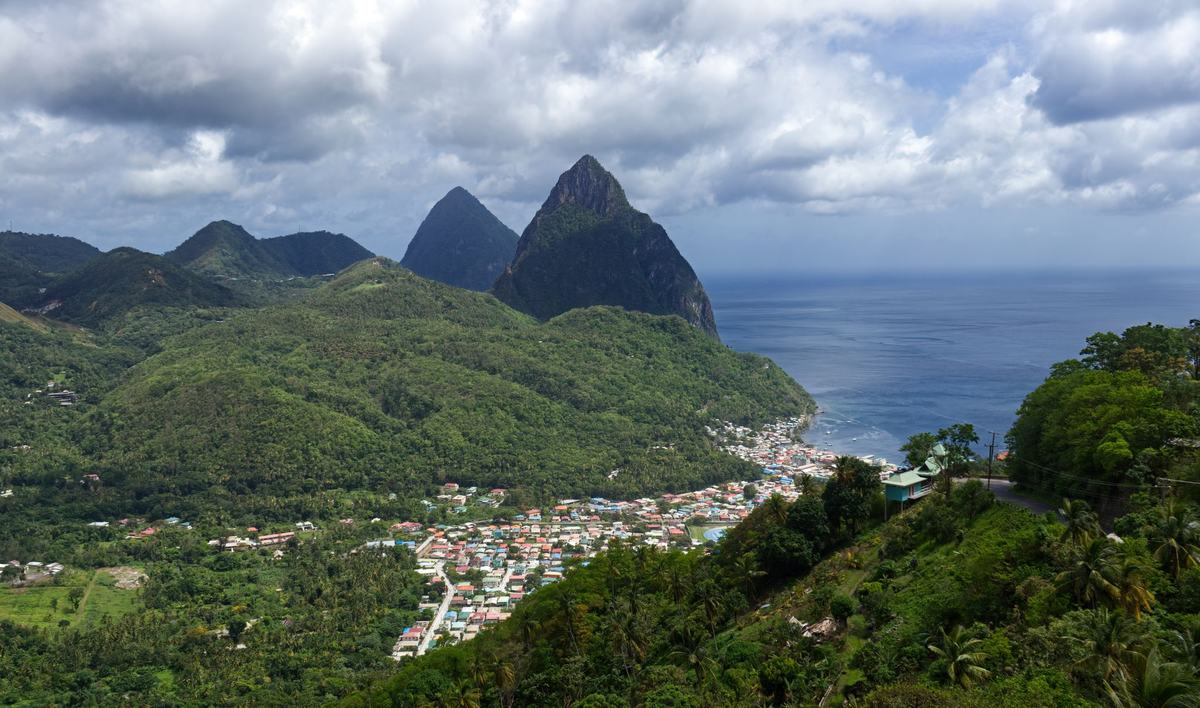
If you have ever seen a postcard of Saint Lucia, you have seen the Pitons. They are two volcanic spires on the southwest coast, rising almost straight out of the Caribbean Sea. Gros Piton is 798 meters tall. Petit Piton, despite the name, is only slightly shorter at 743 meters but looks more dramatic because of how steeply it climbs. They are the eroded plugs of an ancient volcano, and they sit so close to each other that they frame the small town of Soufriere between them like bookends. UNESCO put the area on the World Heritage list in 2004.
Climbing Gros Piton is allowed and takes most people about four hours round trip. Climbing Petit Piton is officially discouraged because the route is genuinely dangerous, with sections that require scrambling on exposed rock with serious drops. Most visitors just look at them from a sailboat in the bay below, which is honestly the better way to take them in.
The Drive-In Volcano
A few miles inland from Soufriere is something the tourism board calls the "world's only drive-in volcano". The label is a bit of a stretch. You don't actually drive into a crater. But you do park your car next to a steaming, sulfur-smelling field of bubbling mud pots and fumaroles in the collapsed caldera of Mount Soufriere, and you can walk right up to vents that hiss like a kettle. The volcano last had a real eruption around 1766, but it has never gone fully quiet, and the geothermal activity is part of the local economy now between tourism and a planned geothermal power project.
Down the road, the same volcanic system feeds a set of natural sulfur springs and mud baths that locals have been using for centuries. The mud is supposed to be good for your skin. The smell is not.
A Country Named After a Woman
Saint Lucia is the only sovereign nation in the world named after a real woman. The island was named for Saint Lucy of Syracuse, a fourth-century Christian martyr from Sicily, by French sailors who supposedly landed there on her feast day, December 13th. That date is still celebrated every year as the National Day. There is some debate among historians about whether the naming story is exactly accurate, but the country has owned it for a long time. The flag, designed by a local artist in 1967, features a black and white triangle on a blue field meant to represent the Pitons rising from the sea.
The island changed hands between France and Britain fourteen times before finally settling under British rule in 1814. That back and forth is why English is the official language but most Saint Lucians also speak Kweyol, a French-based creole that is closer in many ways to Haitian Creole than to anything you would hear in Britain or America.
Two Nobel Prizes
Now back to those Nobel laureates. Sir Arthur Lewis won the Nobel Prize in Economics in 1979 for his work on economic development in poor countries, becoming the first Black person to win a Nobel in any category outside of Peace. Derek Walcott won the Nobel Prize in Literature in 1992 for his poetry, which drew on Caribbean history, language, and landscape. Both men were born in Castries. Walcott and Lewis attended the same secondary school. Castries had a population of around 25,000 at the time. Two boys from the same small town, on a small island, in the same generation, both ended up in Stockholm. I had to look this up twice.
Walcott's epic poem Omeros, published in 1990, retells parts of the Iliad and the Odyssey through the lives of Caribbean fishermen on Saint Lucia. It is the kind of book that people who do not normally read poetry end up reading anyway, because once you start it pulls you under. If you ever want to understand a place from the inside, that's the book.
Frequently Asked Questions
What is the capital of Saint Lucia?
The capital of Saint Lucia is Castries, located on the northwest coast of the island. It is home to about 22,000 people in the city itself and roughly 70,000 in the wider urban area. Castries is also the country's main port and the birthplace of both of Saint Lucia's Nobel laureates.
What language do they speak in Saint Lucia?
English is the official language of Saint Lucia and is used in government, schools, and business. In everyday life, most Saint Lucians also speak Kweyol, a French-based creole, which reflects the island's long history of switching between French and British colonial rule.
Is Saint Lucia a safe place to visit?
Saint Lucia is generally considered safe for tourists, with most visits passing without incident. As with much of the Caribbean, petty theft happens, and visitors are advised to stay alert in Castries at night. The main resort areas in the south and northwest are well policed.
What currency does Saint Lucia use?
Saint Lucia uses the East Caribbean Dollar (XCD), shared with seven other Eastern Caribbean countries. It is pegged to the US dollar at a fixed rate of about 2.70 XCD to 1 USD, which makes prices easy to estimate. US dollars are also widely accepted in tourist areas.
When is the best time to visit Saint Lucia?
The best time to visit Saint Lucia is between December and April, during the dry season. Temperatures stay around 80 degrees Fahrenheit year round, but the wet season from June through November brings more rain and overlaps with the Atlantic hurricane season, which can disrupt travel.