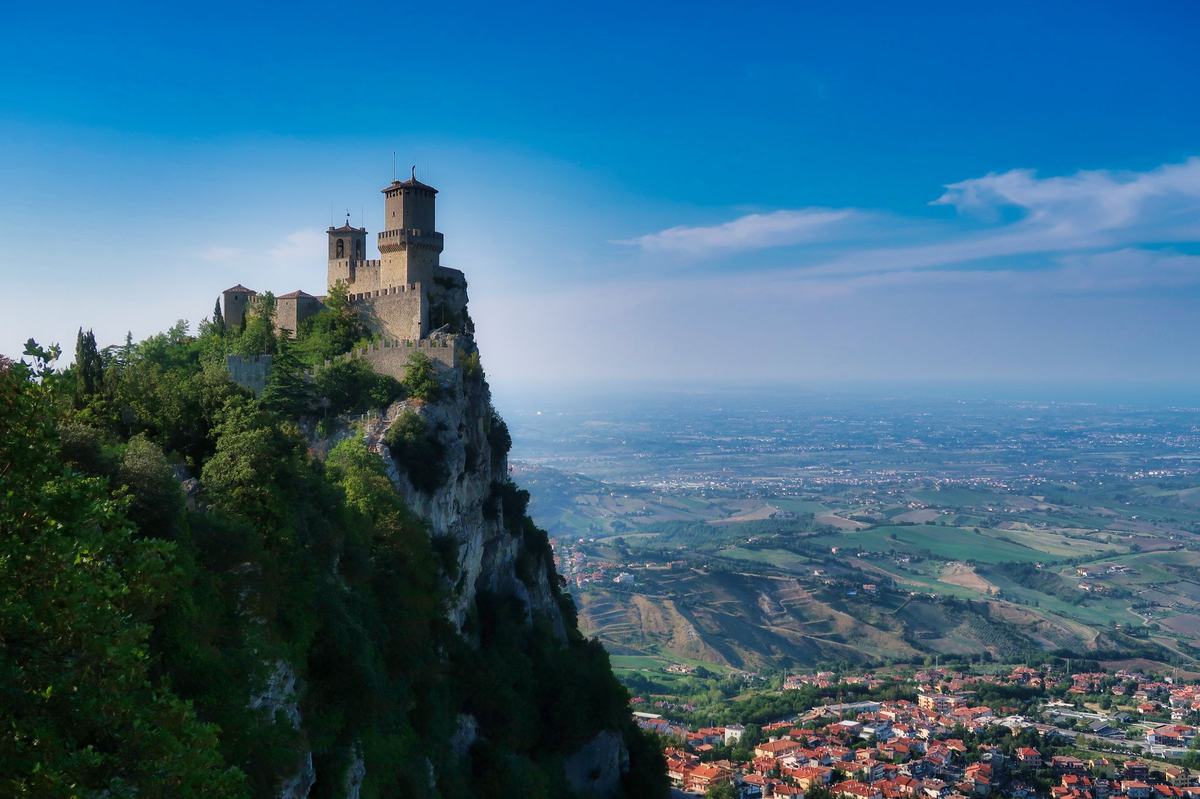
San Marino at a glance
- Capital: City of San Marino, on the slopes of Mount Titano [1]
- Population: about 33,600 (2023) [2]
- Area: 61 km² (24 sq mi), making it the fifth-smallest country in the world [1]
- Official language: Italian [1]
- Currency: euro (EUR), though San Marino is not in the European Union [3]
- Founded in 301 AD, the oldest continuous sovereign state and the oldest republic on the planet [4]
I grew up thinking the United States was an old country. Then I read about San Marino and realized this tiny patch of stone in northern Italy had already been a self-governing republic for almost fifteen hundred years before Philadelphia ever saw a Continental Congress. [4]
The country sits on a single mountain in Emilia-Romagna, completely surrounded by Italy, and somehow it has survived Roman emperors, popes, Napoleon, Mussolini, and the European Union without ever losing its independence. Here's the thing: it didn't survive by accident. It survived because the people running it were unusually careful and unusually stubborn.
A Republic Started by a Stonemason
The founding story is almost too tidy to be true, but the date sticks. In 301 AD, a Christian stonemason from the Dalmatian island of Rab, fleeing the persecutions of the Roman emperor Diocletian, climbed Mount Titano and built a small religious community there. His name was Marinus. Within his lifetime the community was governing itself, and it has been doing so ever since. [4]
The country still keeps a copy of the political statutes Marinus's successors drew up. The oldest surviving version dates from 1600 and is one of the world's longest-running written constitutions. [4] Most countries with a 1700-year-old founding myth would have rewritten the rules a dozen times. San Marino has mostly just amended them.
Two Captains Regent, Six Months at a Time
San Marino has two heads of state, called Captains Regent, who serve together for exactly six months. They are elected by the country's parliament, the Grand and General Council, every April and October. One traditionally represents the governing majority, the other the opposition, so that neither side can run the country alone. [4]
The system is a direct descendant of the consular pairs that ran the Roman Republic. San Marino kept the model long after Rome itself had abandoned it. Captains Regent cannot be re-elected for three years after their term ends, which keeps the office from being captured by any one person. The investiture ceremony, held twice a year on Mount Titano, still uses medieval costume and Latin oaths.
How a Mountain Republic Outlasted Empires
San Marino's survival is one of the strangest stories in European political history. When Napoleon swept through Italy in 1797, he reached the border of the tiny republic, sent in an envoy, and offered to expand its territory. The Captains Regent politely declined, on the grounds that more land would only invite envy and trouble. Napoleon was reportedly charmed and left them alone. [5]
The same instinct held during the unification of Italy in the 1860s. Giuseppe Garibaldi, on the run from Austrian and papal forces in 1849, was given shelter inside San Marino. He never forgot it, and when Italy unified soon after, the new kingdom signed a treaty respecting San Marino's independence. [5] That treaty, updated several times, is still the basis of the relationship today.
The Second World War nearly ended the streak. San Marino declared neutrality, but in 1944 it was briefly occupied by German forces and then bombed by the British Royal Air Force, which mistakenly believed the country was sheltering retreating Axis troops. Sixty-three Sammarinese civilians were killed. The country held on, and the Allies later paid reparations. [4]
Three Towers and a UNESCO Listing
The skyline of San Marino is dominated by three medieval towers strung along the ridge of Mount Titano: Guaita, Cesta, and Montale. The oldest, Guaita, dates from the 11th century and was for a long time the country's main prison. The three towers and the historic center of the City of San Marino were inscribed as a UNESCO World Heritage Site in 2008. [6]
The view from the ridge is the kind of thing you do not forget. On a clear day you can see across the rolling hills of Romagna all the way to the Adriatic coast at Rimini, about ten miles away. Back home in Montana, the closest equivalent I can think of is the view from a fire lookout, except this one happens to be in a country.
A Country That Runs on Tourism and Stamps
The Sammarinese economy is mostly services, with tourism leading the way. Around two million visitors come every year, which is roughly sixty times the country's population. [3] Many come for the day, drive up from the Italian coast, climb the towers, eat lunch, buy a souvenir, and drive back. The country has no airport and no railway; the only way in is by road from Italy.
For a long time, postage stamps were a serious export. San Marino has been issuing its own stamps since 1877, and Sammarinese stamps are prized by collectors worldwide. [3] The numismatic side is just as active. San Marino mints its own euro coins under an agreement with the EU, and the coins are scarce enough that collectors snap them up almost as soon as they appear. [3]
Frequently Asked Questions
What is San Marino most known for?
San Marino is best known as the world's oldest surviving republic, founded in 301 AD, and as one of Europe's microstates. It sits on Mount Titano, surrounded entirely by Italy, and is famous for its three medieval towers, its UNESCO-listed historic center, and its system of two heads of state who serve only six months at a time.
Is San Marino a country or part of Italy?
San Marino is a fully independent sovereign state, not part of Italy. It is completely surrounded by Italian territory but has its own constitution, government, currency arrangements, and seat at the United Nations. Its independence has been recognized continuously for more than seventeen centuries, including by treaty with Italy since 1862.
How old is the Republic of San Marino?
San Marino traces its founding to the year 301 AD, when a Christian stonemason named Marinus established a community on Mount Titano. That makes it the oldest continuously existing sovereign state and the oldest republic in the world, with a written political statute that dates in its current form to 1600.
What language do they speak in San Marino?
The official language of San Marino is Italian. A regional dialect known as Romagnolo, closely related to the speech of neighboring Emilia-Romagna, is also used in informal settings, particularly among older residents. English and other European languages are common in the tourism sector but have no official status.
Is San Marino in the European Union?
San Marino is not a member of the European Union, but it has a customs union with the EU and uses the euro under a 2012 monetary agreement that allows it to mint its own euro coins. The country is currently negotiating a wider association agreement that would give it deeper access to the European single market.