- Capital: Riyadh [1]
- Population: About 36 million [1]
- Area: 2,149,690 square kilometers (830,000 sq mi) [1]
- Official language: Arabic [1]
- Currency: Saudi riyal (SAR) [1]
- Distinguishing claim: Holds the two holiest cities in Islam, Mecca and Medina, and sits on roughly 17 percent of the world's proven petroleum reserves [2]
I grew up thinking of Saudi Arabia as one big stretch of sand with oil under it. That's not exactly wrong, but it misses most of the actual country. The kingdom covers about four-fifths of the Arabian Peninsula, which is bigger than Alaska, and it includes mountains in the southwest, a long Red Sea coast with coral reefs, ancient rock-cut tombs older than Petra, and a desert called the Empty Quarter that is so empty most maps just leave it blank. There are no permanent rivers anywhere in the country. There are about 4 million date palms. And there is the city of Mecca, which roughly 1.8 billion Muslims around the world face five times a day. That is a lot to fit into one passport.
A Country Mostly Made of Desert
About 95 percent of Saudi Arabia is desert or semi-arid land [3]. The Rub' al Khali in the south, the Empty Quarter, is the largest continuous sand desert on Earth, covering roughly 650,000 square kilometers, an area bigger than France. Dunes there can reach 250 meters high, taller than a 70-story building. Some stretches of the Empty Quarter have no permanent human population at all, which is exactly the kind of fact that sounds normal until you try to picture it. France with nobody in it.
The country has no permanent rivers. None. What it has are wadis, dry riverbeds that briefly fill with water after the rare rains and then go quiet again for years. Most of the kingdom's water comes from underground aquifers and from desalinating seawater on a massive scale. Saudi Arabia produces about 22 percent of the world's desalinated water, more than any other country [4]. Turn on a tap in Riyadh and what comes out used to be in the Persian Gulf.
Back home in Montana, the driest part of the state gets about 12 inches of rain a year. Most of Saudi Arabia gets less than four. Some areas get almost none.
Mecca and Medina: The Two Holy Cities
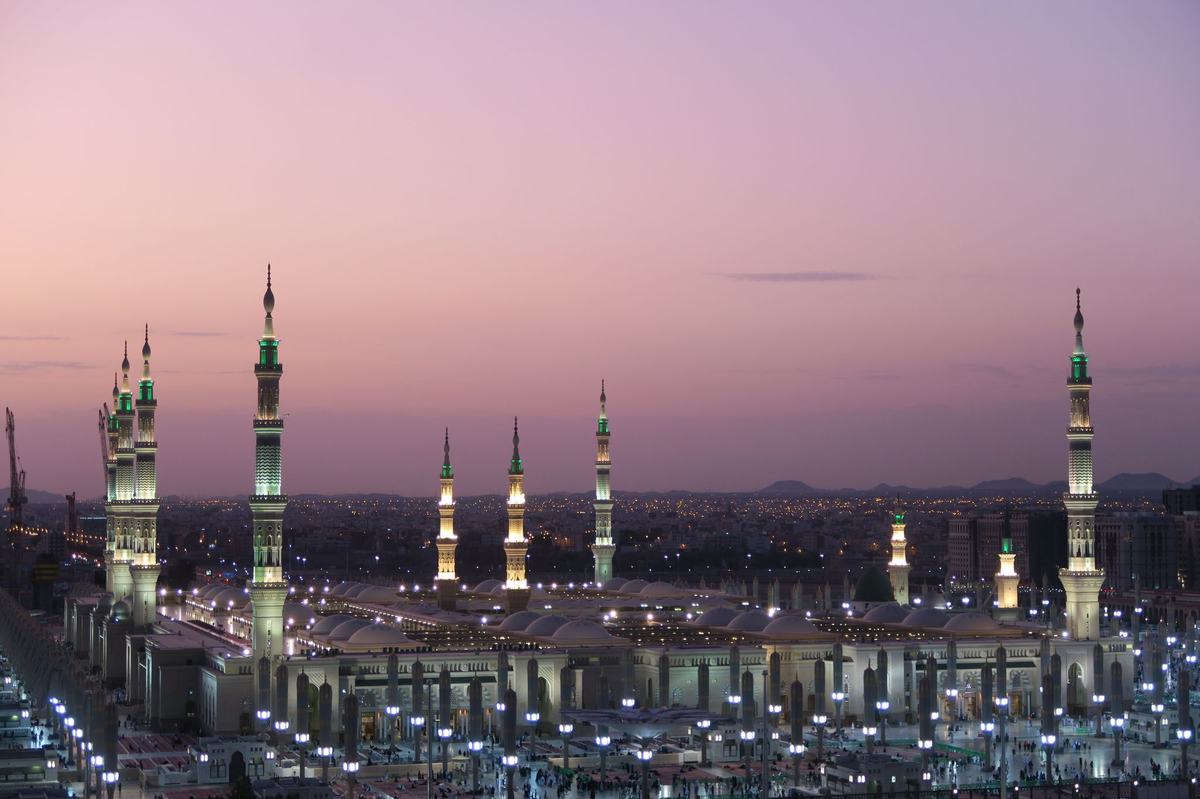
Mecca, on the western side of the country, is the birthplace of the Prophet Muhammad and the site of the Kaaba, the cube-shaped building inside the Grand Mosque that Muslims face during prayer. Every able Muslim is expected to make the pilgrimage to Mecca, the Hajj, at least once in their lifetime if they can afford it. In a normal year about 2 to 3 million pilgrims attend the Hajj during a single week, which is one of the largest annual gatherings of human beings anywhere on Earth [5].
Medina, about 280 miles north of Mecca, is where the Prophet Muhammad migrated in 622 CE and where he is buried. Both cities are closed to non-Muslims, which is unusual among the world's major religious sites. The logistics of moving millions of people through a single city in a few days have made Saudi Arabia an unlikely world expert in crowd flow engineering. The Grand Mosque can hold about 1.5 million worshippers at once after recent expansions, and pilgrims circle the Kaaba seven times in a ritual called tawaf that has been happening, in some form, for fourteen centuries.
The Saudi king's official title is Custodian of the Two Holy Mosques, a phrase that gets used in formal speech and even on government letterhead. It's a job description as much as a title.
The Oil That Changed Everything
Oil was discovered in commercial quantities at Dammam Well No. 7 in 1938, in the Eastern Province near the Persian Gulf. Within a few decades that single discovery had rewired the country, the region, and the global economy. Saudi Arabia holds roughly 17 percent of the world's proven petroleum reserves, the second largest after Venezuela [2]. The Ghawar field, also in the Eastern Province, is the largest conventional oil field ever discovered.
Before oil, the Saudi economy ran on dates, camels, and the seasonal income from Hajj pilgrims. Within two generations the country went from one of the poorest in the region to one of the wealthiest in the world. Saudi Aramco, the state oil company, is one of the most profitable companies in human history. It briefly became the most valuable publicly listed company on Earth after its 2019 IPO [6].
The kingdom is now spending a chunk of that wealth trying to build something for after oil. The Vision 2030 plan, launched in 2016, is an attempt to shift the economy toward tourism, technology, manufacturing, and entertainment, including projects like NEOM, a planned city in the northwest that has become a kind of architectural Rorschach test for what a post-oil Gulf state might look like.
Ancient Sites in the Desert
Most people don't think of Saudi Arabia as a place with archaeology, but the country has six UNESCO World Heritage sites and more being added [7]. The most striking is Hegra (also called Mada'in Salih), a Nabatean city carved into sandstone in the country's northwest. The Nabateans were the same culture that built Petra in Jordan, and Hegra is its sister city, with more than 100 monumental tombs cut directly into the rock. Until 2019 the area was almost completely closed to outside visitors.
There's also Diriyah, the original mud-brick capital of the first Saudi state, founded in the 15th century and now being restored as a heritage destination just outside Riyadh. And there are rock art sites in the Hail region that include some of the oldest petroglyphs in the Arabian Peninsula, with carvings of cattle and human figures from a time when the desert was a savanna with rivers and game.
Turns out the Arabian Peninsula was green about 8,000 years ago. The Empty Quarter had lakes. People hunted hippos there. The country sitting on the world's largest sand desert was once a wetland.
Coffee, Dates, and a Long Coast
Saudi coffee, called qahwa, is light gold, served unsweetened, and often flavored with cardamom. It's offered to guests in small cups and refilled until the guest tilts the cup as a sign they've had enough. The ritual is older than the country and is part of how hospitality is performed across the Gulf. Dates are usually served alongside, and Saudi Arabia is one of the largest producers of dates in the world, with thousands of named varieties [3].
The country has a long Red Sea coastline, about 1,800 kilometers, with coral reefs that are surprisingly understudied because most of them have been off-limits to mass tourism. Some scientists think these reefs may be more heat-tolerant than reefs elsewhere, which has made them a quiet hope in climate research. The coast is now opening to international tourists as part of the Vision 2030 push, with new resorts on the Red Sea and on islands that were essentially uninhabited for most of recorded history.
Frequently Asked Questions
What is Saudi Arabia known for?
Saudi Arabia is best known for being the birthplace of Islam and home to its two holiest cities, Mecca and Medina. It is also one of the world's largest oil producers, holding about 17 percent of global proven petroleum reserves, and it contains the largest continuous sand desert on Earth.
What language is spoken in Saudi Arabia?
Arabic is the official language of Saudi Arabia and is used in government, education, and daily life. Most Saudis speak a Gulf or Najdi dialect, while Modern Standard Arabic is used in media and formal settings. English is widely used in business and is taught in schools.
What is the capital of Saudi Arabia?
The capital of Saudi Arabia is Riyadh, located in the center of the country. It has a metropolitan population of about 7 million people and is the political, financial, and administrative center of the kingdom. Riyadh sits on the Najd plateau in the central region known historically as the heartland of the Saudi state.
Why is Saudi Arabia important to Muslims?
Saudi Arabia is the birthplace of Islam and contains its two holiest cities, Mecca and Medina. Muslims face Mecca during their five daily prayers and are expected, if able, to make the Hajj pilgrimage there at least once. Both cities are restricted to Muslims.
How large is the Empty Quarter desert?
The Rub' al Khali, or Empty Quarter, covers roughly 650,000 square kilometers across southern Saudi Arabia and parts of Oman, Yemen, and the United Arab Emirates. It is the largest continuous sand desert on Earth, larger than France, with dunes that can reach 250 meters in height.
Sources
- The World Factbook: Saudi Arabia
- U.S. Energy Information Administration: Saudi Arabia
- Encyclopaedia Britannica: Saudi Arabia
- International Desalination Association: Global Desalination Data
- BBC News: Hajj pilgrimage in numbers
- Reuters: Saudi Aramco IPO and market value
- UNESCO World Heritage Centre: Hegra Archaeological Site