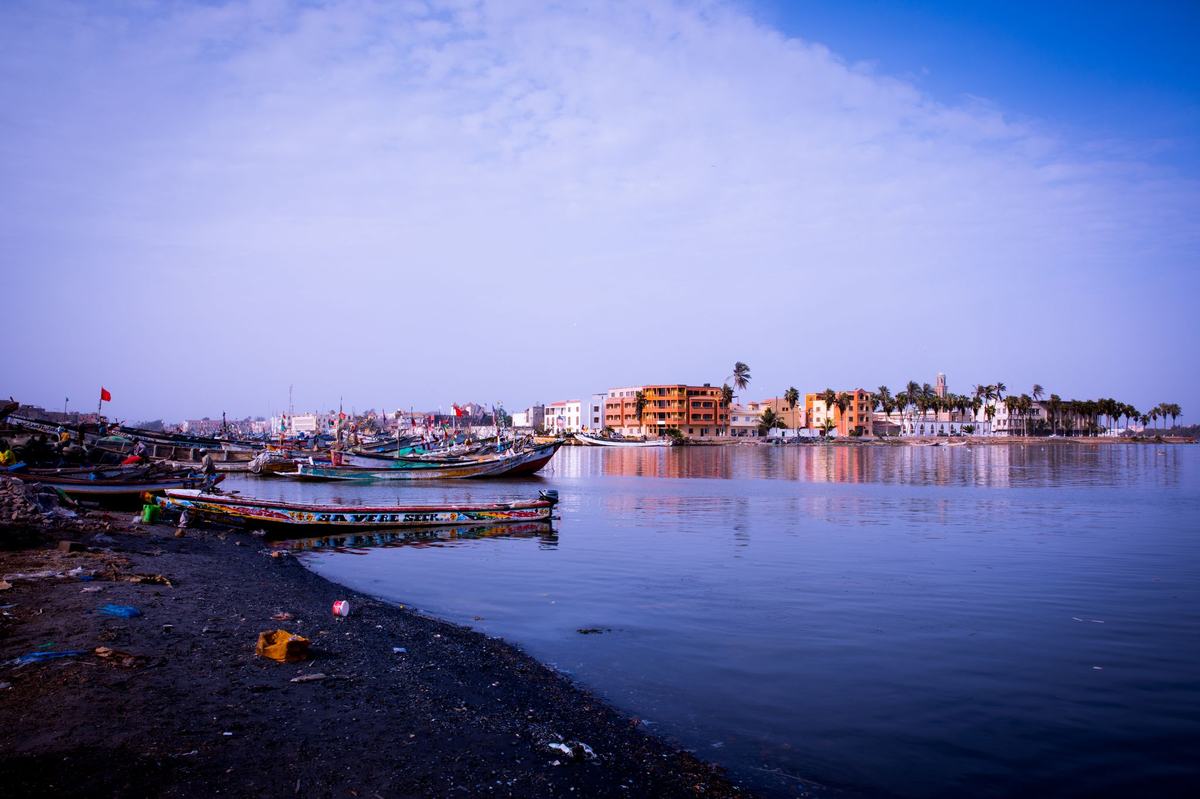
- Capital: Dakar [1]
- Population: about 18.4 million (2024 estimate) [2]
- Area: 196,712 square kilometers [1]
- Official language: French; national languages include Wolof, Pulaar, Serer, Diola, Mandinka, and Soninke [1]
- Currency: West African CFA franc (XOF) [3]
- Distinguishing claim: Cap-Vert peninsula near Dakar is the westernmost point of mainland Africa [1]
I grew up tracing my finger along the bulge of West Africa on a beat-up classroom globe, never quite registering that the tip of that bulge had a name and a city sitting on it. Turns out the westernmost point of mainland Africa isn't somewhere remote and abstract. It's a peninsula called Cap-Vert, and there's a capital city built on it called Dakar, and people live there, work there, raise families, and run one of the most stable democracies on the continent. Senegal is one of those countries that punches way above its weight in things that actually matter, and almost nobody back home in Montana could place it on a map.
A Stable Democracy in a Tough Neighborhood
Here's the thing about Senegal that you don't hear enough: since independence from France in 1960, the country has never had a successful military coup [4]. That sentence sounds small until you look at the map of West Africa over the last sixty years and realize how unusual that is. Power has changed hands through elections. In 2024, Bassirou Diomaye Faye won the presidency just days after being released from prison, and the incumbent stepped aside peacefully [5]. That kind of transition is the quiet miracle of Senegalese politics. It's not perfect, but the institutions hold.
The country also runs on a model that political scientists love to study: a Muslim-majority population (about 95 percent) with deep Sufi brotherhoods, a constitution that's strictly secular, and Christians who hold senior government positions without anyone making a big deal of it [6]. The first president, Léopold Sédar Senghor, was a Catholic poet in a Muslim country, and he served for twenty years before voluntarily stepping down. Which, if you think about it, is a pretty extraordinary thing for any leader to do anywhere.
Teranga: The Word That Explains the Country
If you talk to anyone who has spent time in Senegal, the word teranga comes up within five minutes. It's a Wolof word that gets translated as "hospitality", but that translation undersells it. Teranga is more like a national operating principle. The expectation is that you welcome strangers, share food even when there isn't much, and treat guests with the kind of attention you'd give your own family. The national football team is called the Lions of Teranga. Senegal Airlines used to be called Air Senegal International before being rebranded under the teranga banner. The word shows up on restaurant signs, hotel names, T-shirts, taxis.
It's not just marketing. The practice of sharing a communal bowl of thieboudienne (more on that in a second) at lunchtime, where everyone eats with their right hand from the same dish, is teranga in action. You don't eat alone if you can help it. The visitor gets the best pieces of fish.
The National Dish You'll Want to Try Twice
Thieboudienne (pronounced roughly "cheb-oo-jen") is rice cooked in a tomato-based broth with fish, vegetables, and a layer of caramelized rice at the bottom of the pot that everyone fights over. In December 2021, UNESCO inscribed thieboudienne on its Representative List of the Intangible Cultural Heritage of Humanity [7]. The country has been quietly proud of this dish for centuries, and now it's officially recognized as part of the cultural heritage of mankind. The story behind it is good too: a 19th-century cook named Penda Mbaye, working in Saint-Louis, is credited with creating the modern version of the dish.
If you want to understand Senegal's culture in one meal, this is it. Rice came over from Asia, tomatoes from the Americas, the technique from West African one-pot cooking traditions, and the whole thing eaten communally on the floor with your hand. A country at a crossroads, serving the world on a single plate.
Gorée Island and a Door That Faces the Ocean
About three kilometers off the coast of Dakar sits a tiny island, less than a kilometer long, called Gorée. From the 15th to the 19th century, it was one of the largest slave-trading centers on the African coast, controlled at various times by the Portuguese, Dutch, English, and French [8]. UNESCO made it a World Heritage Site in 1978, and the small pink building called the Maison des Esclaves still stands with its famous "Door of No Return" facing the Atlantic.
Historians debate exactly how many enslaved people passed through Gorée specifically versus other ports. The numbers vary widely. What isn't debated is the symbolic weight of the place. Nelson Mandela visited. Pope John Paul II visited. Barack Obama visited in 2013 and stood at the door looking out at the ocean. I had to look this up twice because I couldn't quite believe how small the island is. You can walk across it in fifteen minutes. The whole place is a memorial that hasn't stopped functioning.
The Pink Lake That Used to End a Rally
For decades, the Dakar Rally ended near a lake called Lac Rose, or Lake Retba, about thirty kilometers northeast of Dakar. The lake is pink. Not "kind of pinkish in certain light" pink. Bubble-gum, strawberry-milkshake pink, because of a salt-loving microorganism called Dunaliella salina that thrives in the hypersaline water and produces a red pigment to protect itself from the sun. The salt content can hit 40 percent, almost as salty as the Dead Sea. Local workers harvest the salt by hand, standing in the water for hours with shea butter rubbed on their skin to keep it from burning [9].
The Dakar Rally itself moved out of Senegal in 2009 after security concerns in Mauritania along the route, and it now runs in Saudi Arabia. Lac Rose is still there though, still pink, still being worked by salt harvesters who haul out the crystals in wooden boats. The pink is sometimes faint depending on rainfall and the season, but on a hot dry day it looks like someone spilled a strawberry slushie across the desert.
Music That Helped Invent a Genre
Senegal has produced some of the most influential African musicians of the last fifty years. Youssou N'Dour is the most famous: a Grammy winner, a former Minister of Culture, and one of the people most responsible for putting mbalax (a style that fuses Wolof percussion with Cuban, jazz, and pop influences) onto the world stage [10]. He sang on Peter Gabriel's "In Your Eyes" back in 1986, and that one collaboration introduced a whole generation of American listeners to West African vocal traditions whether they knew it or not.
Then there's Akon, born in St. Louis, Missouri but raised partly in Senegal, who became one of the bestselling R&B artists of the 2000s. The country's music scene is dense and active, with everyone from traditional kora players to Dakar hip-hop artists pulling from the same well. Nobody talks about this enough, but West African music shaped global pop in ways that don't always get traced back to the source.
A Country Looking Outward
Senegal is one of the most-visited countries in West Africa, with a tourism industry built around beaches, music festivals, the Saloum Delta, and the historical weight of Saint-Louis and Gorée. It also produces some of the best peanuts in the world (the country is among the top peanut producers globally, and groundnuts have shaped its economy for over a century), and offshore natural gas production began in earnest in 2024 from the GTA field shared with Mauritania, which is going to change the economic picture significantly over the coming years [11].
For a country smaller than South Dakota, Senegal sits on a remarkable amount of cultural and political real estate. It hosts the secretariat of the African Renaissance Monument, the tallest statue in Africa at 49 meters, standing on a hill overlooking Dakar Bay. It hosted the Youth Olympic Games in 2026, the first time the Olympics in any form came to Africa. The country exports more diplomatic influence than its GDP would predict, and it does so with the kind of quiet confidence that comes from knowing who you are.
That's the Senegal worth knowing about. Not a country defined by what colonizers built or what aid agencies fund, but one that defined itself, kept defining itself, and has plenty more to show the rest of us.
Frequently Asked Questions
What is Senegal famous for?
Senegal is famous for teranga (its hospitality tradition), thieboudienne (its UNESCO-recognized national rice and fish dish), Dakar as the westernmost city on mainland Africa, and the historic island of Gorée. The country is also known for its stable democracy and influential music scene led by artists like Youssou N'Dour.
What language do they speak in Senegal?
French is the official language of Senegal, used in government and education. However, Wolof is the most widely spoken language in daily life, understood by more than 80 percent of the population. Pulaar, Serer, Diola, Mandinka, and Soninke are also recognized as national languages.
Is Senegal safe to visit?
Senegal is generally considered one of the safer countries in West Africa for travelers, with a stable government and a strong tourism infrastructure. Dakar and the major coastal areas are popular with visitors. Travelers should still take normal precautions, particularly with petty theft in busy markets and transit hubs.
What is the capital of Senegal?
The capital of Senegal is Dakar, located on the Cap-Vert peninsula at the westernmost point of mainland Africa. With a metropolitan population of over 3 million, Dakar is the country's political, economic, and cultural center, and one of the most important port cities in West Africa.
When did Senegal gain independence?
Senegal gained independence from France on April 4, 1960, initially as part of the short-lived Mali Federation with French Sudan. The federation dissolved in August 1960, and Senegal became fully independent under its first president, Léopold Sédar Senghor, a poet and one of the founders of the Négritude literary movement.
Sources
- Senegal Country Profile - The World Factbook (CIA)
- Senegal - World Bank Country Data
- West African CFA Franc - Banque Centrale des États de l'Afrique de l'Ouest
- Senegal Country Report - Freedom House
- Senegal's New President Bassirou Diomaye Faye - BBC News
- Religion in Senegal - Pew Research Center
- Ceebu Jen Inscribed on UNESCO Intangible Heritage List
- Island of Gorée - UNESCO World Heritage Centre
- Lake Retba (Lac Rose) - Encyclopaedia Britannica
- Youssou N'Dour Biography - Encyclopaedia Britannica
- Greater Tortue Ahmeyim Project - BP