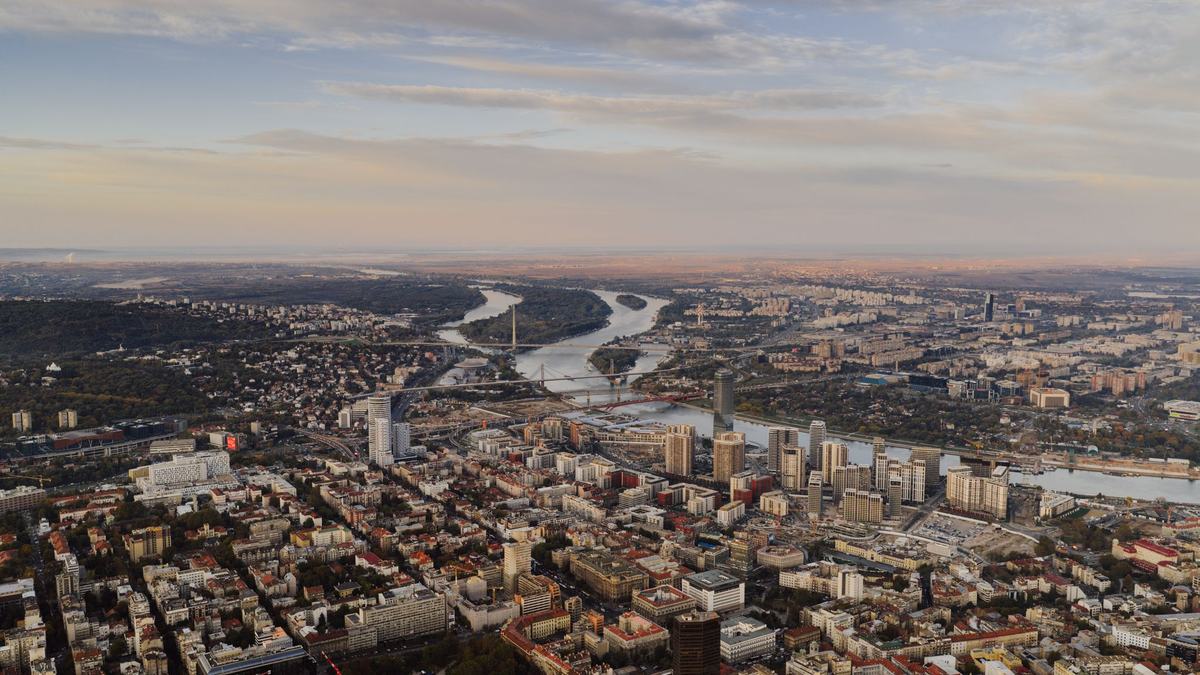
- Capital: Belgrade, one of the oldest continuously inhabited cities in Europe [1]
- Population: about 6.6 million [2]
- Area: 77,474 square kilometers (29,913 square miles) [1]
- Official language: Serbian, written in both Cyrillic and Latin alphabets [1]
- Currency: Serbian dinar (RSD)
- Distinguishing claim: world's largest exporter of frozen raspberries, with around 90,000 tonnes shipped annually [3]
I grew up thinking the Balkans were one blurry shape on a map. Then I started reading about Serbia and realized I'd been missing a country that's been at the center of European history for two thousand years and somehow still feels under-told. It sits right where east meets west, where the Romans built one capital and the Ottomans built another, and where today the Danube and the Sava rivers meet under a fortress that has been destroyed and rebuilt more than 40 times.
Most American travelers skip it. That's their loss.
Belgrade and the Fortress That Refuses to Stay Down
Belgrade means "white city", and the name has stuck through Celts, Romans, Byzantines, Bulgarians, Hungarians, Ottomans, Austrians, and a handful of others. Kalemegdan Fortress sits on the bluff where the Sava pours into the Danube, and it has been a military site since the third century BC [1]. Forty-something destructions and rebuilds. Think about that for a second. The bricks you walk on were laid by people who didn't know what country they were in because the country kept changing under them.
The city itself has a strange double character. The old town has Habsburg facades and Ottoman alleys sitting next to brutalist concrete from the Yugoslav era. New Belgrade, across the river, looks like a Soviet-era science fiction set. It shouldn't work. It does.
The Danube Cuts Through Everything
The Danube runs 588 kilometers through Serbia, more than any other country it passes through except Romania. It carved out the Iron Gates gorge on the Romanian border, where the river squeezes between cliffs nearly 800 meters tall. There's a rock carving there of Decebalus, the last Dacian king, that took ten years to finish and is the tallest rock relief in Europe at 40 meters [4].
Back home in Montana, we have rivers that feel old because they've cut through stone. The Danube feels old because empires have argued over it. Different kind of old.
Food That Sticks to You
Serbian food is heavy. That's not a complaint. Cevapi (small grilled minced-meat sausages), pljeskavica (a giant flat patty), kajmak (a clotted dairy spread that ruins regular butter for you forever), ajvar (a roasted red pepper relish that should be sold in every grocery store on earth). Sarma (cabbage rolls) shows up at every holiday. Burek, the flaky pastry filled with cheese or meat, gets eaten for breakfast with yogurt poured into a glass.
Then there's slivovitz, the plum brandy. Serbia produces more plums than almost anywhere outside of China, and a lot of those plums end up in a bottle [5]. It's strong. People drink it before meals as an aperitif, after meals as a digestif, and at funerals, weddings, and any moment in between.
The Raspberry Capital You've Never Heard Of
Here's the thing nobody tells you. The raspberries in your supermarket smoothie pack, your jam, your yogurt cup - there's a real chance they came from Serbia. The country is the world's largest exporter of frozen raspberries, mostly grown in the Arilje region, and accounts for roughly a third of global supply [3]. Farmers there have been at it for generations. The variety they grow, called Willamette, was developed in Oregon - which made me laugh out loud the first time I read it. A berry from my part of the world traveled across the Atlantic and quietly became Serbia's signature export.
Saints, Slava, and the Orthodox Calendar
Serbia is overwhelmingly Serbian Orthodox, and the religion shapes the social calendar in a way that secular Americans don't always grasp. The biggest example is slava, a celebration of a family's patron saint, passed down through the male line for centuries. Each family has one. You inherit it, you host it once a year, you cook for everyone who shows up. UNESCO put it on the Intangible Cultural Heritage list in 2014 [6].
Christmas falls on January 7 because the Serbian Orthodox Church still uses the Julian calendar. New Year's gets celebrated twice. The second one, on January 14, is called Serbian New Year, and yes, it's mostly an excuse for another party.
Novak Djokovic Is Not the Only Thing Serbia Has Done in Sports
But he's the obvious one. The kid who learned tennis on a court next to a bombed-out swimming pool in Belgrade in 1999 grew up to win more grand slam titles than any man in tennis history. Serbia is a country of 6.6 million that punches at the level of nations ten times its size in basketball, water polo, and volleyball. The men's water polo team has won the Olympic gold three times. The basketball team has been a perennial threat at the Olympics and the World Cup. There's a kind of national stubbornness that translates well to team sports played at the highest level.
The Inventor Most Americans Forget Was Serbian
Nikola Tesla was born in 1856 in what is now Croatia, but he was ethnically Serbian and is claimed (rightly) by Serbia as one of its own. His face is on the 100-dinar note. The international airport in Belgrade is named after him. The Nikola Tesla Museum in Belgrade holds his ashes in a golden sphere, which is exactly the kind of detail you don't believe until you see it [7]. Walk in, and there's a coil that lights up fluorescent tubes you hold in your hand from across the room. It's the kind of museum that makes you remember why you loved science as a kid.
Frequently Asked Questions
Where is Serbia located?
Serbia is a landlocked country in southeastern Europe, in the central Balkans. It borders Hungary to the north, Romania and Bulgaria to the east, North Macedonia to the south, and Kosovo, Montenegro, Bosnia and Herzegovina, and Croatia to the west. The capital and largest city is Belgrade.
What language do people speak in Serbia?
The official language is Serbian, a South Slavic language closely related to Croatian and Bosnian. It is unusual in being written in two scripts: Cyrillic, which is the official script, and Latin, which is widely used in everyday life, signage, and the internet. Most younger Serbs also speak English.
Is Serbia in the European Union?
No, Serbia is not in the EU. It has been an official candidate country since 2012 and is in active accession negotiations, but a final timeline depends on political reforms and unresolved questions about Kosovo. Serbia uses its own currency, the dinar, not the euro.
What is Serbia famous for?
Serbia is known for Belgrade nightlife, the Kalemegdan Fortress, Orthodox monasteries, raspberry exports, plum brandy (slivovitz), the Exit music festival in Novi Sad, and producing world-class athletes including Novak Djokovic. Historically, it sits at the crossroads of European empires and was the heart of former Yugoslavia.
Is Serbia safe to visit?
Yes, Serbia is generally a safe destination for tourists. Violent crime is rare, and Belgrade is considered one of the safer European capitals at night. Standard travel precautions apply. The country is also affordable compared to Western Europe, with strong food, hospitality, and cultural scenes.
Sources
- Serbia - Encyclopaedia Britannica
- Statistical Office of the Republic of Serbia
- Serbia raspberry production overview - FAO
- Iron Gates and Decebalus rock sculpture - UNESCO
- Plum production statistics - FAO
- Slava, celebration of family saint patron's day - UNESCO Intangible Cultural Heritage
- Nikola Tesla Museum, Belgrade