- Capital: Victoria, one of the smallest capital cities in the world [1]
- Population: about 120,000, the smallest of any African country [2]
- Area: 459 square kilometers (177 square miles), scattered across 1.4 million square kilometers of ocean [1]
- Official languages: Seychellois Creole, English, and French [1]
- Currency: Seychellois rupee (SCR)
- Distinguishing claim: the only country on Earth made up of mid-ocean granite islands, the rest of which sank with the continents 65 million years ago [3]
I grew up thinking all tropical islands were basically the same story. Volcanoes pushed up some land, coral built on top, palm trees showed up, postcard photographers followed. Then I read about Seychelles and learned that most of these islands are not volcanic at all. They're chunks of ancient continent, granite outcrops left behind when India and Madagascar broke off from Africa and drifted away. The boulders on the beaches are older than the dinosaurs. That changed how I thought about the place before I'd even gotten to the part about the tortoises.
Seychelles sits about a thousand miles off the East African coast, well into the Indian Ocean, and almost nobody in the United States can place it on a map. Turns out it's one of the most unusual countries you can visit, and one of the smallest by every measure that matters.
The Granite Islands That Shouldn't Exist
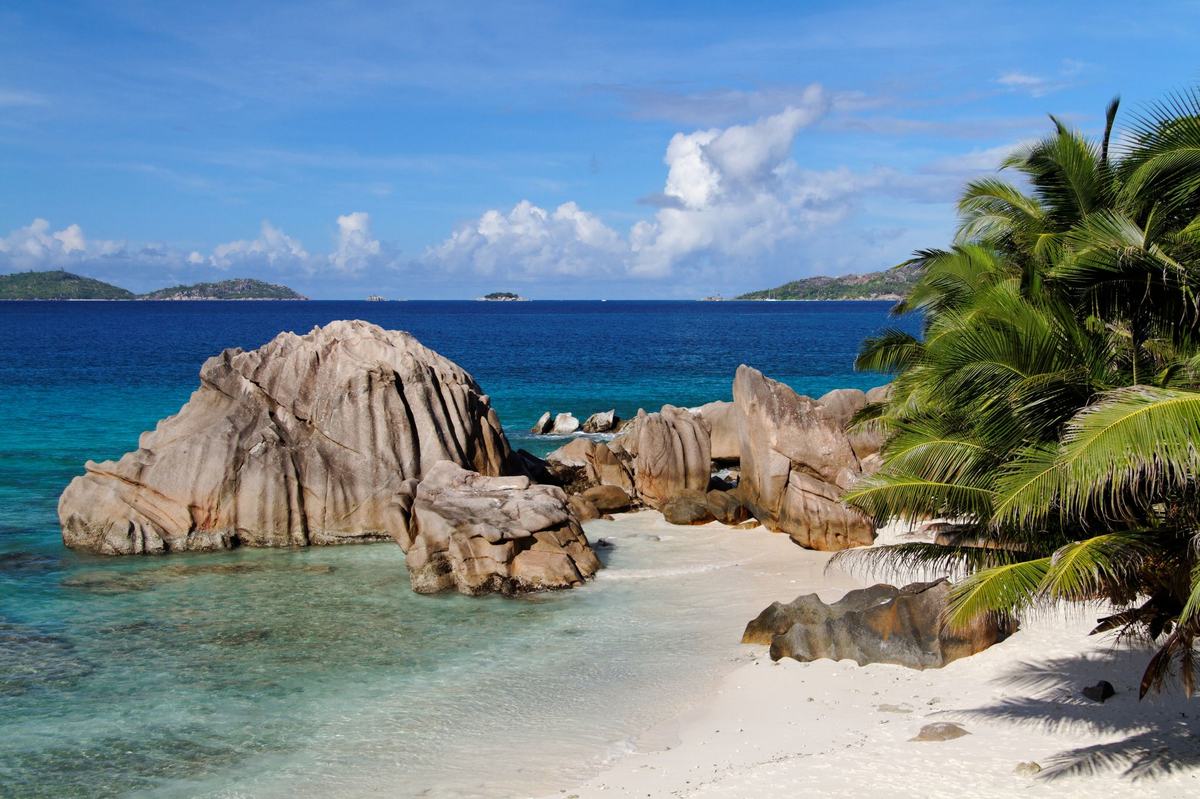
Most oceanic islands are young volcanoes or coral reefs. Seychelles is the rare exception. The inner islands, including Mahe, Praslin, and La Digue, are made of granite that formed roughly 750 million years ago, when this part of the planet was still glued together as the supercontinent Rodinia [3]. When everything broke apart, these granite blocks ended up stranded in the middle of the ocean. Geologists call them a microcontinent. You'll see them in person and they look like someone dropped a quarry into a tropical sea. Massive smooth boulders, the color of old butter, piled on white-sand beaches. Anse Source d'Argent on La Digue is one of the most photographed beaches on the planet for exactly this reason.
The outer islands are a different story. They're coral atolls, low and flat, and one of them is the Aldabra Atoll, a UNESCO World Heritage Site and one of the largest raised coral atolls anywhere [4].
Giant Tortoises and a Forest That Predates the Country
Aldabra is where the giant tortoises live. There are around 100,000 of them, which is more than the human population of the entire country and the largest giant tortoise population on Earth [4]. They can live well past 150 years. Some of the ones alive today were already adults when the United States Civil War ended.
On the granite island of Praslin, there's a forest called Vallee de Mai that looks the way the world might have looked before flowering plants took over. It's a palm forest dominated by the coco de mer, which produces the largest seed of any plant on Earth. A single nut can weigh up to 25 kilograms (55 pounds), and they take seven years to ripen [5]. The seed is shaped, accidentally and unmistakably, like a human pelvis. General Charles Gordon visited in 1881 and decided it was the original Garden of Eden. The whole forest is now a UNESCO site, and the Seychellois take poaching of the nuts seriously enough that each one is registered with a serial number.
A Country That Got Its Independence in 1976
The islands were uninhabited when the Portuguese first spotted them in 1502. The French claimed and settled them in the 1750s, the British took over in 1814, and the country only gained independence in 1976 [1]. That's recent. Marcus, who is me, was born only eight years after Seychelles became a country. The first president was overthrown in a coup the next year while he was at a meeting in London, and the second president ruled until 2004. Quiet on the outside, complicated on the inside, which is how a lot of small island nations work.
The population is a blend of African, French, Indian, Chinese, and British roots, and the language they share, Seychellois Creole, evolved from French. About 95 percent of people speak Creole at home, English in government, and French somewhere in the middle [1]. It is the only African country where the majority of people are Christian and speak a French-based Creole as the first language.
Currency, Cost, and the Economy
Seychelles is upper-income by World Bank standards, with one of the highest per capita GDPs in Africa [2]. Tourism drives roughly a quarter of the economy. Fishing, mainly tuna, drives another big chunk. The country runs almost entirely on imports for food and fuel, which makes it expensive. A hotel that would be mid-range in Florida runs you luxury prices here. There's no real backpacker scene. The government decided decades ago to chase high-value, low-volume tourism, and they've stuck with it.
The Seychellois rupee floats freely and has been relatively stable. The capital, Victoria, sits on Mahe and has a population of around 26,000. You can walk across the downtown in about ten minutes. The clock tower in the middle of town is a small-scale copy of one on Vauxhall Bridge in London, which is the kind of colonial detail that turns up in places like this.
The Coco de Mer, Pirates, and a National Symbol
Back to that nut. The coco de mer floats on currents, and for centuries Europeans found them washed up on beaches in India and the Maldives with no idea where they came from. They assumed the trees grew underwater. The nuts were worth more than gold to European royalty in the 1500s. Once the source was found in Seychelles in 1768, the price collapsed almost overnight.
Pirates used the islands as a hideout during the same period. Olivier Levasseur, a French pirate known as La Buse, was hanged in 1730 after allegedly burying a fortune somewhere in the islands. Treasure hunters have been looking for it for almost 300 years. Nothing has turned up. Which, if you think about it, is exactly what makes the legend last.
Frequently Asked Questions
Where is Seychelles located?
Seychelles is an archipelago in the Indian Ocean, about 1,500 kilometers east of the African mainland and northeast of Madagascar. The country consists of 115 islands spread across 1.4 million square kilometers of ocean. The capital, Victoria, sits on the main island of Mahe.
What language do people speak in Seychelles?
Seychelles has three official languages: Seychellois Creole, English, and French. Creole, a French-based language with African and Malagasy influences, is spoken at home by roughly 95 percent of the population. English is used in government and business, while French is common in media and the Catholic Church.
Is Seychelles part of Africa?
Yes, Seychelles is geographically and politically an African country and a member of the African Union. With a population of around 120,000, it is the smallest African country by population. Its cultural identity blends African, European, Indian, and Chinese influences from centuries of trade and colonization.
What is Seychelles famous for?
Seychelles is best known for its granite-boulder beaches, particularly Anse Source d'Argent on La Digue, which is one of the most photographed beaches in the world. Other draws include giant Aldabra tortoises, the coco de mer nut, world-class diving, luxury resorts, and the UNESCO-listed Vallee de Mai palm forest on Praslin.
Is Seychelles expensive to visit?
Yes, Seychelles is one of the more expensive destinations in the world. The government has long favored high-value, low-volume tourism, so most accommodations are mid-range to luxury, and food and fuel are imported. Budget travel is possible through guesthouses and self-catering, but costs are still well above most tropical destinations.