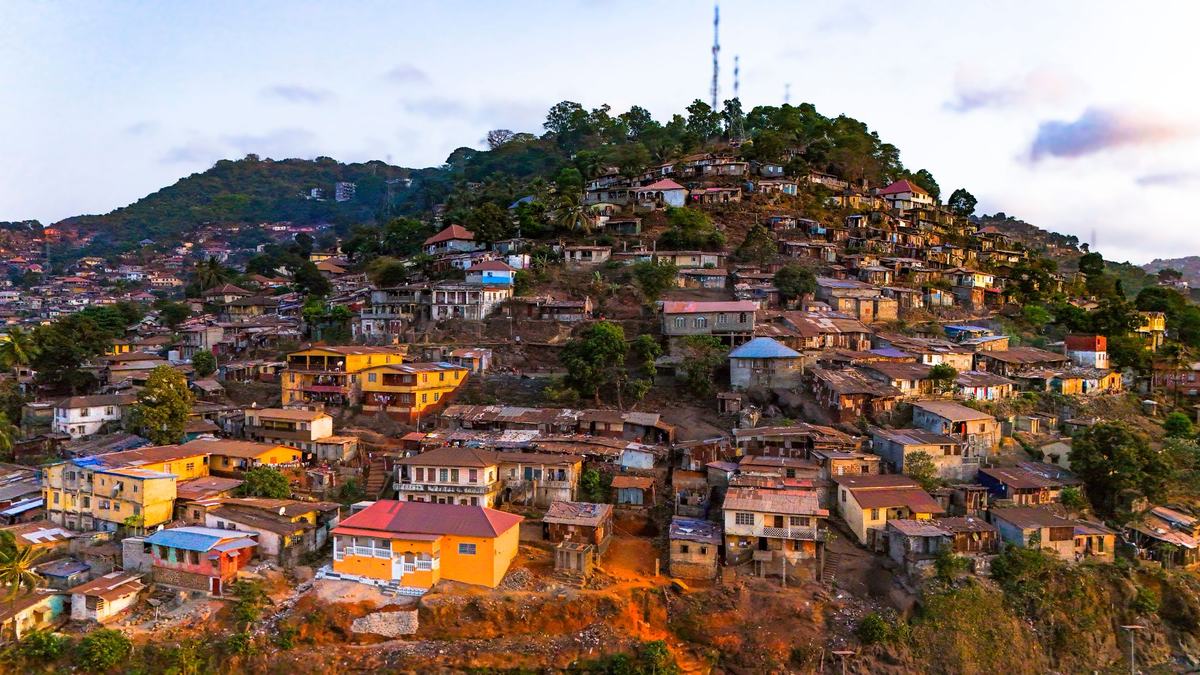
- Capital: Freetown [1]
- Population: about 8.6 million [2]
- Area: 71,740 square kilometers (27,699 sq mi) [1]
- Official language: English, with Krio as the lingua franca [1]
- Currency: Leone (SLL) [3]
- Named by a Portuguese sailor in 1462 who thought the coastal mountains looked like crouching lions [4]
Most people couldn't find Sierra Leone on a map. That's a shame, because the country sitting between Guinea and Liberia on the West African bulge has one of the more unusual origin stories on the continent, and a name that's been there since the age of caravel ships.
A Name From a Portuguese Sailor in 1462
The name comes from Portuguese explorer Pedro de Sintra, who sailed past the coast in 1462 and saw the mountains rising behind what is now Freetown harbor [4]. He called it Serra Leoa, which translates as "Lion Mountains". Some accounts say he was struck by the shape of the peaks. Others say it was the sound of thunder echoing off them during a storm, which he thought sounded like lions roaring.
Either way, the name stuck through five centuries, through Spanish and English translations, until it settled into the form we use today. It's one of the few country names in Africa that comes directly from a fifteenth-century European description, rather than from a colonial administrator's pen later on.
Turns out the mountains he saw are still there. The hills behind Freetown rise sharply from the Atlantic and give the city one of the most dramatic settings of any capital on the continent.
Freetown, Founded for Freed Slaves
Freetown was established in 1792 as a home for formerly enslaved people who had won their freedom by fighting for the British during the American Revolution, along with others freed from slave ships intercepted by the Royal Navy after Britain abolished the trade in 1807 [4]. The name is literal. It was meant as a place of freedom.
That makes Sierra Leone part of a small group of African countries with a founding story tied to repatriation, alongside neighboring Liberia. The two countries have very different histories after that, but they share this thread of being shaped by the Atlantic slave trade and the movement of people back across it.
The Krio language, which most Sierra Leoneans speak as a common tongue, grew out of the speech of those returned settlers. It's an English-based creole with vocabulary from Yoruba, Portuguese, and a handful of West African languages. Listen to it for a minute and you can pick out English words, but the rhythm and grammar are something else entirely.
One of the Best Natural Harbors in the World
The estuary of the Sierra Leone River, where Freetown sits, is one of the largest natural deep-water harbors on the planet [5]. Big ships can sail right in without much dredging. That geographic fact shaped almost everything about the country's history, from the early trade routes, to the British naval base, to the city's modern role as a regional shipping hub.
Stand on Lumley Beach and look north across the water, and you're looking at a body of water that has been carrying ships in and out for more than five centuries. The harbor is also why the country exists at this exact spot on the map. Without it, the settlement that became Freetown probably would have ended up somewhere else.
Diamonds, Bauxite, and a Hard Recent History
Sierra Leone sits on substantial deposits of diamonds, gold, bauxite, and rutile [1]. The diamond fields in the east of the country, around Kono and Kenema, have been mined since the 1930s, and at various points have produced some of the largest gem-quality diamonds in the world.
Those diamonds also funded a brutal civil war between 1991 and 2002 that killed tens of thousands of people and displaced more than two million [6]. The phrase "blood diamonds" entered the global vocabulary largely because of what happened in Sierra Leone during those years. The Kimberley Process, which is the international certification scheme designed to keep conflict diamonds out of the legitimate market, was created in direct response to that war and others like it.
The country has been at peace since 2002 and has held a series of competitive elections, including peaceful transfers of power between parties. The recovery has been uneven, but it has been real.
Beaches, Chimps, and Things Travelers Miss
The Freetown peninsula has some of the most spectacular beaches in West Africa, with white sand running for miles and almost no development behind them. Places like River No. 2 Beach and Bureh Beach look more like a Caribbean postcard than what most people picture when they think of the region.
Tacugama Chimpanzee Sanctuary, in the hills above the capital, rescues and rehabilitates chimpanzees orphaned by the bushmeat trade [1]. The chimp is the national animal of Sierra Leone, and the sanctuary is one of the only places in West Africa where you can see them up close in something approaching their natural habitat.
Nobody talks about this, but Sierra Leone is also home to Tiwai Island, a small river island in the south that has one of the highest densities of primate species anywhere on Earth.
Frequently Asked Questions
What does Sierra Leone mean?
Sierra Leone means "Lion Mountains" in Portuguese, from the words "serra" (mountain range) and "leoa" (lioness). Portuguese explorer Pedro de Sintra gave the coastal region this name in 1462 after seeing the dramatic mountains behind what is now Freetown.
What language is spoken in Sierra Leone?
The official language of Sierra Leone is English, used in government and education. Most people also speak Krio, an English-based creole that serves as the lingua franca. Mende and Temne are the largest Indigenous languages, with several others spoken across different regions.
Is Sierra Leone safe to visit?
Sierra Leone is generally safe for travelers who take standard precautions. The country has been politically stable since the end of the civil war in 2002, and crime against tourists is uncommon. Most visits to Freetown, the beaches, and major sites pass without incident.
What is Sierra Leone famous for?
Sierra Leone is famous for its diamonds, its founding as a home for freed slaves at Freetown in 1792, and one of the largest natural harbors in the world. It also has spectacular Atlantic beaches and the Tacugama Chimpanzee Sanctuary.
What is the currency of Sierra Leone?
The official currency of Sierra Leone is the Leone (SLL). The currency was redenominated in 2022, removing three zeros from the previous notes. US dollars are also widely accepted in hotels and larger transactions in Freetown.