- Capital: Ljubljana [1]
- Population: about 2.12 million [2]
- Area: 20,271 km² (7,827 sq mi) [1]
- Official language: Slovenian [1]
- Currency: Euro (EUR) [1]
- Forest cover: roughly 58% of the country, one of the highest shares in Europe [3]
I had to look this up twice. More than half of Slovenia is covered in trees. Not parks, not the occasional tidy woodland. Actual forest. You can drive across the whole country in about three hours, and most of what you'll see out the window is green.
A Country You Can Cross Before Lunch
Slovenia is small. Smaller than New Hampshire and Vermont put together. The whole place fits into 20,271 square kilometers, which means you can have espresso on the Adriatic coast in the morning and be eating strudel in the Alps by dinner. The drive from one border to the other takes less time than my old commute back home.
But here's the thing about small countries with this much variety. They pack everything into a tight space. Slovenia has a slice of the Mediterranean (about 46 kilometers of coastline), part of the Julian Alps with peaks over 2,800 meters, the rolling Pannonian Plain in the east, and the limestone karst country in the southwest where the word "karst" actually comes from [4]. The Slovenian Karst is the place that gave geologists the term they now use for every cave-riddled, sinkhole-pocked landscape on Earth.
The Forests Aren't Just Pretty
About 58% of Slovenia is forest, putting it in the top three most forested countries in Europe along with Finland and Sweden [3]. And these aren't farmed plantations. A good chunk of them are old, biodiverse woodlands that still shelter brown bears, wolves, and the occasional lynx. Slovenia has one of the densest brown bear populations in Europe, with roughly 1,000 bears living mostly in the southern Dinaric forests [5].
I grew up in Montana, where forests felt like something you drove into. In Slovenia they feel like something you live inside. Even the suburbs of Ljubljana butt right up against woods. People go mushroom hunting on the weekend the way Americans go to Costco.
Lake Bled Looks Photoshopped
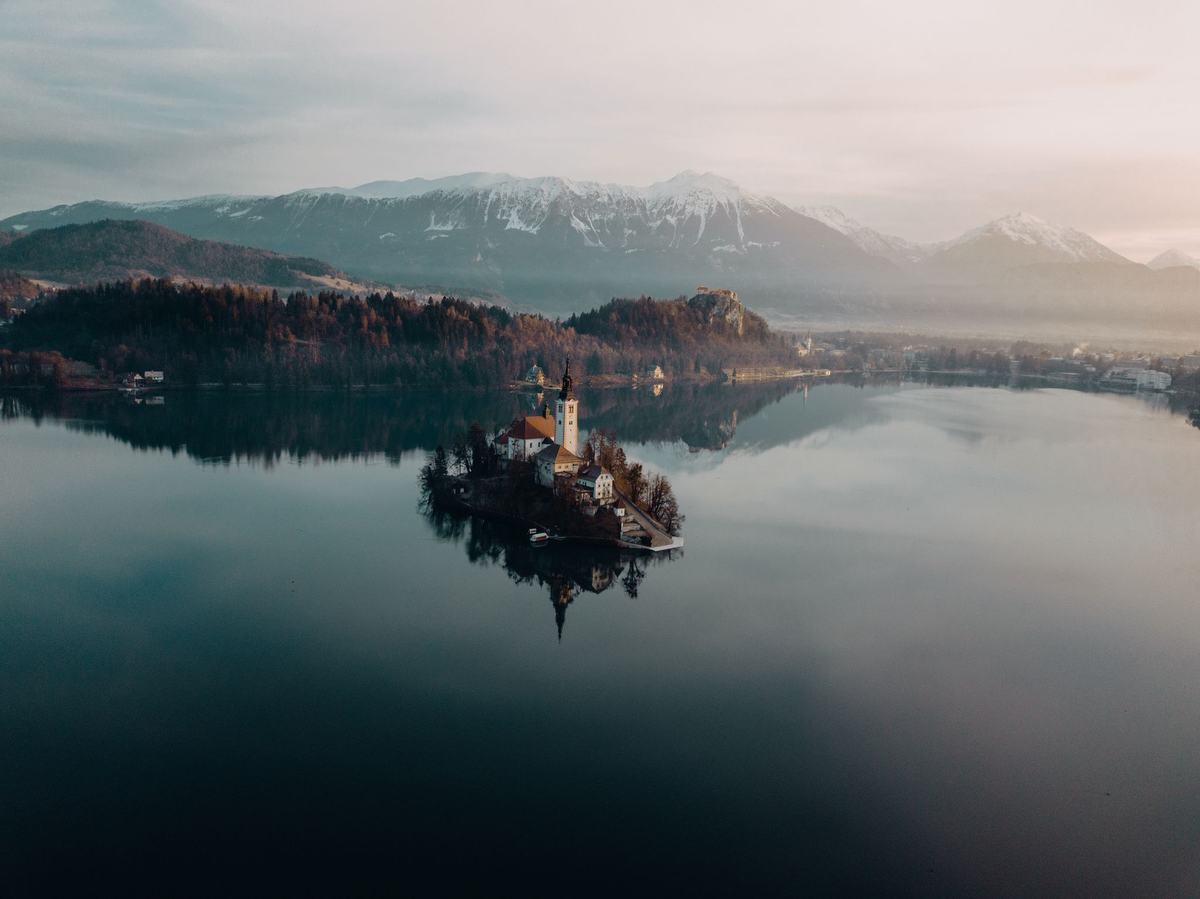
Lake Bled is the picture you've already seen, even if you don't know you've seen it. A turquoise glacial lake, an island in the middle, a tiny church on the island, and a medieval castle on a cliff above it all. It's the kind of place that looks fake until you're standing there.
The church on Bled Island has a wishing bell, and tradition says you ring it three times to make a wish come true. To get there, you take a pletna, a flat-bottomed wooden boat that's been hauling visitors across the lake since the 1500s. The boats are still rowed standing up, by hand, the same way they always were. The right to be a pletna oarsman is passed down through about 23 local families, and that's it [6]. You can't apply for the job. You have to be born into it.
Two Million People, A Lot of Cave
Slovenia sits on top of one of the most extensive cave systems in the world. The Postojna Cave alone runs for over 24 kilometers, and you visit part of it on an electric train that's been running underground since 1872 [7]. Down there lives the olm, a blind, pale, eel-shaped salamander the locals call the "human fish". It can survive ten years without eating. Ten. Years.
Then there's the Skocjan Caves, a UNESCO World Heritage site since 1986, which contain one of the largest known underground river canyons on Earth [8]. You walk along a path carved into the canyon wall while the Reka River roars in the dark hundreds of feet below. There's no railing in some places, and the bridge across the gorge is the kind of thing that makes your knees ask questions.
A Language With Three of Everything
Slovenian is one of the few living languages that still uses the dual grammatical number. Most languages have singular and plural - one apple, two apples. Slovenian has singular, dual, and plural - one apple, two apples (a special form), three or more apples (back to plural). You actually have a different verb ending when you're talking about exactly two of something. Two friends. Two hands. Two people in love.
Which, if you think about it, is a beautiful piece of grammar to keep alive. It builds the idea of a pair into the bones of the language.
Wine That Predates Half of Europe
In the city of Maribor stands the world's oldest grapevine still producing fruit, certified by Guinness. It's over 400 years old, planted around 1600, and it still gives 35 to 55 kilograms of grapes a year, which get turned into a tiny batch of wine bottled and given to visiting dignitaries [9]. The vine survived two Habsburg empires, two world wars, and the breakup of Yugoslavia, and it's still out there making grapes.
Slovenia has been making wine for about 2,400 years, going back to the Celtic and Illyrian tribes who lived here before the Romans showed up. There are three official wine regions and more wineries per capita than France. Almost all of it is consumed inside the country, which is part of why most Americans have never tasted a Slovenian wine. They drink it before it can leave.
A Calm Independence
Slovenia broke away from Yugoslavia in June 1991, and the war that followed lasted just ten days. Compared to what happened next in the rest of the former Yugoslavia, the Slovenian independence war was almost bloodless. The country joined the European Union in 2004, adopted the euro in 2007, and became the first former communist state to host the EU presidency in 2008 [10]. Quiet, fast, and done.
That seems to be the Slovenian way. Get on with it. Don't make a scene. Then go for a hike.
Frequently Asked Questions
What is Slovenia famous for?
Slovenia is famous for Lake Bled, its extensive cave systems including the UNESCO-listed Skocjan Caves, and being one of the most forested countries in Europe. It's also known for the Julian Alps, the Lipizzaner horses, and the world's oldest fruit-bearing grapevine in Maribor.
Is Slovenia the same as Slovakia?
No. Slovenia and Slovakia are two separate countries. Slovenia borders Italy, Austria, Hungary, and Croatia and was part of Yugoslavia. Slovakia is in central Europe, borders Poland and Ukraine, and was part of Czechoslovakia. The two share a similar Slavic root in their names but are otherwise unrelated.
What language do they speak in Slovenia?
The official language is Slovenian, a South Slavic language spoken by about 2.5 million people worldwide. Slovenian is unusual for using the dual grammatical number, with separate verb forms for exactly two of something. English is widely spoken, especially by younger Slovenians.
Is Slovenia in the EU and the eurozone?
Yes. Slovenia joined the European Union on May 1, 2004, and adopted the euro as its currency on January 1, 2007. It was the first of the post-communist EU member states to switch to the euro and the first to hold the rotating EU Council presidency, in 2008.
Is Slovenia a safe country to visit?
Slovenia is consistently ranked among the safest countries in Europe and the world, with very low violent crime rates. The Global Peace Index typically places it in the top ten safest nations. Common sense precautions against petty theft in tourist areas like Ljubljana and Bled are sensible.
Sources
- The World Factbook: Slovenia
- Statistical Office of the Republic of Slovenia: Population
- Eurostat: Forests, forestry and logging
- UNESCO World Heritage Centre: Skocjan Caves
- Slovenia Forest Service: Brown Bear Management
- Bled Tourist Board: Pletna Boats
- Postojna Cave Park: History
- UNESCO World Heritage Centre: Skocjan Caves of Slovenia
- City of Maribor: The Old Vine
- European Union: Slovenia Country Profile