- Capital: Mogadishu [1]
- Population: about 18.1 million [2]
- Area: 637,657 km² (246,201 sq mi) [1]
- Official languages: Somali and Arabic [1]
- Currency: Somali shilling (SOS) [1]
- Coastline: roughly 3,333 km (2,071 mi), the longest of any country on the African mainland [1]
Most Americans know one thing about Somalia, and it's usually something they saw on the news. Turns out the country itself is older, stranger, and a lot more poetic than the headlines let on. I grew up thinking of Somalia the way most kids in Montana did, which is to say barely at all, and almost everything I've learned about it since has been a small correction.
A Coastline That Runs Forever
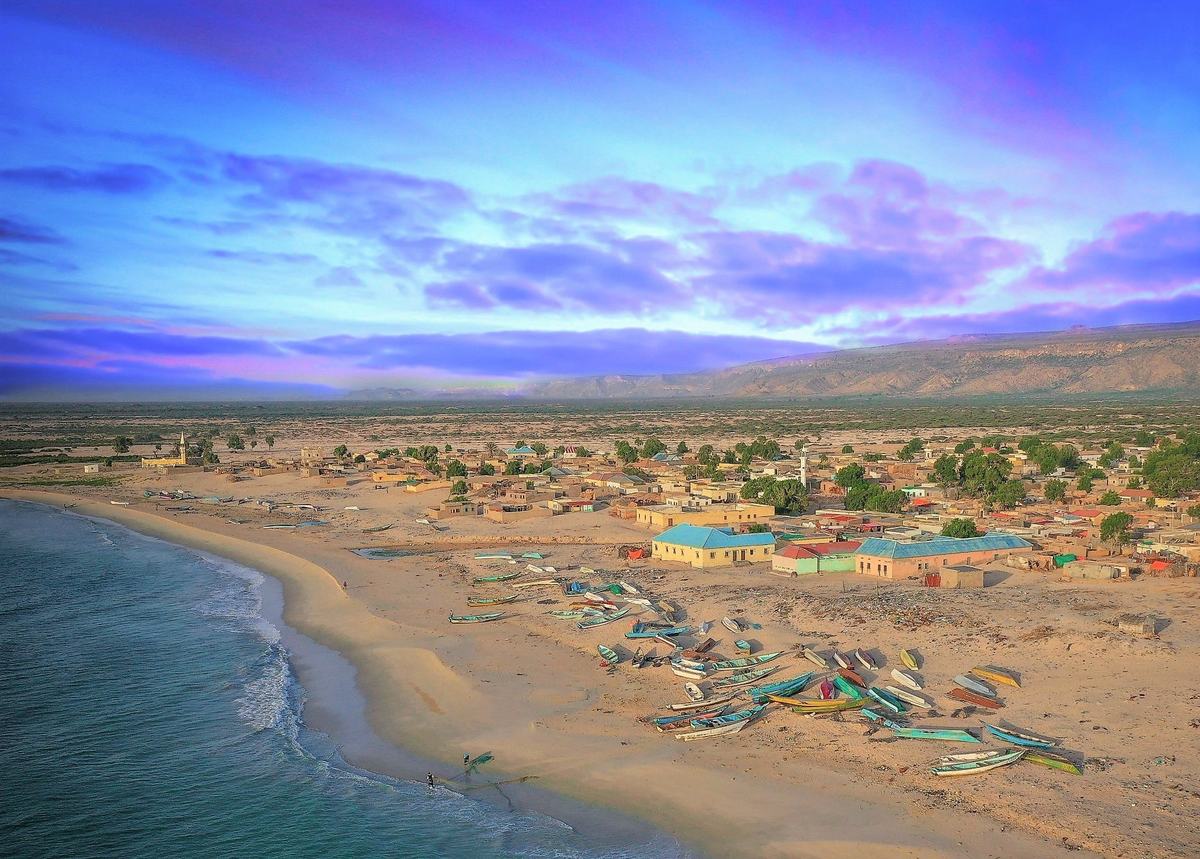
Somalia sits at the easternmost tip of Africa, on the Horn, with the Indian Ocean on one side and the Gulf of Aden on the other. The coastline stretches for about 3,333 kilometers, which makes it the longest of any country on the African mainland [1]. That's roughly the distance from Seattle to Miami, all of it beach, cliff, dune, and turquoise water.
For most of human history that coast was a working road. Frankincense and myrrh moved out of these ports thousands of years ago, headed for Egypt, Arabia, and Rome. The ancient Egyptians sailed to a place they called Punt, and a lot of historians think Punt was somewhere along this stretch of shoreline [3]. You can't drive far in Somalia without crossing land that was, at some point, part of a trade network older than most countries.
A Land of Poets
Here's something that'll ruin the next geography quiz you take. Somalia has been called a "nation of poets", and the description is not romantic exaggeration. Poetry sits at the center of Somali culture in a way that's hard to find a parallel for in the West. Major decisions, political arguments, romantic feuds, and historical memory have all been handled in verse for centuries.
Somali was a purely oral language for most of its history. A standardized written script wasn't adopted until 1972 [4]. Before that, everything that mattered, from clan genealogies to news reports, traveled by memory and meter. Poets were celebrities and political operators. They still are. A famous Somali poem can make the rounds of the diaspora the way a viral video makes the rounds of the internet, and people will quote lines from memory the same way Americans quote movies.
One Country, One Language
This part surprised me. Somalia is one of the most linguistically homogeneous countries in Africa. Almost everyone speaks Somali as their first language [4]. In a continent where most national borders cut across dozens of language groups, that's unusual. The shared language is part of why Somali identity travels so well, holding together across borders, refugee camps, and the global diaspora that now stretches from Minneapolis to Melbourne.
Arabic is the second official language, a reflection of the country's deep ties to the Arabian Peninsula. Trade and Islam came across the Gulf of Aden centuries ago, and the influence is still everywhere, in vocabulary, architecture, and the calls to prayer that ripple over Mogadishu at dawn.
The Camel Capital of the World
Somalia has more camels than any other country on Earth, with estimates around 7 million animals [5]. That's roughly one camel for every two and a half people. Camels here aren't a tourist novelty. They're working livestock, dairy producers, savings accounts, wedding gifts, and the subject of an enormous body of folk wisdom.
Camel milk is a daily staple. It's higher in vitamin C than cow's milk and is one of the few foods that can be reliably produced in the dry, scrubby interior. There's a Somali saying that goes, roughly, that a man with no camels is a man with no future. The country runs on these animals in a way that's almost invisible to outsiders.
Mogadishu Is Older Than You Think
Mogadishu has been a city for over a thousand years. By the 12th century it was already a major Indian Ocean trading port, swapping cloth, spice, gold, and ivory with merchants from as far away as China [6]. Ming Dynasty coins have been dug up along the Somali coast. A 14th century Moroccan traveler named Ibn Battuta visited Mogadishu and wrote about the size of the meals he was served, which he described as enough for a regiment.
The old city, called Hamar Weyne, still has Arab-Swahili merchant houses with carved wooden doors that date back centuries. Decades of conflict have damaged much of it, but the bones of a very old trading city are still there.
A Country Still Writing Itself
Somalia has had a hard half century. A civil war that began in 1991 fractured the central state, and parts of the country still function more or less independently, including Somaliland in the north, which declared its own independence in 1991 and operates with its own government and currency, though it's not internationally recognized [7]. The Federal Government of Somalia, reestablished in 2012, is slowly rebuilding institutions, and Mogadishu has been climbing back, one neighborhood at a time.
Recovery is uneven and the headlines stay grim, but the country in 2026 is not the country of 1995. There's a stock exchange in Mogadishu, mobile money is nearly universal (Somalia has one of the highest rates of mobile money use in the world), and a generation of young Somalis is rebuilding what their parents lost.
Frequently Asked Questions
What is Somalia famous for?
Somalia is famous for having the longest coastline on the African mainland, its strong oral poetry tradition, and being home to the largest camel population in the world. It's also known for the ancient trading port of Mogadishu and for the Somali diaspora communities in cities like Minneapolis and London.
What language do they speak in Somalia?
The official languages are Somali and Arabic. Somali is spoken by almost the entire population as a first language, making Somalia unusually linguistically unified for an African country. Somali was a purely oral language until a Latin-based script was standardized in 1972.
Is Somaliland part of Somalia?
Somaliland is internationally recognized as part of Somalia but operates as a de facto independent state. It declared independence in 1991, has its own government, currency, and elections, but no United Nations member has formally recognized it. Most maps still show it as part of Somalia.
What religion is practiced in Somalia?
Islam is the official religion and is practiced by nearly the entire population, almost all of whom are Sunni Muslims. Islam has been part of Somali life since the 7th century, when the religion arrived from the Arabian Peninsula across the Gulf of Aden, and it remains central to law, culture, and daily life.
Is Somalia safe to visit?
Most foreign governments advise against travel to most of Somalia due to ongoing conflict, terrorism, and kidnapping risks. Somaliland is generally considered safer than the south but is still cautioned by many advisories. Anyone considering a visit should consult their government's current travel advice and arrange experienced local support.