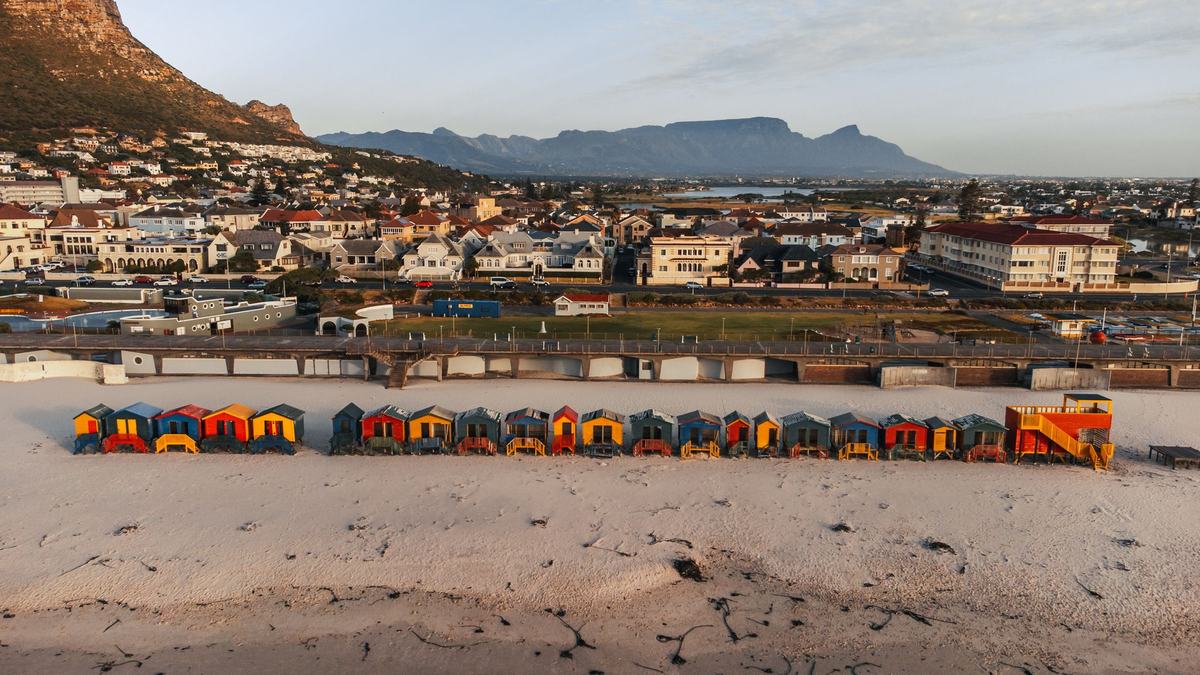
- Capital: Pretoria (executive), Cape Town (legislative), Bloemfontein (judicial) [1]
- Population: ~62 million (2024 estimate) [2]
- Area: 1,221,037 km² (471,445 sq mi) [1]
- Official languages: 12, including isiZulu, isiXhosa, Afrikaans, English, and South African Sign Language [3]
- Currency: South African rand (ZAR) [1]
- Distinguishing claim: Home to the world's deepest gold mine and some of the oldest human fossils ever found [4][5]
Most countries pick one capital and call it a day. South Africa has three, and there's a real reason for each of them. I had to look this up twice when I first read it, because it sounds like a trivia answer somebody made up. But Pretoria, Cape Town, and Bloemfontein each hold a different branch of government, and the arrangement goes back to a compromise from when the country was first unified in 1910. It's the kind of detail that tells you something about a place before you even get to the geography or the food or the music. South Africa is a country that has always had to figure out how to hold a lot of different things together at once.
Three Capitals, One Country
Pretoria is the executive capital, where the president and the cabinet do their work. Cape Town is the legislative capital, where parliament meets, looking out over Table Mountain. Bloemfontein, smaller than the other two and tucked into the country's interior, is the judicial capital and home to the Supreme Court of Appeal [1].
The whole arrangement came out of the Union of South Africa in 1910, when four British colonies merged and nobody wanted to give up being the seat of power. So they split the job up. More than a century later, it's still that way. Most countries would have consolidated by now, but South Africa kept the split. Pragmatic, a little strange, and somehow it works.
Eleven Official Languages, Then Twelve
For decades, South Africa had eleven official languages, which already made it one of the most linguistically diverse countries on earth. Then in 2023, the constitution was amended to add South African Sign Language as the twelfth [3]. That puts SASL on the same legal footing as isiZulu, isiXhosa, Afrikaans, English, Sepedi, Setswana, Sesotho, Xitsonga, siSwati, Tshivenda, and isiNdebele.
isiZulu is the most widely spoken at home, followed by isiXhosa. English is what you'll hear in business and government, but it's the first language of only about 8% of South Africans [3]. Almost everyone is multilingual. Code-switching mid-sentence is normal. Listen to a Cape Town conversation for ten minutes and you might hear three or four languages flowing in and out of each other without anybody noticing.
The Cradle of Humankind
Back home in Montana, the oldest human history you can really touch is a few thousand years of Indigenous presence and bones from animals that went extinct at the end of the last ice age. South Africa operates on a different timescale. The limestone caves northwest of Johannesburg have produced some of the oldest hominin fossils ever found, including a near-complete skeleton nicknamed "Little Foot" that's estimated at around 3.67 million years old [5].
The area is now a UNESCO World Heritage Site called the Cradle of Humankind. Standing on that ground, you're not looking at history. You're looking at the place where the human story might have actually started. Or one of the places. The story is still being argued and rewritten, which is half of what makes it interesting.
The Deepest Hole on Earth
The Mponeng gold mine, southwest of Johannesburg, goes nearly four kilometers (about 2.5 miles) below the surface, making it the deepest mine on the planet [4]. The temperature at the bottom can climb past 60°C (140°F) before the air conditioning brings it down to something workers can survive in. They send the miners down in elevators that drop faster than most office buildings are tall.
The whole Witwatersrand gold belt around Johannesburg has produced something like 40% of all the gold ever pulled out of the earth. That's the reason Johannesburg exists at all. In 1886 it was empty veld. Within a decade it was a boomtown. Within fifty years it was the largest city in sub-Saharan Africa, built almost entirely on the back of what was buried underneath it.
Wildlife and the Big Five
Kruger National Park is roughly the size of New Jersey, and it's home to the African big five: lion, leopard, elephant, rhino, and Cape buffalo [6]. The park has been protected since 1898, which makes it older than most US national parks. South Africa also has the world's largest population of white rhinos, though "largest" is doing a lot of grim work in that sentence given how badly poaching has hammered the numbers over the last fifteen years.
The country's biodiversity goes beyond the famous safari animals. The Cape Floral Region on the southwestern tip is one of only six floral kingdoms in the world, and the smallest by far. It holds nearly 9,000 plant species, about 70% of which are found nowhere else [7]. Table Mountain alone has more plant species than the entire United Kingdom. Which, if you think about it, is the kind of fact that makes you want to fly there immediately.
Cultural Layers and the Rainbow Nation
Archbishop Desmond Tutu coined the phrase "Rainbow Nation" after the end of apartheid in 1994, and it stuck. The cultural mix in South Africa is something you can taste, hear, and see within an hour of arriving. Bunny chow, a Durban dish of curry served inside a hollowed-out loaf of bread, is South African Indian. Bobotie, a spiced minced meat with an egg topping, has roots in Cape Malay cooking. Braai, the national obsession with grilling meat outdoors, cuts across every community.
Music tells the same layered story. Miriam Makeba carried the sound of South African vocal traditions to a global audience in the 1960s. Hugh Masekela's trumpet helped score the country's resistance and its release. Today, amapiano, a house and jazz hybrid born in Pretoria's townships in the mid-2010s, is one of the most influential dance genres on the planet, with Spotify streams in the billions.
Two Oceans Meet Here
Cape Agulhas, not the more famous Cape of Good Hope, is the actual southernmost tip of Africa, and it's where the Atlantic and Indian Oceans officially meet [8]. There's a marker on the cliff, and you can stand with one foot on each side. The water on the Atlantic side runs cold, fed by the Benguela current pushing up from Antarctica. The Indian Ocean side runs warm, carried south by the Agulhas current. You can see the temperature line in the water on a calm day. It's the kind of thing you read about, expect to be underwhelming, and then find yourself standing there for an hour.
Frequently Asked Questions
Why does South Africa have three capitals?
South Africa has three capitals because of a political compromise reached when four British colonies unified in 1910. Pretoria became the executive capital, Cape Town the legislative, and Bloemfontein the judicial. Each of the former colonies wanted to keep some seat of national power, and the arrangement has remained ever since.
What is the most spoken language in South Africa?
isiZulu is the most widely spoken first language in South Africa, used at home by roughly 24% of the population. isiXhosa is second, and Afrikaans third. English ranks much lower as a home language at around 8% but functions as the dominant language of government, business, and higher education.
Is South Africa safe to visit?
South Africa is a popular destination for international tourists, with millions of visitors a year, and tourist areas in Cape Town, the Garden Route, and the major game reserves are generally well managed. Crime rates are high in some urban areas, so travelers usually take normal precautions and rely on guides for unfamiliar regions.
What animals can you see in South Africa?
South Africa is home to the African big five: lion, leopard, elephant, rhino, and Cape buffalo. Kruger National Park is the most famous place to see them, alongside cheetah, giraffe, hippo, and over 500 bird species. The Cape coast also offers whale watching from June to November.
When is the best time to visit South Africa?
The dry winter months from May to September are usually considered the best time to visit for safaris, since animals gather around water sources and the bush is less dense. For Cape Town and the coast, the warm summer months from November to March are more popular, with long beach days and good wine country weather.
Sources
- South Africa - The World Factbook
- Statistics South Africa - Mid-year population estimates
- South African Government - Official Languages
- Britannica - Mponeng gold mine
- UNESCO World Heritage Centre - Fossil Hominid Sites of South Africa
- South African National Parks - Kruger National Park
- UNESCO World Heritage Centre - Cape Floral Region Protected Areas
- South African Tourism - Cape Agulhas