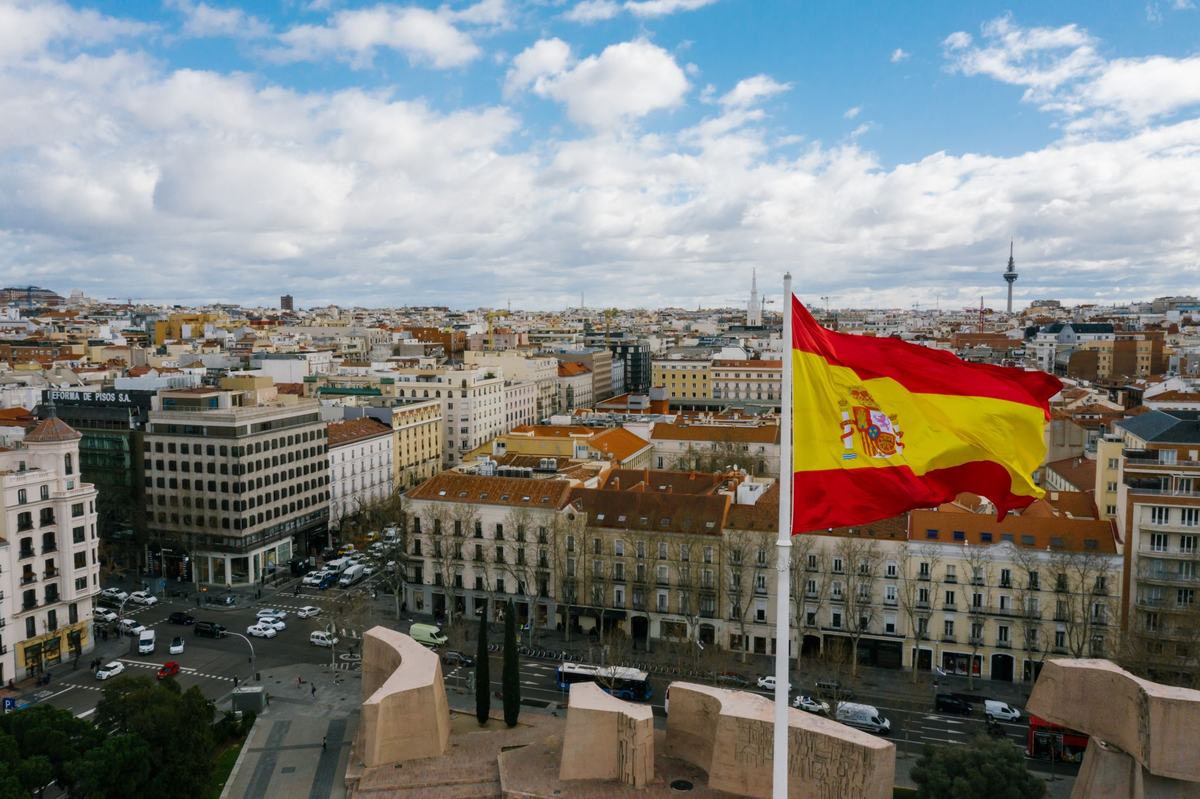
- Capital: Madrid [1]
- Population: about 48.6 million [1]
- Area: 505,370 square kilometers (195,124 square miles), the second-largest country in the European Union [1]
- Official language: Spanish (Castilian), with co-official Catalan, Galician, Basque, and Aranese in specific regions [1]
- Currency: Euro (EUR) [1]
- Holds 49 UNESCO World Heritage Sites, the fourth-highest count of any country in the world [2]
I grew up thinking Spain was basically Mexico with better infrastructure. That's the kind of thing you believe when you're a kid in rural Montana whose closest reference for Spanish anything is the menu at the local Tex-Mex place. Then I actually read about Spain for this series, and the picture cracked open. Spain is older than most countries have any right to be. It runs on a clock that doesn't match the rest of Europe. It has four official languages, a king, and a restaurant that has been continuously open since 1725. None of that fit my mental model, and almost none of it fits anyone else's either.
Here's the thing about Spain. It occupies most of the Iberian Peninsula in the southwest corner of Europe, sharing borders with Portugal, France, Andorra, and the British territory of Gibraltar. It also includes the Balearic Islands in the Mediterranean, the Canary Islands off the coast of Africa, and two small cities on the North African mainland called Ceuta and Melilla. So Spain is technically a European country, an Atlantic country, a Mediterranean country, and an African country, all at the same time. That's a lot of identities to carry.
A Country Running on the Wrong Time Zone
Spain sits on roughly the same longitude as the United Kingdom and Portugal, which both run on Greenwich Mean Time. Spain does not. It runs on Central European Time, an hour ahead of where the sun actually puts it. The reason is political and a little absurd. In 1940, Francisco Franco changed Spain's clocks to match Nazi Germany's, partly as a gesture of solidarity, partly for trade reasons. The change was supposed to be temporary. Eighty-five years later, Spain still hasn't switched back [3].
The result is a country where the sun rises late and sets late, and where daily life has shifted to match. Lunch is at two or three in the afternoon. Dinner happens at nine or ten at night, sometimes later. Prime-time television starts at 10:30 pm. Spaniards sleep about an hour less than the European average, and a long-running parliamentary commission has spent years arguing about whether to fix the clocks or just embrace the schedule. Back home in Montana, dinner at 6 pm is already considered late. In Spain, that's still afternoon coffee.
The World's Oldest Restaurant Is Here
In a narrow side street in Madrid, a few minutes from the Plaza Mayor, there's a restaurant called Sobrino de Botín. It has been open continuously since 1725, which makes it the oldest restaurant in the world according to Guinness World Records [4]. The same wood-fired oven, originally built into the cellar walls, has been roasting suckling pig and lamb without interruption for three hundred years. Goya supposedly washed dishes there as a teenager. Hemingway ate there often and wrote it into the last page of "The Sun Also Rises".
Spain is good at this kind of continuity. You can walk into a cafe in Salamanca that's been pouring coffee since the Hapsburgs, or a tavern in Toledo where the floor was laid before the United States existed. Time runs differently when buildings outlast empires.
More UNESCO Sites Than Almost Anyone
Spain holds 49 UNESCO World Heritage Sites, which puts it fourth in the world behind only Italy, China, and Germany [2]. The list is wildly varied. The historic center of Cordoba, with its mosque turned cathedral. The Alhambra in Granada. The cave paintings at Altamira, some of the most sophisticated prehistoric art ever made. The Roman aqueduct in Segovia, still standing without mortar after nearly two thousand years. The medieval old towns of Toledo, Salamanca, Avila, and Caceres. The pilgrim route to Santiago de Compostela. Antoni Gaudí's works in Barcelona. The list keeps going.
What makes Spain unusual is the layered quality of its history. Most countries have one dominant cultural era stamped onto the landscape. Spain has at least four overlapping ones. Iberian and Celtic peoples first, then Phoenicians and Greeks, then Romans for six hundred years, then Visigoths, then nearly eight centuries of Muslim rule across most of the south, then the Christian reconquest, then the global empire. You can stand in Cordoba and see all of that in a single afternoon. The mosque-cathedral has Roman columns holding up Visigothic capitals supporting Moorish arches under a Renaissance dome. That's not a metaphor. That's the building.
A Cathedral Still Under Construction
Antoni Gaudí started designing the Sagrada Família in Barcelona in 1883. He worked on it for forty-three years, lived on the construction site for the last few, and was killed by a tram in 1926 with the project nowhere near finished. The cathedral is still being built today. Construction has continued, with interruptions for the Spanish Civil War and the pandemic, for over 140 years. Current estimates put completion sometime around 2026 to 2034, depending on which project director you ask [5].
The thing about Gaudí is that he didn't really design buildings the way other architects design buildings. He used hanging chains and weights to model his structures, letting gravity work out the shape of the arches for him. The result looks like nothing else on Earth. Trees holding up the ceiling, columns that lean and branch, light pouring through stained glass that turns blue at one end of the day and red at the other. It's the most visited religious site in Europe. It's also a working construction site, which means tourists buy tickets to walk through scaffolding while stonecutters work overhead. Spain seems entirely comfortable with this.
Four Languages, Sometimes in the Same Conversation
Spanish, what Spaniards usually call Castilian, is the country's main language and is spoken everywhere. But it isn't the only official language. Catalan is co-official in Catalonia, Valencia, and the Balearic Islands. Galician is co-official in Galicia, in the green northwest. Basque, which isn't related to Spanish or to any other known living language on Earth, is co-official in the Basque Country and parts of Navarre. Aranese, a variant of Occitan, is official in a small valley in the Pyrenees. All of these have their own literature, media, and school systems [1].
This isn't a museum-piece situation. Around a quarter of Spaniards speak a co-official language at home, and you can fly into Barcelona and immediately see Catalan on every street sign, ATM screen, and government document. The country has spent the last four decades figuring out how to be one place and many places at once, with varying levels of comfort and the occasional independence crisis. The 1978 constitution that holds it all together is younger than most of the people running the country, which feels significant.
Olive Oil, Ham, and the World's Most Surprising Dairy Cow
Spain produces more olive oil than any other country in the world, by a large margin. About half of all olive oil consumed globally comes from Spanish groves, mostly in Andalusia, where there are around 350 million olive trees [6]. Some of them are over a thousand years old, still producing fruit, planted by Romans who watched the empire fall around their orchards.
Then there's jamón ibérico, the cured ham from acorn-fed black-footed pigs. The pigs roam through oak forests called dehesas, eating only acorns for the final months before slaughter. The hams are aged for two to four years and sell for hundreds of dollars apiece. Spain is also the world's second-largest producer of wine, and the Rioja region has been making it since the Romans showed up. And nobody talks about this, but Spain is also a major producer of saffron, lemons, almonds, and strawberries. The Mediterranean diet that doctors keep telling Americans to eat is essentially the Spanish weekly shopping list.
A Monarchy That Voted Itself Back
Spain is a constitutional monarchy, which puts it in the same category as Sweden, the Netherlands, and Britain. What makes Spain unusual is that the monarchy was abolished in 1931, replaced by a republic, then suspended during Franco's nearly four-decade dictatorship, then voluntarily restored after Franco's death in 1975. The current king, Felipe VI, is the son of Juan Carlos I, who took the throne specifically to dismantle the dictatorship he was supposed to inherit.
Juan Carlos surprised almost everyone by walking Spain into a democratic constitution within three years of taking power, then defending it personally on television during a 1981 coup attempt. The democracy that resulted has been imperfect, but it's the longest stretch of continuous democratic government Spain has ever had. Most countries don't get to choose their political systems by referendum. Spain did, twice, and the second time it picked a king and then wrote rules that limit what he can do.
Frequently Asked Questions
What is the capital of Spain?
The capital of Spain is Madrid, located near the geographic center of the Iberian Peninsula. It's the political, economic, and cultural heart of the country, with a city population of around 3.3 million and a metropolitan area approaching 7 million people.
Why does Spain eat dinner so late?
Spain runs on Central European Time, an hour ahead of its actual solar position, because Franco changed the clocks in 1940 to align with Nazi Germany. The mismatch has shifted daily life by about an hour, pushing lunch to 2 or 3 pm and dinner to 9 or 10 pm.
How many official languages does Spain have?
Spain has one nationwide official language, Castilian Spanish, and four regional co-official languages: Catalan, Galician, Basque, and Aranese. Each is used in government, education, and media within its respective region, and around a quarter of Spaniards speak a co-official language at home.
Is the Sagrada Família finished?
No. Antoni Gaudí started the Sagrada Família in 1883, and construction has continued for over 140 years. Current estimates project completion between 2026 and 2034. The cathedral is the most visited religious site in Europe and operates as a working construction site during tours.
How many UNESCO World Heritage Sites does Spain have?
Spain has 49 UNESCO World Heritage Sites, ranking fourth in the world after Italy, China, and Germany. The list includes the Alhambra, the Cordoba mosque-cathedral, the prehistoric Altamira caves, the Roman aqueduct of Segovia, and the pilgrim route to Santiago de Compostela.
Sources
- Spain Country Profile - CIA World Factbook
- World Heritage List by Country - UNESCO
- Spain Time Zone Debate - BBC News
- Oldest Restaurant in Operation - Guinness World Records
- Sagrada Família Construction Progress - Basilica of the Sagrada Família
- Olive Oil Production Statistics - International Olive Council