- Capital: Khartoum, where the Blue Nile and White Nile meet [1]
- Population: roughly 48 million [2]
- Area: about 1,861,484 square kilometers, making it Africa's third-largest country [1]
- Official languages: Arabic and English [1]
- Currency: Sudanese pound (SDG)
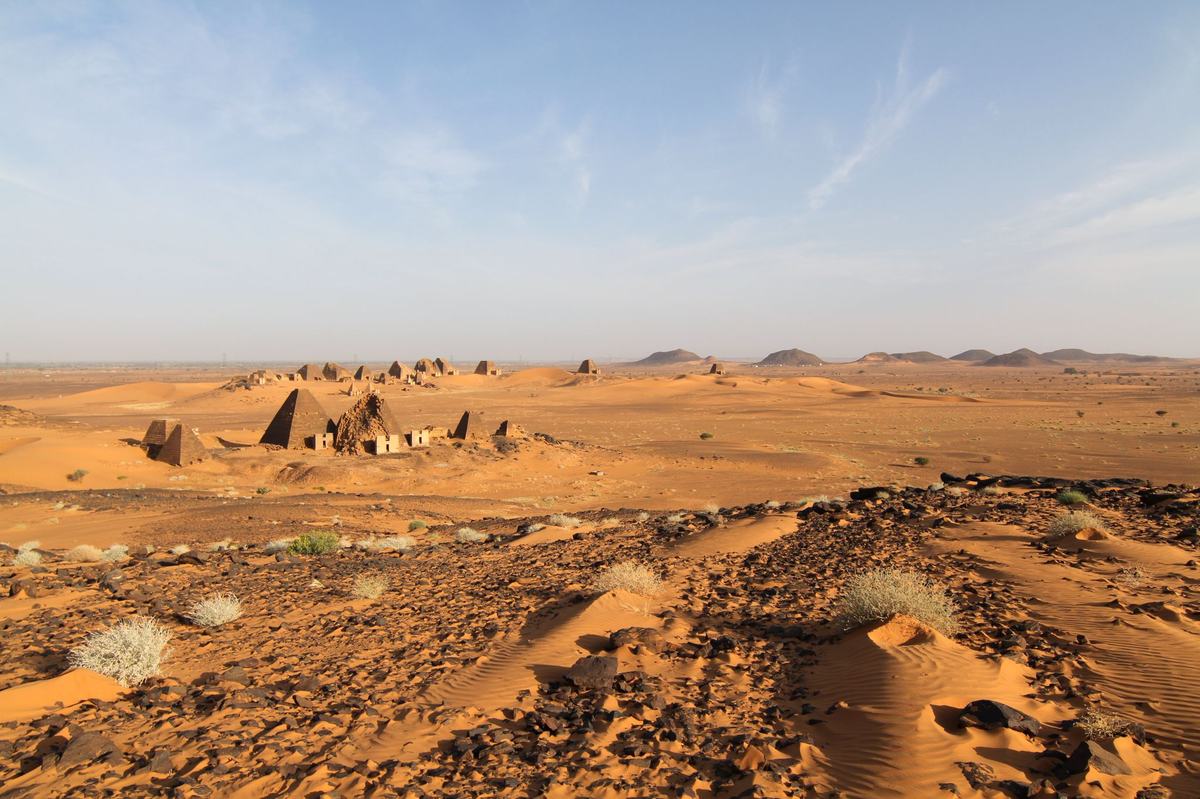
- Distinguishing claim: Sudan has more ancient pyramids than Egypt - around 200 of them, mostly at Meroe [3]
Here's something that'll ruin the next geography quiz you take: Sudan has more pyramids than Egypt. Not a few more. Roughly twice as many. And almost nobody outside of archaeology circles seems to know it. I had to look this up twice. Back home in Montana, our idea of "ancient" was a homestead barn from 1910, so the first time I read about the Nubian pyramids of Meroe, I sat with the photo for a long minute. Smaller than the ones at Giza, steeper, packed close together in the desert, and somehow almost forgotten.
The Pyramids Most People Don't Know Exist
The Kingdom of Kush, centered in what is now northern Sudan, built pyramids for almost a thousand years. The site at Meroe alone has around 200 of them [3]. They're narrower than Egypt's, with steeper sides, and they served as royal tombs for the Kushite kings and queens who ruled this stretch of the Nile.
For a brief, wild period around 750 BCE, Kushite pharaohs actually ruled Egypt itself - the so-called 25th Dynasty, sometimes called the "Black Pharaohs". Sudanese kings sat on the Egyptian throne. That fact alone reshuffles a lot of assumptions about who was building what in the ancient world. UNESCO listed the archaeological sites of the Island of Meroe as a World Heritage Site in 2011 [3]. The pyramids took a beating in the 1830s when an Italian treasure hunter named Giuseppe Ferlini blew the tops off dozens of them looking for gold. He found a little. The damage was permanent.
Two Niles Meet in Khartoum
The Blue Nile comes down out of the Ethiopian highlands. The White Nile rises near Lake Victoria. They meet in the middle of Khartoum, and you can actually see the line where the two waters mix - the Blue Nile darker, the White Nile paler. The locals call the spot al-Mogran, "the confluence" [1].
This is where Sudan starts to feel less like a country on a map and more like a hinge. North flows the combined Nile, eventually crossing into Egypt and the Mediterranean. Khartoum sits on that hinge. The city's name is widely said to come from the Arabic word for "elephant's trunk", describing the strip of land between the two rivers, though scholars argue about the etymology.
A Country That Used to Be Bigger
For most of modern history, Sudan was the largest country in Africa. Then in 2011, after decades of civil war, the southern third of the country voted to become its own nation. South Sudan became independent on July 9 of that year [4]. Sudan dropped to third-largest on the continent, behind Algeria and the Democratic Republic of the Congo.
The split was a long time coming. The peoples of the south - largely Christian and following traditional religions, speaking Nilotic languages - had been in conflict with the Arabic-speaking, mostly Muslim north for generations. Two civil wars and millions of deaths later, the country divided along that fault line. It's the kind of recent history that doesn't make it into most American classrooms.
Nubian Culture and the Languages Beyond Arabic
Sudan is officially Arabic and English speaking, but the country has more than 70 indigenous languages [1]. Nubian, in particular, has been spoken along the Nile for thousands of years, and it's still spoken today by communities in northern Sudan and southern Egypt. The Nubian people predate the rise of pharaonic Egypt, and their culture has held on through every empire that has passed through.
You'll find Nubian weddings that last for days, distinctive painted houses with bright geometric patterns, and a tradition of hospitality that travelers consistently describe as unmatched. Which, if you think about it, is striking for a country that has been in the news mostly for war.
The Sahara, the Sahel, and a Climate of Extremes
Most of northern Sudan is Sahara Desert. The middle of the country is the Sahel - that semi-arid band that stretches across Africa. The south, before secession, was tropical and green. Even now, Sudan covers an enormous range of ecosystems, from sand seas to riverine wetlands. The Sudd, a vast swamp on the White Nile (now mostly in South Sudan), is one of the largest wetlands on Earth.
Summer temperatures in Khartoum routinely climb above 40 degrees Celsius (104 Fahrenheit). The haboob - a wall of dust pushed by thunderstorm winds - can roll across the city and turn day into orange dusk in minutes. I've seen dust storms in eastern Montana. Nothing like a haboob.
Frequently Asked Questions
Does Sudan really have more pyramids than Egypt?
Yes. Sudan has roughly 200 ancient pyramids, mostly at Meroe and other Nubian sites, while Egypt has around 100 to 138 depending on how you count. The Nubian pyramids are smaller and steeper, built as royal tombs for the Kingdom of Kush. UNESCO recognized them as a World Heritage Site in 2011.
What language do people speak in Sudan?
Arabic and English are the two official languages of Sudan. Sudanese Arabic is the most widely spoken dialect, but the country is also home to more than 70 indigenous languages, including Nubian, Beja, and Fur. English is used in government and higher education.
Why did Sudan split into two countries?
After two civil wars between the largely Arab-Muslim north and the largely Christian and traditional-religion south, a 2011 referendum led to the independence of South Sudan. The split was driven by long-standing ethnic, religious, and political divisions. South Sudan became the world's newest country on July 9, 2011.
Where do the Blue Nile and White Nile meet?
The Blue Nile and White Nile meet in central Khartoum, Sudan's capital, at a point known locally as al-Mogran, meaning "the confluence". The Blue Nile rises in the Ethiopian highlands, the White Nile near Lake Victoria. From Khartoum north, they flow as a single river toward Egypt.