- Capital: Paramaribo [1]
- Population: about 623,000 [2]
- Area: 163,820 square kilometers (63,251 square miles) [1]
- Official language: Dutch [1]
- Currency: Surinamese dollar (SRD)
- Distinguishing claim: the smallest sovereign country in South America, and one of the most forested nations on Earth [3]
Here is something that will ruin the next geography quiz you take. The smallest country in South America is not in Central America, not a Caribbean island, and not a place most Americans have ever heard of. It is Suriname, tucked between Guyana and French Guiana on the northern coast of the continent. It speaks Dutch. It is mostly rainforest. And it has one of the most ethnically mixed populations of any country on the planet, packed into a strip of coast where almost everyone lives within sight of the Atlantic.
A Dutch-Speaking Country in South America
Most people assume every country in South America speaks Spanish or Portuguese. Suriname is the exception that even surprises geography teachers. The official language is Dutch, and it is the only sovereign country in the Americas where that is true. Newspapers, schools, court documents, government business - all of it runs in Dutch [1].
The reason goes back to a colonial trade most history books skip past. In 1667, the Dutch and the English signed the Treaty of Breda, and the Dutch handed over a small island called New Amsterdam in exchange for what they thought was the better deal: a sugar colony in South America called Suriname. New Amsterdam became New York. Suriname stayed Dutch until 1975. Three and a half centuries later, kids in Paramaribo still learn their multiplication tables in the same language as kids in Amsterdam.
In day to day life, though, you hear Sranan Tongo more than Dutch on the street. It is a creole language that grew out of plantation life, blending English, Dutch, Portuguese, and West African languages into something distinctly Surinamese. People also speak Sarnami Hindi, Javanese, and a handful of Indigenous and Maroon languages depending on the community. The result is a country where many people grow up bilingual without thinking about it.
Paramaribo Is a UNESCO World Heritage City
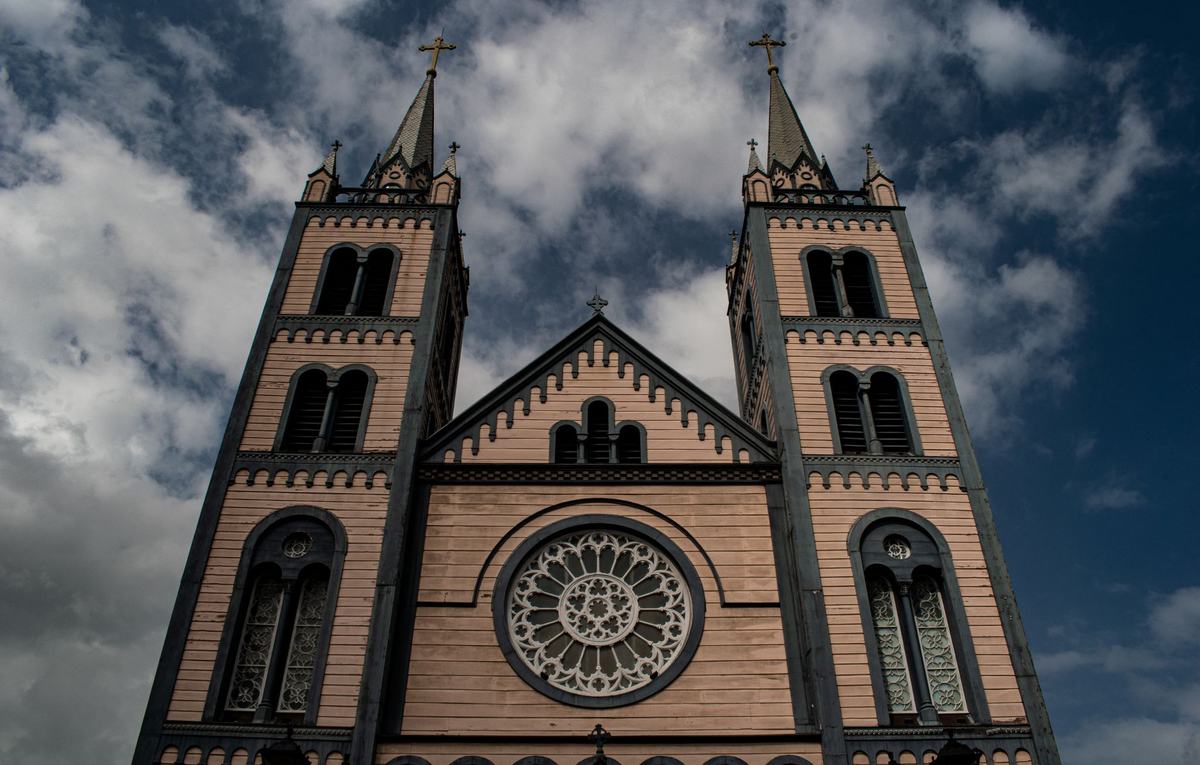
Paramaribo, the capital, holds something I did not expect to find in the tropics. Its historic inner city is a UNESCO World Heritage site, recognized for a streetscape of wooden colonial buildings that look like they were lifted out of seventeenth century Amsterdam and dropped under palm trees [3]. White wood, dark green shutters, narrow gables, brick foundations. The largest wooden cathedral in the Western Hemisphere, the Cathedral Basilica of Saint Peter and Paul, sits right in the middle of it.
What makes the place work is that it is not a museum. People live in those buildings. The cafes are full. Cars rattle past on streets named after Dutch admirals. And a few blocks away you find a mosque and a synagogue standing right next to each other, sharing a parking lot. That image gets used in every Suriname tourism brochure, and for once the brochure is not exaggerating.
Ninety Percent of Suriname Is Rainforest
About 93 percent of Suriname is covered in tropical rainforest, which makes it one of the most forested countries on Earth by share of land [4]. The Central Suriname Nature Reserve alone protects 1.6 million hectares of untouched primary forest, an area larger than the state of Connecticut, and it is also a UNESCO site. Jaguars, giant river otters, harpy eagles, eight species of monkeys, and freshwater stingrays the size of dinner plates all live in there.
Roughly 90 percent of the population lives on a narrow coastal strip, which means the interior is almost empty of permanent settlement. The people who do live in the forest are mostly Indigenous communities and Maroons, descendants of enslaved Africans who escaped Dutch plantations in the seventeenth and eighteenth centuries and built independent societies deep in the bush. The Saramaka and Ndyuka peoples still govern significant parts of the interior under traditional law. There is nothing quite like it back home in Montana, where "remote" means a two hour drive from a Starbucks. In Suriname, "remote" means several days by boat upriver.
One of the Most Diverse Populations on Earth
For a country of 623,000 people, Suriname is staggeringly mixed. The population breaks down roughly into Hindustanis with roots in northern India, Maroons, Creoles of mixed African and European descent, Javanese brought by the Dutch from Indonesia, Indigenous peoples, Chinese, and smaller communities of Lebanese, Brazilians, and Europeans [2]. No single group is a majority.
The everyday result is striking. A weekday lunch in Paramaribo might be roti from a Hindustani stall, nasi goreng from a Javanese warung, or pom, a Creole oven dish made from tayer root and chicken. Diwali, Eid, Chinese New Year, Christmas, and Keti Koti, the day commemorating the end of slavery, are all national holidays. The country sometimes describes itself as a working laboratory for how different cultures can share one small place.
Frequently Asked Questions
Where is Suriname located?
Suriname is on the northeastern coast of South America, between Guyana to the west and French Guiana to the east, with Brazil to the south and the Atlantic Ocean to the north. It is the smallest sovereign country on the continent.
What language do they speak in Suriname?
Dutch is the official language of Suriname, the only country in the Americas where that is the case. Most people also speak Sranan Tongo, a local creole, and many speak Sarnami Hindi, Javanese, or Indigenous languages at home.
Is Suriname part of the Caribbean?
Suriname is geographically in South America but culturally and politically tied to the Caribbean. It is a full member of CARICOM, the regional Caribbean bloc, and shares historical and demographic links with Caribbean nations through its colonial past.
What is Suriname known for?
Suriname is known for being the smallest country in South America, its Dutch colonial heritage, the UNESCO-listed wooden inner city of Paramaribo, and its vast pristine rainforest, which covers more than 90 percent of the country.