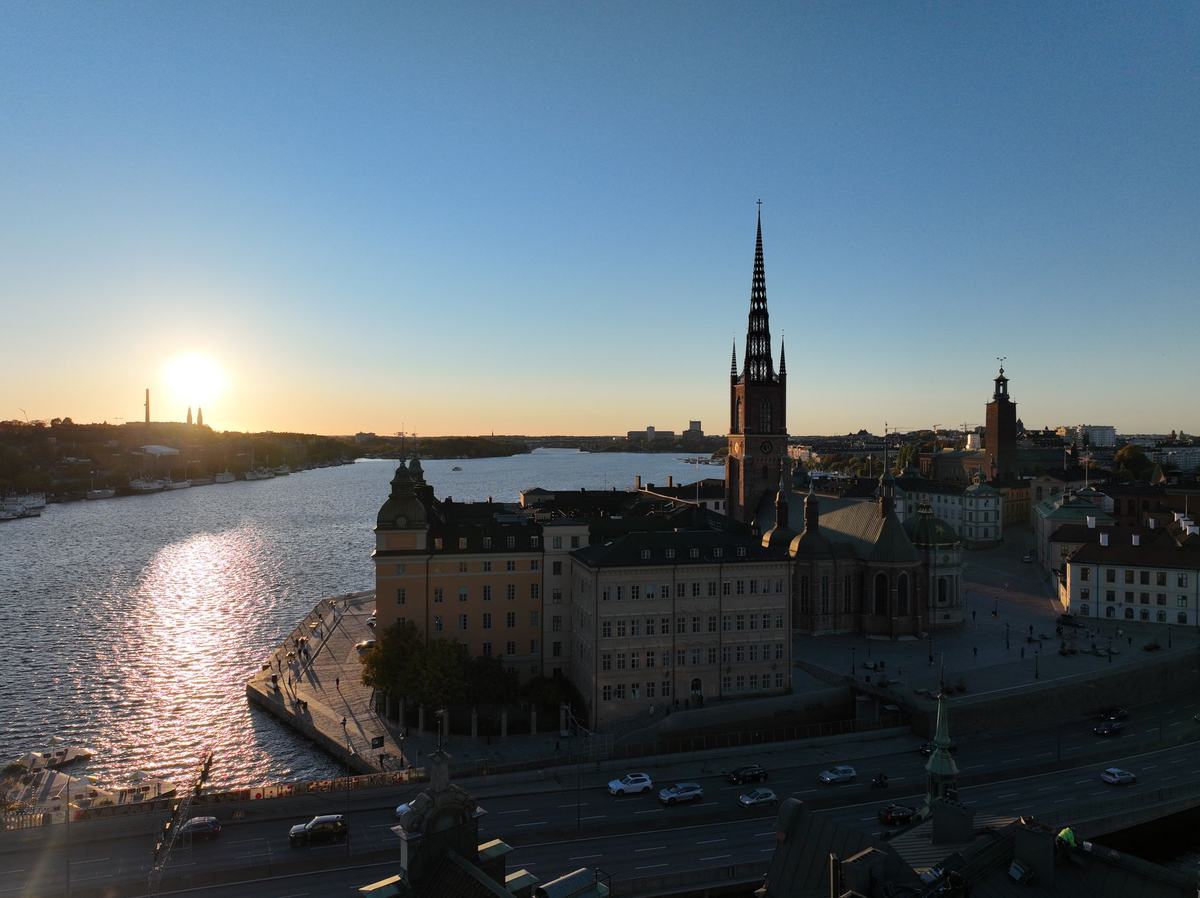
- Capital: Stockholm, built across 14 islands connected by 57 bridges [1]
- Population: About 10.6 million as of 2024 [2]
- Area: 450,295 square kilometers (third-largest country in the European Union) [1]
- Official language: Swedish, with five recognized minority languages including Sami and Finnish [3]
- Currency: Swedish krona (SEK) - Sweden kept the krona instead of adopting the euro
- Distinguishing claim: Sweden has roughly 100,000 lakes and 267,570 islands, more than any other country [1]
Most of what you own probably has a Swedish fingerprint on it somewhere. The seatbelt in your car. The flat-pack bookshelf in your living room. The pop song stuck in your head from 2003. Sweden quietly invented or perfected a startling amount of modern life, and then shrugged about it. I had to look this up twice when I first started reading about Swedish patents - the country has fewer people than the state of Michigan, but its inventors handed the world the three-point seatbelt, the adjustable wrench, the zipper's modern form, and Spotify. And nobody talks about this, but Sweden has been doing that quiet, world-shaping thing for centuries.
A Country Mostly Made of Trees and Water
Sweden is the third-largest country in the European Union by area, but you'd never guess that from looking at where people actually live. About 87 percent of the population is crammed into the southern third of the country, mostly in or around three cities: Stockholm, Gothenburg, and Malmo [2]. The rest is forest. Real forest - the kind that goes on for hundreds of miles without much in the way of human interruption.
Roughly 69 percent of Sweden's land is covered in forest, which is one of the highest forest percentages of any developed country on Earth [4]. Drive north of Uppsala and the towns thin out, the trees thicken, and suddenly you're in a landscape that feels closer to the boreal stretches of Alaska than to anywhere in Europe. The country also has somewhere around 100,000 lakes and 267,570 islands [1]. That's not a typo. Most of those islands are tiny and uninhabited, but Sweden technically owns more islands than any other country, which is a fact I find oddly comforting.
Back home in Montana, we had what felt like endless wilderness too, but it was rugged, dry, and arranged around mountain ranges. Swedish wilderness is different. Softer. Wetter. Everything reflects everything else because there's always a lake nearby.
The Right to Roam, Written Into the Constitution
Here's the thing about all that forest and water: in Sweden, you can pretty much just walk into it. The country has a constitutional principle called allemansratten, which translates roughly as "everyone's right" or "the right of public access" [5]. It means you can hike, camp, pick berries, swim, and ski on almost any land in Sweden, including private property, as long as you don't damage anything, get too close to someone's house, or stay too long.
It's been part of Swedish life for centuries, and was formally written into the constitution in 1994. There's no equivalent in American law. Try setting up a tent on someone's back forty in rural Montana and see how that goes. In Sweden, that same act would be completely legal, as long as you packed out your trash and stayed a respectful distance from any buildings.
Stockholm, the City on the Water
Stockholm gets called the "Venice of the North" by people who haven't been to Venice and "the Venice that actually works" by people who have. The city sits across 14 islands connected by 57 bridges, which means you're never more than a few minutes from open water [1]. The old town, Gamla Stan, dates back to the 1200s and still has streets so narrow you can touch the buildings on both sides at the same time.
Stockholm is also the cleanest capital city I've read about. The water in the harbor is clean enough to swim in and fish in - people catch salmon in the middle of downtown. That wasn't always true. In the 1960s the harbor was a chemical mess. Sweden just decided to fix it, and over about thirty years they did.
Fika Is Not Just Coffee Break
Every guidebook will tell you fika means "coffee and a pastry". That's like saying Thanksgiving means "a turkey dinner". Fika is closer to a national ritual. Twice a day, often at 10 a.m. and 3 p.m., people stop what they're doing, sit down with coworkers or friends, and have coffee and something sweet. Usually a cinnamon bun, which Swedes call kanelbulle. The point isn't the coffee. The point is the stopping.
Swedish workplaces build fika into the schedule. Hospitals do it. Schools do it. Construction crews do it. The cultural assumption is that you'll do worse work and be less pleasant to be around if you don't stop and have coffee with someone twice a day. Which, if you think about it, is probably the most sensible policy any country has ever had about productivity.
Sweden consumes around 8 to 9 kilograms of coffee per person per year, putting it consistently among the world's top coffee-drinking nations [6]. For a country with no coffee plants and a long history of just drinking water from lakes, that's a remarkable cultural pivot.
The Inventions Nobody Mentions
This is where Sweden gets quietly mind-bending. The three-point seatbelt, the kind in every modern car, was invented by a Volvo engineer named Nils Bohlin in 1959. Volvo then did something almost unheard of in corporate history - they made the patent free for all other car manufacturers to use, because they decided saving lives mattered more than the licensing money [7]. Estimates suggest the invention has saved more than a million lives since.
The adjustable wrench (the kind with the sliding jaw) came from a Swedish inventor named Johan Petter Johansson in 1892. The zipper as we know it was refined by Gideon Sundback, a Swedish-American engineer. Tetra Pak, the milk carton, is Swedish. The pacemaker was first successfully implanted by a Swedish surgeon using a Swedish-designed device. Skype was co-founded by a Swede. Spotify was founded in Stockholm in 2006 and now has more than 600 million users worldwide [8].
Then there's the cultural exports. ABBA. Roxette. Avicii. The Cardigans. Sweden punches absurdly above its weight in pop music, partly because the country invested heavily in public music education starting in the 1940s, and partly because of one extraordinary songwriter named Max Martin who has written more number-one hits in America than anyone in history except Paul McCartney and John Lennon. He's from a town outside Stockholm and almost nobody outside the industry knows his name.
Daylight That Doesn't Behave
Up north, in places like Kiruna and Abisko, summer means weeks where the sun doesn't set. Locals call it the midnight sun, and it's exactly what it sounds like - 11 p.m., bright as midday, kids playing soccer outside. Winter is the opposite. The sun barely clears the horizon, and on the darkest days it doesn't rise at all. This is called polar night, or kaamos in Finnish, and it lasts about a month in the far north.
People deal with this in a few ways. Light therapy lamps are everywhere. Saunas help. So does a particular Swedish concept called mys, which is roughly the equivalent of the Danish hygge - the idea of being cozy on purpose. Candles, blankets, slow food, low expectations. The northern lights also help. Abisko National Park is one of the best places on Earth to see the aurora borealis, partly because it has its own microclimate that keeps the sky clearer than the surrounding regions.
Sweden Invented the National Park (in Europe)
In 1909, Sweden became the first country in Europe to establish national parks, designating nine of them in a single year [9]. The model came partly from American influence - Yellowstone had been founded in 1872, and Swedish naturalists were paying attention. But Sweden adapted the idea for its own landscape, prioritizing the protection of ancient forests and the traditional grazing lands of the Sami, the indigenous people of northern Scandinavia.
Today Sweden has 30 national parks covering everything from coastal archipelagos to the high mountains of Lapland. Sarek, way up north, is one of Europe's largest roadless wilderness areas. There are no marked trails, no huts, no bridges over the rivers. You walk in, you take care of yourself, you walk out. It's the kind of place that reminds you Europe is bigger and wilder than most Americans imagine.
Frequently Asked Questions
What is Sweden famous for?
Sweden is famous for IKEA, ABBA, meatballs, the Nobel Prize, and a long tradition of social welfare policies. The country is also known for its vast forests, the midnight sun, the Vikings, and quiet inventions like the three-point seatbelt and Spotify that shaped modern life worldwide.
Is Sweden a part of the European Union?
Yes, Sweden joined the European Union in 1995. However, Sweden chose not to adopt the euro after a 2003 national referendum, and continues to use its own currency, the Swedish krona. Sweden also joined NATO in 2024 after decades of military non-alignment.
What language do they speak in Sweden?
Swedish is the official language, spoken by nearly the entire population. Sweden also recognizes five minority languages, including Finnish, Sami, Meankieli, Romani, and Yiddish. Most Swedes speak English fluently as a second language, especially in cities, where you can travel comfortably without knowing Swedish.
Why does Sweden have so many islands?
Sweden has roughly 267,570 islands, most along its long Baltic coastline. The high number is the result of glacial retreat at the end of the last ice age, which carved the bedrock into countless small landmasses. The land is still slowly rising, so new islands occasionally emerge.
Is Sweden expensive to visit?
Sweden is moderately expensive compared to most of Europe, with prices similar to Norway or Switzerland in big cities. Stockholm and Gothenburg can be costly for restaurants and hotels, but public transport is efficient and reasonably priced, and Sweden's right-to-roam law makes camping and hiking essentially free.
Sources
- Sweden country profile - CIA World Factbook
- Statistics Sweden - Population
- Government of Sweden - National minorities
- Swedish Forest Industries Federation
- Naturvardsverket - The Right of Public Access
- International Coffee Organization - Country statistics
- Volvo Cars - The three-point safety belt
- Spotify Newsroom - Company info
- Naturvardsverket - Swedish national parks