- Capital: Bern (not Zurich, which trips up most people) [1]
- Population: about 8.9 million [1]
- Area: 41,285 square kilometers, roughly the size of West Virginia [1]
- Official languages: German, French, Italian, and Romansh [2]
- Currency: Swiss franc (CHF), one of the world's most stable [3]
- Distinguishing claim: by law, Switzerland has enough nuclear fallout shelter space for every single resident [4]
Here's something that'll ruin the next geography quiz you take: the capital of Switzerland isn't Zurich. It's Bern, a medieval town of about 130,000 people with a bear pit in the middle of it. I had to look this up twice the first time it came up at a dinner party, because Zurich is the famous one, the banking one, the one everyone names. But Bern got picked back in 1848 specifically because it was a compromise between the bigger cities. Switzerland does that a lot. The whole country runs on compromises that somehow work.
Four Official Languages in One Small Country
Switzerland has four official languages, and that's not a fun trivia note, it's how the country actually functions. German is spoken by about 62% of the population, French by 23%, Italian by 8%, and Romansh by less than 1%. Romansh is the wild one. It descends from the Latin spoken by Roman soldiers two thousand years ago, and today only about 60,000 people speak it, mostly in the canton of Graubünden. The Swiss federal government translates official documents into all four. Train announcements switch languages depending on where you are. Cross from Zurich to Geneva and you've crossed a language border without crossing a national one.
What gets me is how casual the Swiss are about it. Back home in Montana, knowing one other language well is considered impressive. In Switzerland, a kid in Lausanne might learn French at home, German in school, English from movies, and Italian from a grandparent. Nobody makes a big deal out of it. It's just how the country talks to itself.
A Mountain Country That's Mostly Not Mountains
Everyone pictures Switzerland as wall-to-wall Alps. The mountains take up about 60% of the country, but the Swiss Plateau, which is where most people actually live, is rolling green farmland and lakes. Speaking of lakes, Switzerland has around 1,500 of them. Lake Geneva, shared with France, is the biggest. Lake Constance, shared with Germany and Austria, comes next. There's a saying that you're never more than 16 kilometers from a lake anywhere in Switzerland, and looking at the map, it checks out.
The Alps still get the headlines, though, and for good reason. The Matterhorn, that pyramid-shaped peak you've seen on Toblerone wrappers, sits on the Italian border at 4,478 meters. The Swiss have been climbing it since 1865, when a British party made the first ascent and four of them died on the way down. The Jungfraujoch railway, finished in 1912, still runs up to 3,454 meters through a tunnel bored into the Eiger and Mönch. It's the highest railway station in Europe. Engineering on that scale, in that terrain, with Victorian tools, is the kind of thing that makes you stop and reread the date.
The Bunker Thing Nobody Talks About
And nobody talks about this, but every single person in Switzerland has a guaranteed spot in a nuclear fallout shelter. A 1963 law requires every residential building to have one, or to pay into a community shelter fund. The country has roughly 370,000 private shelters and 5,100 public ones, with enough space for the entire population plus extra. Cold War paranoia built it, and Switzerland never dismantled it. Most of the bunkers now double as wine cellars, storage rooms, or band practice spaces. But if something terrible ever happened, the doors close and the air filters turn on and every person has a place to go. Which, if you think about it, is a deeply Swiss way to handle anxiety. Don't talk about it. Just be ready.
The Swiss military fits the same pattern. Switzerland has been neutral since 1815, but every man does mandatory service and keeps his service rifle at home. The country has demolition charges built into key bridges and tunnels so they can blow them in an invasion. It's not a country at war. It's a country that has spent two hundred years quietly making sure war can't happen to it.
Direct Democracy, Sometimes Quarterly
The Swiss vote on things Americans would never imagine voting on. Roughly four times a year, citizens get a ballot with national, cantonal, and municipal questions on it. They've voted on whether cows should be allowed to keep their horns. They've voted on whether to give every adult a guaranteed basic income (they said no, in 2016). They've voted on minarets, on immigration quotas, on executive pay caps. To change the constitution, a proposal needs both a majority of voters and a majority of the 26 cantons. That second requirement means a tiny rural canton has roughly the same weight as Zurich. It's slow. It's messy. It also means almost nothing gets imposed on the Swiss without their direct sign-off.
Watches, Chocolate, Cheese, and Other National Hobbies
Switzerland makes about half the world's luxury watches by value, with brands like Rolex, Patek Philippe, and Omega all based there. The industry survived the 1970s quartz crisis by reinventing itself, partly through Swatch, which made plastic watches cool again. Swiss chocolate consumption per person is among the highest on the planet, around 11 kilograms a year. The country invented milk chocolate (Daniel Peter, 1875) and the conching process that makes chocolate smooth (Rodolphe Lindt, 1879). And then there's cheese. Gruyère, Emmental (the one with the holes), Appenzeller, Raclette - every region has its own. Cheese fondue, the thing tourists eat in wooden chalets, was actually marketed nationally in the 1930s by the Swiss Cheese Union to sell more cheese. The marketing worked.
A Flag That's Literally Square
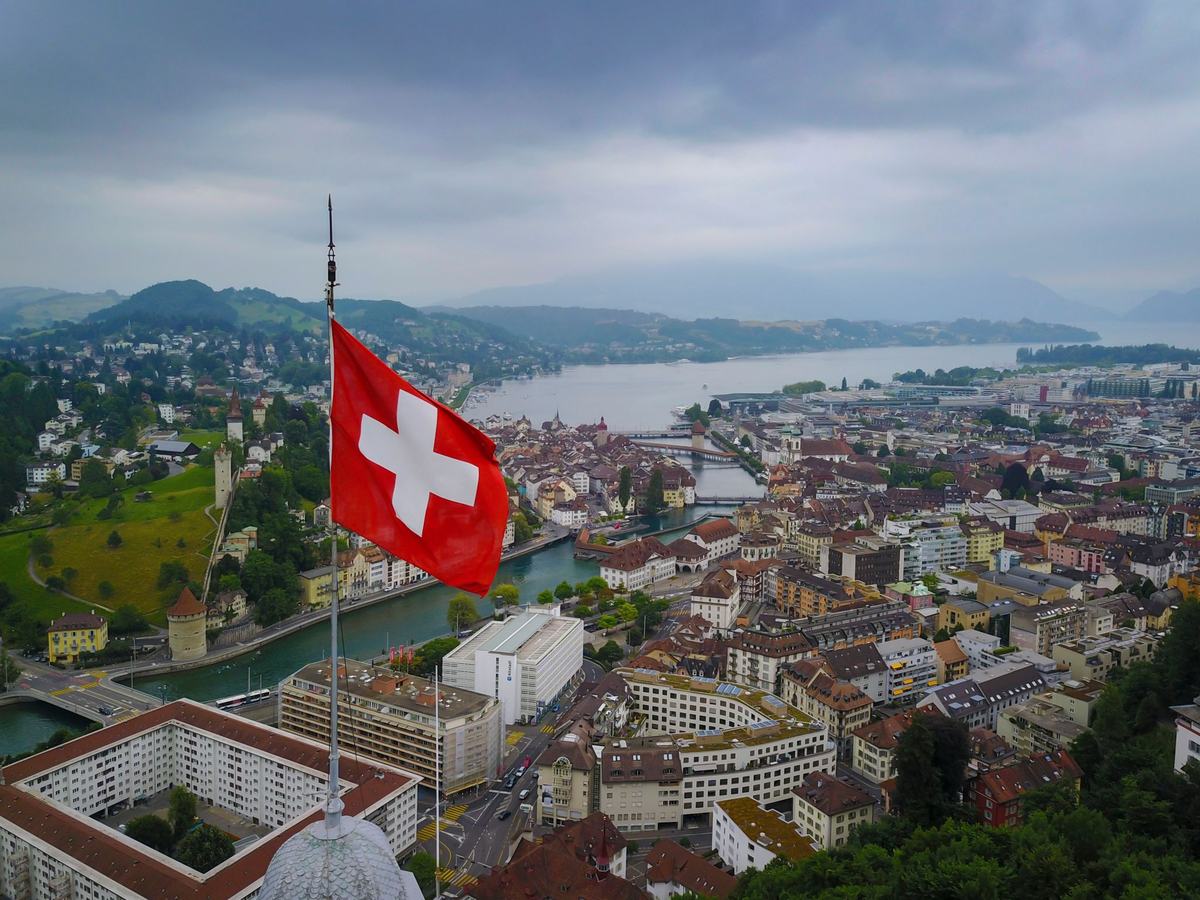
Switzerland and Vatican City are the only two countries in the world with square national flags. Every other country uses a rectangle. The Swiss flag, a white cross on red, is also the inspiration for the Red Cross emblem, which is the Swiss flag with the colors reversed. The Red Cross was founded in Geneva in 1863 by Henry Dunant, who'd witnessed the carnage of the Battle of Solferino and decided wounded soldiers deserved neutral care. Switzerland has been quietly running humanitarian operations from Geneva ever since. The city now hosts the UN's European headquarters, the WHO, the WTO, and dozens of other international bodies, more than any other city on earth.
Frequently Asked Questions
What is the capital of Switzerland?
The capital of Switzerland is Bern, not Zurich. Bern was chosen in 1848 as a compromise between the larger cities. It's a medieval town of about 130,000 people and houses the Federal Assembly and the seven-member Federal Council that runs the country.
How many languages are spoken in Switzerland?
Switzerland has four official languages: German, French, Italian, and Romansh. About 62% of Swiss speak German, 23% French, 8% Italian, and under 1% Romansh. Federal laws and announcements are translated into all four, and language regions shift as you cross the country.
Is Switzerland really neutral?
Yes. Switzerland has held a policy of armed neutrality since the Congress of Vienna in 1815, recognized by international treaty. It maintains a standing militia, hosts UN humanitarian agencies in Geneva, and avoids military alliances. It joined the UN only in 2002 and is not a member of the European Union.
Why does Switzerland have so many bunkers?
A 1963 federal law requires every residential building to provide nuclear fallout shelter space, or contribute to a public shelter. The country has around 370,000 private and 5,100 public shelters, with capacity for the entire population. Most are now used for storage but remain functional.
What currency does Switzerland use?
Switzerland uses the Swiss franc (CHF), not the euro, even though it's surrounded by eurozone countries. The franc is one of the world's most stable currencies and is often treated as a safe-haven asset during global market stress. Liechtenstein also uses it.