- Capital: Dodoma (official), with Dar es Salaam as the commercial hub [1]
- Population: roughly 67 million (2024 estimate) [2]
- Area: 947,303 square kilometers, about twice the size of California [1]
- Official languages: Swahili and English [1]
- Currency: Tanzanian shilling (TZS)
- Home to Mount Kilimanjaro, the highest mountain in Africa and the tallest free-standing mountain on Earth [3]
I used to think of Tanzania the way most Americans do, which is to say I pictured a single image: a lion on a savanna at sunset, the kind of thing you see on a nature documentary while eating cereal. Then I started reading, and the country kept getting bigger. Bigger geographically, bigger linguistically, bigger in just about every direction you can measure. Tanzania holds the tallest peak on the continent, the second-deepest lake in the world, the largest land migration on Earth, and a coastline that traded with merchants from Oman and India centuries before America was a sentence anyone had written down. Here's the thing about it: most of that gets compressed into a single safari brochure, and the actual country is a lot stranger and more interesting than the brochure lets on.
A Country Stitched Together From Two
Tanzania, as a name, is only about sixty years old. In April 1964, the mainland country of Tanganyika merged with the island nation of Zanzibar, and somebody had the sense to combine the two names rather than pick a winner. Tan plus Zan plus a vowel for grace. That's where the word comes from. Before that merger, the two were separate countries with separate colonial histories: Tanganyika had been a German colony, then a British mandate after World War I, while Zanzibar had been its own sultanate with deep Omani Arab roots stretching back centuries [4]. The merger is still in place, but Zanzibar runs its own semi-autonomous government, has its own president, and feels in many ways like its own place. You fly from Dar es Salaam to Stone Town and the air smells different. The architecture is different. The food, the music, the calls to prayer at dusk are all different.
Kilimanjaro Is Stranger Than the Postcards Suggest
Kilimanjaro shows up in every Tanzania article ever written, and for a reason, but the version most people carry around is incomplete. It's 5,895 meters tall, which makes it the highest point in Africa, but the part that always gets me is that it's a free-standing mountain. It isn't part of a range. It just rises out of the East African plains, which means on a clear day from Moshi you can see the whole shape of it from base to glacier in one continuous line. That's almost unheard of for a mountain that size.
The other thing nobody tells you is that you can hike to the summit without technical climbing gear. There are no ropes, no ice axes, no crampons for most routes. It's a long, slow, oxygen-starved walk, and roughly 30,000 to 50,000 people attempt it every year [3]. About two-thirds make it to Uhuru Peak. The glaciers on top, though, are a different story. They've been shrinking for decades, and current projections put their full disappearance somewhere in the next twenty to thirty years. The summit photos people are taking in 2026 won't be possible by mid-century.
The Great Migration Is a Year-Round Loop
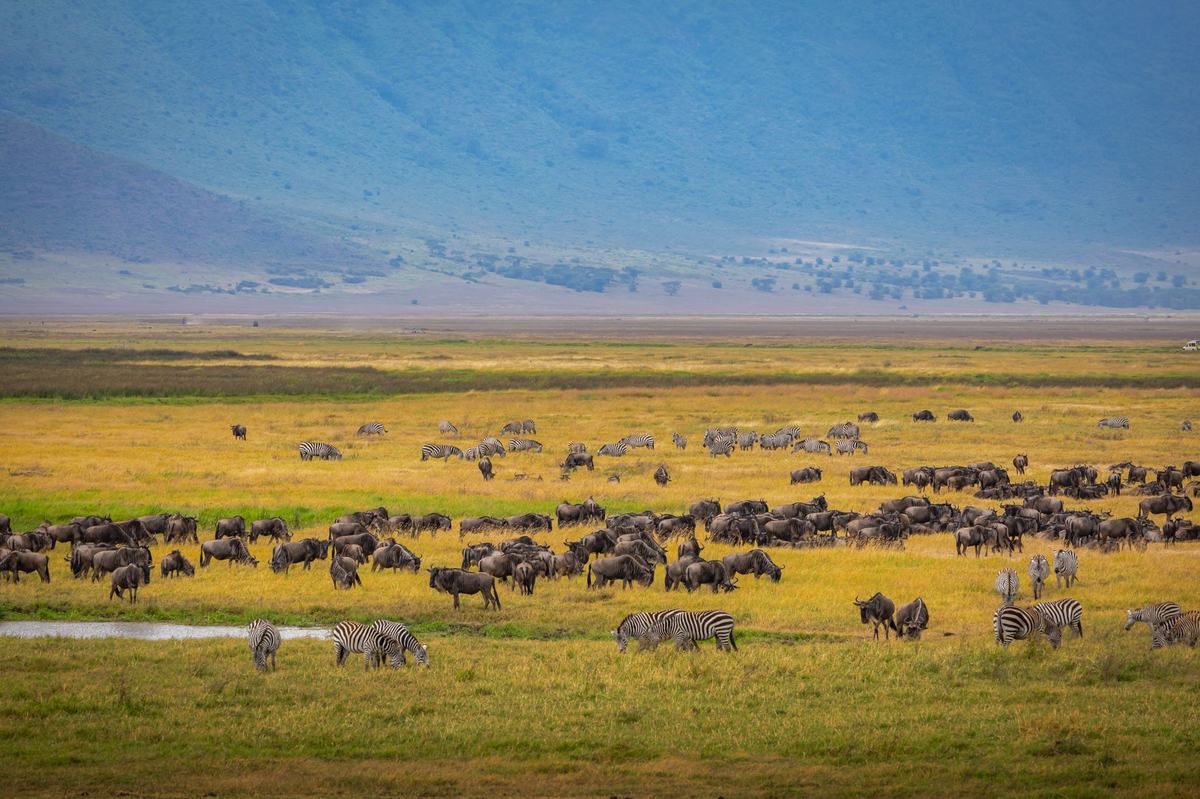
If Kilimanjaro is Tanzania's vertical fact, the Serengeti is its horizontal one. The Serengeti ecosystem covers about 30,000 square kilometers across northern Tanzania and southwestern Kenya, and inside it, every year, roughly 1.5 million wildebeest, 200,000 zebras, and several hundred thousand gazelles move in a continuous clockwise loop chasing rainfall and fresh grass [5]. It's the largest overland migration of mammals on the planet.
The part that surprised me, when I actually read about it, is that it doesn't have a start or an end. It's a loop. The herds calve in the southern plains around January and February, drift west and north through the spring, cross the Mara River (which is where you've seen the crocodile footage), reach the northern grasslands by late summer, and head south again before the December rains. There's no migration "season" in the way I'd assumed. It's always happening somewhere in the ecosystem. The Maasai people, whose ancestral lands overlap heavily with the Serengeti, have been navigating around this rhythm for centuries.
Lake Tanganyika and a Lot of Water Most People Forget
Tanzania has three of Africa's Great Lakes touching its borders: Victoria in the north, Tanganyika in the west, and Nyasa (also called Malawi) in the south. Lake Tanganyika is the one that quietly does the most. It's the second-deepest lake on Earth, after Lake Baikal in Siberia, with a maximum depth of about 1,470 meters [6]. It's also the second-largest freshwater lake by volume, and it holds something like 17 percent of the world's available surface freshwater.
Back home in Montana we have Flathead Lake, which feels enormous when you stand on its shore, and it's about 50 meters deep. Tanganyika is roughly thirty times deeper. The biology in it has been evolving in isolation for nine to twelve million years, which is part of why it contains over 250 species of cichlid fish that exist nowhere else on Earth. Lake biologists treat Tanganyika the way astronomers treat the Galápagos. It's a living laboratory.
More Than 120 Languages, Held Together by One
Tanzania is one of the most linguistically dense countries in the world. Estimates run from about 120 to over 160 living languages depending on who's counting and how they define a language versus a dialect [7]. What's unusual is that the country has managed to function across all of those without the kind of language-based political conflict you see elsewhere. The reason is Swahili.
Swahili, or Kiswahili as it's properly called, isn't tied to a single Tanzanian ethnic group. It grew up as a trade language on the East African coast, blending Bantu grammar with Arabic vocabulary picked up from centuries of Indian Ocean commerce. After independence in 1961, Tanzania's first president, Julius Nyerere, made Swahili a national unifier on purpose. He translated Shakespeare into it. He gave speeches in it. Today every Tanzanian child learns Swahili in primary school, and it functions as the country's connective tissue across hundreds of distinct cultural communities. Turns out a language can be a kind of infrastructure.
Zanzibar's Spice Trade and a Strange Footnote
Zanzibar earned the nickname "Spice Islands" because for a couple of centuries it was the global capital of the clove trade. The cloves came in from Indonesia, the trees thrived in the volcanic soil, and Omani sultans got very wealthy. Stone Town, Zanzibar's old quarter, is now a UNESCO World Heritage site, and walking through it you can read the trade routes in the doors. Heavy carved wooden doors with brass studs - those are Omani in origin. The studs were originally designed in India to keep elephants from breaking through gates, which seems beside the point in Zanzibar until you realize the design just traveled with the trade.
The other footnote, which I had to look up twice: the shortest war in recorded history happened here. In 1896 the British Royal Navy bombarded the sultan's palace in Stone Town after a disputed succession. The war lasted somewhere between 38 and 45 minutes, depending on which clock you trust. Then it was over.
Frequently Asked Questions
What is Tanzania best known for?
Tanzania is best known for Mount Kilimanjaro, the Serengeti National Park and its annual wildebeest migration, and the spice islands of Zanzibar. The country also contains parts of three of Africa's Great Lakes and is the birthplace of modern Swahili as a unifying national language.
Is Tanzania a safe country to visit?
Tanzania is generally considered safe for tourism, particularly in the main safari circuits and Zanzibar. Standard precautions apply: avoid displaying valuables in cities like Dar es Salaam, use licensed tour operators for parks, and check current government travel advisories before booking, since conditions can shift in border regions.
What language do they speak in Tanzania?
Tanzania has two official languages, Swahili and English, with Swahili used in daily life and primary education. The country is also home to more than 120 indigenous languages spoken by different ethnic communities, but Swahili functions as the shared national language across all of them.
When is the best time to see the Great Migration?
The wildebeest migration moves through the Serengeti year-round in a continuous loop, so timing depends on which phase you want to see. River crossings in the north typically peak from July to October, while calving season on the southern plains runs from late January through February.
Is Zanzibar part of Tanzania?
Yes, Zanzibar is part of Tanzania, but it operates as a semi-autonomous region with its own president, parliament, and laws on local matters. The United Republic of Tanzania was formed in 1964 when the mainland nation of Tanganyika merged with the Zanzibar archipelago.
Sources
- Tanzania - The World Factbook
- World Bank: Tanzania Population
- Kilimanjaro National Park - UNESCO World Heritage Centre
- Tanzania: History and Independence - Encyclopaedia Britannica
- Serengeti National Park - UNESCO World Heritage Centre
- Lake Tanganyika - Encyclopaedia Britannica
- Ethnologue: Languages of Tanzania