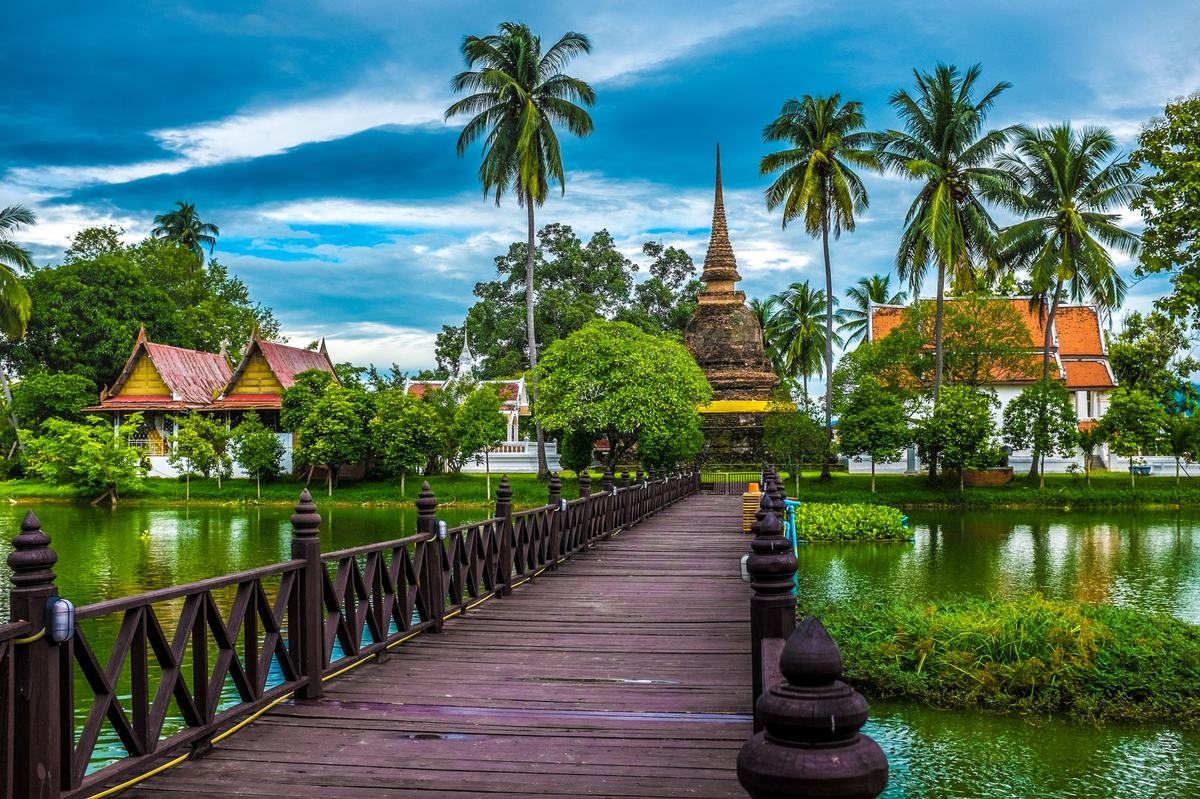
- Capital: Bangkok, with a metro population around 17 million, though its full ceremonial name runs to 168 letters and is officially the longest place name on Earth [1]
- Total population: about 71 million, with around 93 percent identifying as Buddhist [2]
- Area: 513,120 square kilometers, roughly the size of Spain, stretched into a shape Thais call "the head of an elephant"
- Official language: Thai, written in a script with 44 consonants, 15 vowel symbols, and exactly zero spaces between words
- Currency: Thai baht (THB)
- Thailand is the only country in Southeast Asia that was never colonized by a European power [3]
Most people couldn't tell you the capital of Laos or the currency of Myanmar. But almost everyone knows Bangkok. Thailand has this strange gravitational pull where it shows up in everyone's mental map of Asia even if they've never been, and once you start digging into why, the answers are weirder than the tourism posters let on. Let's start with the fact that Bangkok isn't even what Thais call Bangkok.
The full ceremonial name of the city, which schoolchildren still memorize, begins "Krung Thep Mahanakhon Amon Rattanakosin Mahinthara Ayuthaya" and keeps going for another 25 syllables. In daily speech Thais just say "Krung Thep", which means "City of Angels". Bangkok is a leftover from old foreign sailors, and the country has been politely letting us use the wrong name for over two hundred years.
A Country That Never Bent the Knee
Here's the thing nobody really teaches you in American history class: while the British were carving up Burma and Malaya, and the French were taking Indochina, Thailand (then called Siam) sat right in the middle and stayed sovereign. Two kings, Mongkut and his son Chulalongkorn, played the empires against each other through the second half of the 1800s, modernizing fast enough to be taken seriously and ceding just enough territory at the edges to keep the middle intact [3]. The whole region around them turned into colonies. Thailand did not.
That fact shapes more than tourist brochures. It means Thai law, Thai script, Thai monarchy, and Thai religion never had a European layer pasted over them. The temples weren't converted. The court titles weren't anglicized. When you walk around Bangkok and feel like the rhythm is different from Hanoi or Yangon, that's why. The colonial reset button was never pressed.
Bangkok Is Sinking, and It Knows
Bangkok sits on a clay floodplain a meter or two above sea level, and the city is sinking somewhere between one and two centimeters every year. Climate scientists keep flagging it as one of the most at-risk megacities on the planet. The government is now talking, more or less seriously, about whether the capital might need to move within the next several decades.
In the meantime the city just keeps building. The Skytrain (BTS) opened in 1999 and the MRT subway followed in 2004, both running through a humid mess of canals, motorbike taxis, and 7-Elevens (Thailand has the second-most 7-Eleven stores of any country in the world, with around 14,000, behind only Japan). The canals, by the way, are why Bangkok was once called "the Venice of the East". Most of them got paved over in the 20th century, but you can still take a longtail boat through the older neighborhoods and see the city the way it was originally laid out, with stilt houses and floating markets.
The King, the Wai, and Things You Don't Joke About
Thailand has lese-majeste laws among the strictest in the world. Insulting the monarchy can carry a prison sentence of up to 15 years per count, and people have been jailed for Facebook posts and even single Likes [4]. Foreigners get fewer passes on this than they sometimes assume. The royal family appears on every banknote, in nearly every classroom, and at the start of every movie shown in a theater, where the audience stands for the royal anthem before the previews roll.
The wai is the gesture of greeting, palms pressed together, fingertips somewhere between chest and forehead depending on rank. There's a whole grammar to it. You wai monks higher than your parents and your parents higher than your friends. Tourists are not expected to get it right, but Thais notice when someone tries. It's the kind of small social muscle that takes about a week to learn and a lifetime to use correctly.
Forty Thousand Temples
Thailand has somewhere north of 40,000 Buddhist temples, called wats, scattered across the country. The most famous is Wat Pho in Bangkok, home to a 46-meter reclining Buddha covered in gold leaf, with mother-of-pearl inlays on the soles of its feet. Wat Pho is also the official birthplace of Thai massage, and there's still a respected massage school on the temple grounds where students train for years.
Around 95 percent of Thai men spend at least some time as a Buddhist monk at some point in their lives, often just for a few weeks or months, frequently as a way of honoring their parents. You'll see them in saffron robes walking through markets at sunrise with alms bowls. Lay people give them rice and food, which is the monks' only meal of the day. It's so normal that it barely registers as a religious act. It's just morning.
The Food Is Built on Four Tastes at Once
Thai food is engineered around the simultaneous hit of salty, sweet, sour, and spicy in nearly every dish. Pad thai, the dish foreigners know best, is actually a relatively new invention. It was promoted by the government in the 1930s and 40s as part of a national identity campaign under Prime Minister Plaek Phibunsongkhram. He wanted a national dish, gave noodles a Thai twist, and the result stuck. Most Thais consider it solid but a bit basic. Ask a Thai friend what they actually eat and you'll hear about som tam (green papaya salad), khao soi (a northern coconut curry noodle), and gaeng som (a sour orange curry that will burn your face off in the best way).
Then there's fish sauce. Nam pla. It's in everything. A bottle of it on a Thai kitchen counter is what a bottle of olive oil is to an Italian one. It even shows up in ice cream in a few experimental Bangkok dessert shops, paired with caramel, and it actually works.
A Year With Three Calendars
Thailand officially uses the Buddhist calendar, which is 543 years ahead of the Gregorian one. So 2026 in the United States is 2569 in Thailand. The Western calendar runs alongside it for international business, and the lunar calendar runs underneath both for religious festivals like Songkran (the Thai New Year in April, fought largely with water guns in the streets) and Loy Krathong (the November festival of floating lotus-shaped baskets down rivers).
Songkran is genuinely something. The whole country shuts down for three days and turns into a water fight. Pickup trucks roll through Chiang Mai with barrels of water and crews of teenagers armed with Super Soakers. The temperature in April is around 100 degrees Fahrenheit, so getting drenched is welcome. It's the only time of year I've heard of a country canceling traffic enforcement on purpose because everyone is too wet to drive normally.
The Geography Goes From Mountains to Reefs
Thailand stretches almost 1,650 kilometers from the cooler hills of the north, near the Golden Triangle border with Laos and Myanmar, all the way down the peninsula to islands like Phuket and Ko Lipe in the south, where the water turns the kind of blue that doesn't photograph well. In the north you can ride elephants and visit hill tribe villages. In the south you snorkel over reefs that show up in James Bond movies.
The country also has the world's smallest mammal, the Kitti's hog-nosed bat, also called the bumblebee bat. It lives in a few limestone caves in western Thailand, weighs about two grams, and was only discovered in 1974. Turns out a lot of small countries hold one specific world record nobody mentions. Thailand has several.
Frequently Asked Questions
What is the capital of Thailand?
The capital is Bangkok, known to Thais as Krung Thep, with a metro population of about 17 million. Its full ceremonial name is the longest place name in the world at 168 letters, beginning Krung Thep Mahanakhon Amon Rattanakosin. The shorter form is used in everyday speech.
What language do people speak in Thailand?
Thai is the official language, written in a unique script with 44 consonants and no spaces between words. It is tonal, with five tones that can change a word's meaning entirely. English is taught in schools and widely spoken in tourist areas, hotels, and major Bangkok businesses.
Is Thailand safe for tourists?
Thailand is generally safe and welcomes around 35 million international visitors a year. Petty theft and tourist scams are the most common risks, especially in Bangkok and Phuket. Violent crime against foreigners is rare. Standard travel precautions, modest dress at temples, and respect for the monarchy are recommended.
What is the currency in Thailand?
The currency is the Thai baht (THB), divided into 100 satang. ATMs are widely available, and credit cards are accepted in cities, hotels, and most restaurants. Smaller shops, street food stalls, and rural areas remain cash-based, so carrying small bills is standard practice for travel.
Was Thailand ever a colony?
No. Thailand, then called Siam, is the only Southeast Asian country never colonized by a European power. Kings Mongkut and Chulalongkorn navigated diplomatic pressure from Britain and France during the 1800s by modernizing rapidly and ceding peripheral territories, preserving the country's core independence and sovereignty throughout the colonial era.