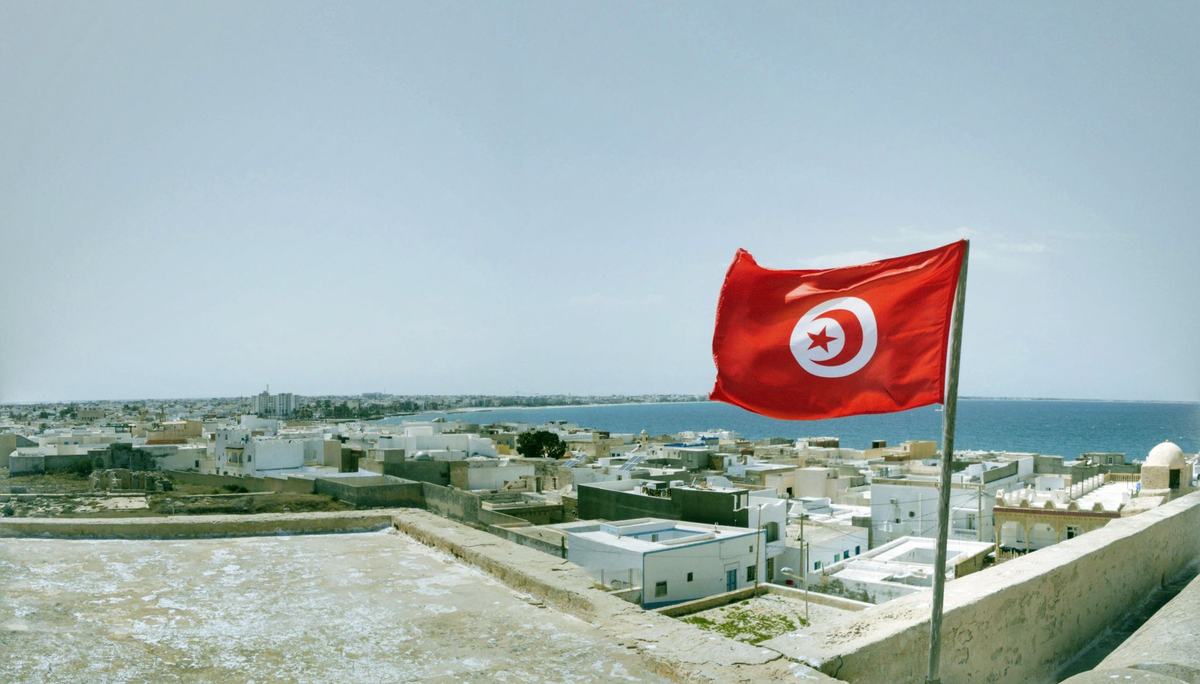
- Capital: Tunis [1]
- Population: roughly 12.3 million [2]
- Area: 163,610 square kilometers, the smallest country in North Africa [1]
- Official language: Arabic, with French widely used in business and education [1]
- Currency: Tunisian dinar (TND) [1]
- Carthage, on the outskirts of Tunis, was once the greatest naval power in the Mediterranean before Rome destroyed it in 146 BC [3]
Most Americans I talk to picture North Africa as one big stretch of sand. Then I mention Tunisia and ask them to place it on a map, and there is usually a long pause. Here's the thing - Tunisia is tucked between Algeria and Libya, jutting up into the Mediterranean like a thumb pointing toward Sicily. It is smaller than the state of Wisconsin. And it has been at the center of Mediterranean history for almost three thousand years.
I first got curious about Tunisia because of Star Wars. The desert planet Tatooine? Named after the southern Tunisian town of Tataouine, and a lot of those scenes were filmed in the country's deep south. That sent me down a rabbit hole I never really climbed out of.
Carthage, the Empire Rome Could Not Forget
Before there was a Roman Empire, there was Carthage. Founded by Phoenician traders around 814 BC on the coast of what is now Tunisia, it grew into a maritime superpower that controlled trade across the western Mediterranean [3]. Hannibal, the general who marched elephants across the Alps to attack Rome, was Carthaginian. He came from the suburbs of modern Tunis.
Rome eventually won the Punic Wars and, in 146 BC, leveled Carthage so thoroughly that the legend says they salted the earth so nothing would grow there again. The salt part is probably a myth, but the destruction was real. What you can visit today are mostly the Roman ruins built on top of what was left, plus the surviving Phoenician harbors. Walking through it feels strange. You are looking at the foundations of a civilization that almost beat Rome.
The Sahara Starts Here
Roughly 40 percent of Tunisia is covered by the Sahara Desert [1]. The north is green, hilly, and Mediterranean - olive groves, cork forests, vineyards that the Romans planted and somebody has been tending ever since. Then you drive south. Within a few hours the landscape goes flat and yellow, and you hit the Chott el Jerid, an enormous dry salt lake that shimmers in the heat. Mirages here are not metaphors. They are real and constant.
Past the salt flats are the Berber villages of the south, including the underground troglodyte homes of Matmata. People carved their houses straight down into the earth to escape the heat. George Lucas saw one in the 1970s and made it Luke Skywalker's childhood home. The hotel is still there. You can sleep in it. Back home in Montana we had root cellars dug into hillsides, and the principle is the same - the earth is a thermostat. Tunisians have been using it for centuries.
The Medina of Tunis
The medina, or old walled city, of Tunis is a UNESCO World Heritage site and has been continuously inhabited since the 7th century [4]. It contains hundreds of monuments - palaces, mosques, mausoleums, madrasas, fountains - packed into a maze of narrow streets that feel like they were laid out by someone who deliberately did not want you to find your way out.
The Zitouna Mosque sits at the heart of it. Founded in the 8th century, it was one of the most important centers of Islamic learning in the medieval world. Students came from across North Africa and Andalusia to study there. The mosque's columns, by the way, were largely scavenged from the ruins of Carthage. That's Tunisia in one detail - layers built on layers, the past never really thrown away.
A Quietly Revolutionary Country
In December 2010, a young fruit vendor named Mohamed Bouazizi set himself on fire in the town of Sidi Bouzid to protest harassment by local officials. Within weeks, mass protests had forced Tunisia's longtime authoritarian president to flee the country. The movement spread to Egypt, Libya, Syria, and beyond. It became known as the Arab Spring, and it started in this small Mediterranean country [5].
Tunisia's transition has been complicated and is still ongoing. But it is the only country from that wave of uprisings that produced a functioning democratic constitution, even with all the strain that has come since. Nobody talks about this enough. A nation of twelve million people changed the political conversation of an entire region.
Food, Tea, and Daily Rhythm
If you have eaten Tunisian food, you have probably had harissa - the fiery red chili paste that goes on basically everything. It has become so central to Tunisian identity that UNESCO added it to the list of intangible cultural heritage in 2022. The country exports more of it every year, mostly to France and Germany.
Couscous is the national dish, but Tunisian couscous is its own thing - often made with fish on the coast, with lamb or vegetables inland. Bricks (thin fried pastries with a runny egg inside) are a Tunisian invention you will find on every café menu. And mint tea is not a drink, it is a ritual. You pour it from high above the glass, three times if you are doing it right, until there is a foam on top.
Cafés are male spaces in a lot of traditional towns, but Tunis has plenty of mixed ones, and the country has one of the highest female literacy rates and university enrollment rates in the Arab world [2]. Tunisia legalized abortion in 1973, two years before France did. Which, if you think about it, complicates a lot of lazy assumptions Americans tend to make.
A Small Country with a Long Memory
Tunisia is the kind of place that makes you reconsider what "small" means. Smaller than Wisconsin in area. Twelve million people. And yet inside its borders you have Phoenician colonies, Roman cities, Berber villages older than Islam, French colonial architecture, the birthplace of the Arab Spring, and the inspiration for Tatooine. I had to look this up twice when I started researching, because every layer revealed another.
Most people will tell you to go to Morocco or Egypt for North Africa. Go to Tunisia instead, or at least also. It is a country that punches far above its weight, and that has been true for almost three thousand years.
Frequently Asked Questions
What is Tunisia known for?
Tunisia is known for the ancient ruins of Carthage, Mediterranean beaches, the Sahara Desert, and being the birthplace of the 2010-2011 Arab Spring. It is also famous as a filming location for several Star Wars movies, including the original 1977 film, in its southern desert regions.
Is Tunisia an Arab country or African?
Both. Tunisia is geographically in North Africa and is culturally and linguistically part of the Arab world, with Arabic as its official language. It also has deep Berber roots that predate the Arab arrival in the 7th century, and French is widely spoken from the colonial period.
What language do they speak in Tunisia?
The official language is Arabic, specifically Modern Standard Arabic for formal contexts and Tunisian Arabic (Derja) in daily life. French is widely used in business, government, and higher education. English is increasingly spoken in tourism, and Berber is still spoken by minorities in the south.
Is Tunisia safe to visit?
Most tourist areas in Tunisia, including Tunis, Carthage, Sousse, and the island of Djerba, are considered generally safe for travelers. Travel advisories often recommend caution near the borders with Libya and Algeria. Checking your country's current advisory before traveling is the standard recommendation.
What is the currency of Tunisia?
The currency is the Tunisian dinar (TND), divided into 1,000 millimes. The dinar is a closed currency, meaning it cannot legally be taken out of the country, so travelers exchange money on arrival and convert any remainder before leaving.