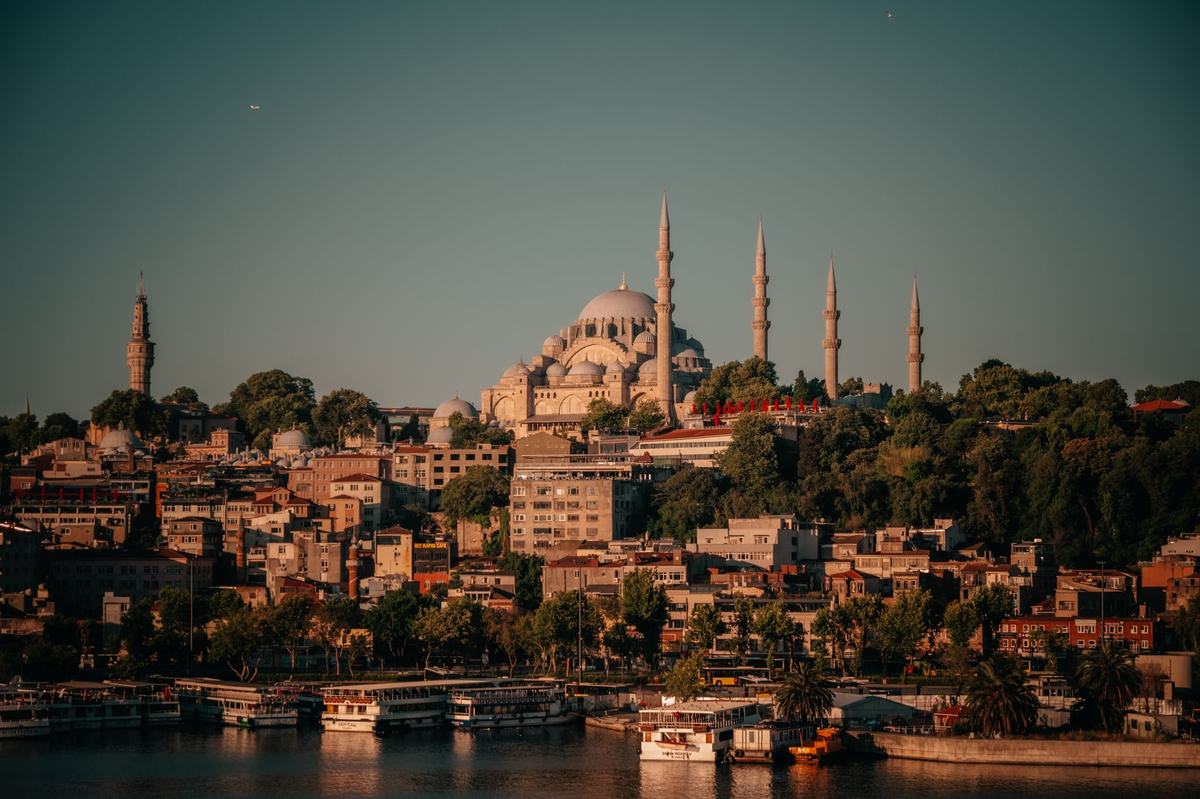
- Capital: Ankara (not Istanbul, a fact that trips up almost everyone) [1]
- Population: roughly 85.3 million [2]
- Area: 783,562 square kilometers, about the size of Texas plus Louisiana [1]
- Official language: Turkish [1]
- Currency: Turkish lira (TRY) [1]
- The only country in the world whose largest city, Istanbul, sits on two continents at the same time [3]
Here's something that'll ruin the next geography quiz you take: the capital of Türkiye is not Istanbul. It's Ankara. I had to look this up twice the first time I read it, because everything I knew about the country - the photos, the news segments, the food shows - had been about Istanbul. Turns out the capital moved to Ankara in 1923, when the modern republic was founded, and it has been there ever since.
That kind of mismatch between what you think you know and what is actually true sums up the whole country for me. Türkiye, which officially changed its English-language name from "Turkey" at the United Nations in 2022, is one of those places that punches through every stereotype you arrive with. It is European and Asian. It is ancient and very modern. It produces more hazelnuts than any other country on Earth, and it also holds the oldest known temple ever built. I started reading about it expecting one thing and kept finding another.
A City Split Between Two Continents
Istanbul is the only major city in the world that straddles two continents [3]. The Bosphorus strait runs right through the middle of it, with Europe on one side and Asia on the other. You can take a ferry from one continent to the other for about the price of a coffee, and people do it every day on their way to work. There are commuters who eat breakfast in Asia and arrive at the office in Europe before the cup is empty.
The city has had three names that mattered. Byzantium, when it was a Greek colony. Constantinople, when it was the capital of the Eastern Roman Empire for over a thousand years. Then Istanbul, when the Ottomans took it in 1453 and made it the seat of their empire. The Hagia Sophia, built in 537 AD, has been a Greek Orthodox cathedral, a mosque, a museum, and is now a mosque again. The dome was the largest in the world for nearly a thousand years.
What gets me is the daily life of it. People live in apartments built on top of Byzantine cisterns. The cat that wanders into your café might be sleeping that night on a 1,500-year-old wall. Back home in Montana, the oldest building in my hometown was from the 1880s and we treated it like a monument. In Istanbul, you trip over things older than that on the way to the grocery store.
The Oldest Temple in the World
Tucked into the hills of southeastern Türkiye near the Syrian border is a site called Göbekli Tepe. It is the oldest known temple ever built, dating back roughly 11,000 years [4]. That's older than Stonehenge by about seven thousand years. It is older than the pyramids by about seven thousand years. It is older than writing, older than the wheel, older than agriculture as we usually think of it.
The site has these massive carved stone pillars arranged in circles, with reliefs of foxes, snakes, scorpions, and birds. Hunter-gatherers built it. People who had not yet invented farming somehow organized to quarry, carve, and erect twenty-ton stones, then later deliberately buried the whole complex. We do not know exactly why. The discovery is rewriting what archaeologists thought they knew about the order of human civilization, because the old story was that we built temples after we settled down to farm. Göbekli Tepe suggests it might have been the other way around. UNESCO made it a World Heritage site in 2018.
Cappadocia and Stone That Looks Like a Dream
Drive into central Anatolia and you reach a place that does not look real. Cappadocia is a landscape of soft volcanic rock that wind and rain have shaped into spires, cones, and what locals call fairy chimneys [5]. The rock is so soft that for thousands of years people simply carved their homes, churches, and entire underground cities into it. There are subterranean cities in Cappadocia that could shelter twenty thousand people, with kitchens, stables, churches, ventilation shafts, and stone doors that rolled shut against invaders.
Early Christians used the carved-out churches to escape Roman persecution, and you can still see Byzantine frescoes painted on the walls inside caves. Some of them are a thousand years old and the paint is somehow still bright. The hot-air balloon photos you have probably seen on Instagram, where dozens of balloons float at sunrise over the strange rock formations, are real. There are mornings when more than a hundred balloons go up at once.
Tea, Coffee, and a Culture That Pours Slowly
Turks drink more tea per capita than any other nation on Earth, including the British [6]. About three to five cups a day is normal. The tea comes from the Black Sea coast, around the city of Rize, where the green hills are stitched with tea fields. It is served in small tulip-shaped glasses, hot and strong, with two sugar cubes on the saucer. Refusing tea in Türkiye is borderline rude. You take the cup.
Turkish coffee is a different ritual entirely. UNESCO put it on the intangible cultural heritage list in 2013. The grounds are ground to a fine powder, brewed in a small copper pot called a cezve, and served unfiltered so the grounds settle at the bottom. After you drink it, an older relative or friend will flip the cup onto the saucer and read your fortune in the patterns the grounds leave. I have had it done once, in a little place near the Grand Bazaar, and the woman told me I was going to take a journey across water. I had a flight home the next day, so technically she was right.
Food That Goes Beyond Kebabs
If you think Turkish food is just kebabs and baklava, you have not started. Turkish breakfast, called kahvaltı, is its own institution. A proper one includes olives, sliced cucumber and tomato, several cheeses, eggs, honeycomb with clotted cream, multiple jams, fresh bread, sometimes spicy sausage, and always tea. It can take two hours. Sunday mornings in Istanbul are basically built around it.
Then there is the regional spread. Pide, which is a boat-shaped flatbread loaded with cheese and meat. Manti, tiny dumplings drowned in yogurt and garlic. Lahmacun, sometimes called Turkish pizza, paper thin and folded around herbs and lemon. Iskender kebab from Bursa, where they pour melted butter and tomato sauce on top of the meat. Künefe, a dessert made of shredded pastry, cheese, and syrup that pulls apart in long stretchy strings. And nobody talks about this, but the country produces around 70 percent of the world's hazelnuts, which is why every chocolate spread you have ever loved exists.
A Republic Built in a Hurry
Modern Türkiye was founded in 1923 by Mustafa Kemal, later given the surname Atatürk, meaning "Father of the Turks". The Ottoman Empire had collapsed after World War I, and Atatürk led a national movement to create a new, secular republic on what remained. In the span of about fifteen years he replaced the Arabic alphabet with a Latin one, gave women the vote (in 1934, before France or Italy), reorganized the legal system, and pushed the country toward Western Europe in dozens of ways at once.
His portrait is still in every government building, every classroom, every shop window in some towns. The Turkish relationship to Atatürk is unlike anything I have seen elsewhere. People speak about him the way Americans sometimes speak about Lincoln, except louder and more present. Whether you agree with everything he did, the scale of the project is genuinely hard to comprehend. He took an empire and turned it into a country in about a decade.
A Place Worth Slowing Down For
I came to Türkiye on the page expecting one country and found about six. The Mediterranean coast feels Greek. The Black Sea coast feels almost Georgian. The southeast feels Middle Eastern. Istanbul feels like its own city-state. Cappadocia feels like a moon. And underneath all of it is a layer of history older than most countries can claim to have. You can stand on a Roman road, look up at a Byzantine wall, drink tea in an Ottoman café, and check your phone all in the same minute.
Most travelers I know spend three or four days in Istanbul and call it Türkiye. That's a mistake. The country rewards the slow trip, the one where you take overnight buses through Anatolia, get lost in a Cappadocian valley, eat breakfast for two hours, and let the geography do its work. Which, if you think about it, is the only way to see a place this big and this layered.
Frequently Asked Questions
What is the capital of Türkiye?
The capital of Türkiye is Ankara, not Istanbul. The capital was moved to Ankara in 1923 when the modern Turkish Republic was founded. Istanbul is the largest city and the economic and cultural center, but Ankara is the seat of government.
Why did Turkey change its name to Türkiye?
The Turkish government officially registered the name Türkiye with the United Nations in 2022 to better reflect the Turkish spelling and pronunciation of the country's name. The government also cited a desire to avoid the bird association in English. The change applies internationally, including in English-language documents.
Is Türkiye in Europe or Asia?
Both. About 3 percent of Türkiye's land area, called Eastern Thrace, lies in Europe, while the remaining 97 percent, known as Anatolia, lies in Asia. Istanbul straddles the Bosphorus strait that separates the two continents, making it the only major city in the world on two continents.
What language do they speak in Türkiye?
The official language is Turkish, spoken by the vast majority of the population. Kurdish is widely spoken in the southeast, along with smaller communities of Arabic, Zaza, and other languages. English and German are common in tourist areas and among younger urban residents.
What is the currency of Türkiye?
The currency is the Turkish lira (TRY), divided into 100 kuruş. The lira has experienced significant inflation in recent years, so visitors often find prices high in local currency but relatively low when converted. Most hotels, restaurants, and shops in tourist areas also accept credit cards.