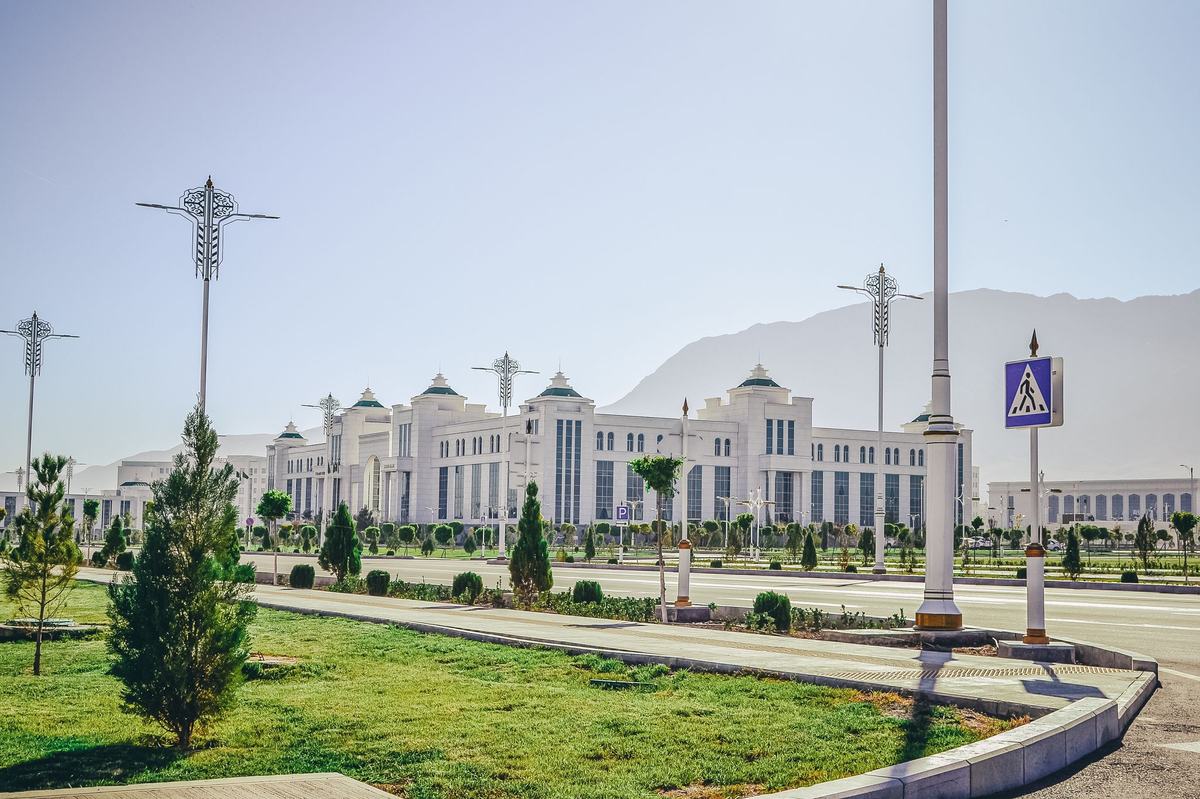
- Capital: Ashgabat, famous for its white marble buildings [1]
- Population: about 7 million [2]
- Area: 488,100 square kilometers, mostly the Karakum Desert [1]
- Official language: Turkmen [1]
- Currency: Turkmenistani manat (TMT)
- Distinguishing claim: home to the Darvaza gas crater, a fire that has burned for over fifty years [3]
Most people couldn't find Turkmenistan on a map. That's probably exactly how the government likes it. The country sits along the eastern edge of the Caspian Sea, ringed by Iran, Afghanistan, Uzbekistan, and Kazakhstan, and getting a tourist visa is harder than for almost any nation on Earth. Inside, there's a desert the size of Germany, a capital built almost entirely from imported Italian marble, and a hole in the ground that has been on fire since the Nixon administration. I had to look this up twice.
The Door to Hell
In 1971, Soviet engineers were drilling for natural gas in the Karakum Desert and hit a pocket of methane. The ground collapsed under their rig and left a crater about 70 meters across. To keep the gas from poisoning nearby villages, they lit it on fire, figuring it would burn off in a few weeks [3]. It is still burning today, more than fifty years later. Locals call it the Darvaza gas crater, or just the Door to Hell.
At night, you can see the glow from miles across the desert. The pit roars. The sand around it is hot to the touch. President Berdimuhamedov ordered the crater closed in 2010, and again in 2022, but nobody has actually figured out how to put it out. As of the most recent reports, the flames have shrunk significantly thanks to new gas-capture wells nearby, but the fire is still there [3]. It has become, almost by accident, the country's most famous landmark.
A Capital Built from White Marble
Ashgabat holds a Guinness World Record. The city has the highest concentration of white marble buildings on Earth, more than 500 of them [4]. After independence in 1991, the country's first president, Saparmurat Niyazov, decided to rebuild the capital as a kind of monument to himself and the new nation. He imported marble from Italy. He commissioned golden statues. He ordered streets so wide they look almost empty in photographs.
Niyazov called himself Türkmenbaşy, the "father of all Turkmen", and the cult of personality he built was something to see. He renamed the months of the year after himself and his mother. He banned lip syncing, ballet, and gold tooth caps. He wrote a spiritual guidance book called the Ruhnama and required every citizen, including schoolchildren and government workers, to study it. After he died in 2006, the country quietly walked some of this back. But the marble city is still standing, and his successors have added their own monuments since.
The Karakum Desert
About 70 percent of Turkmenistan is the Karakum, which means "Black Sand" in Turkmen [1]. It is one of the driest places in Asia. Summer temperatures regularly clear 110 Fahrenheit, and the desert receives less than 8 inches of rain a year. To make the land farmable, the Soviets built the Karakum Canal, one of the longest irrigation canals in the world, running roughly 1,400 kilometers from the Amu Darya river westward toward the Caspian.
Like the Aral Sea farther north, the canal came with a steep environmental cost. So much water was diverted from the Amu Darya that the river barely reaches the Aral anymore, and salt has crept into the irrigated fields. But the canal also turned parts of southern Turkmenistan into cotton country, and cotton, along with natural gas, became the spine of the economy.
Sitting on a Sea of Gas
Turkmenistan holds the fourth-largest natural gas reserves in the world, behind only Russia, Iran, and Qatar [5]. The Galkynysh field, in the southeast, is one of the largest single gas fields ever discovered. Most of this gas now flows east to China, which built a long pipeline across Central Asia in the 2000s and has been the country's main customer ever since.
That gas wealth shows up unevenly. Ashgabat has gleaming marble apartment blocks, fountains, and a giant Ferris wheel enclosed in a glass dome. Outside the capital, much of the country lives a far more modest life, with widespread shortages of basics like flour and cooking oil reported in recent years. For a long time, citizens received free electricity, gas, water, and salt, a perk introduced by Niyazov, but these subsidies were gradually phased out in the late 2010s.
The Akhal-Teke Horse
Turkmenistan's national symbol is a horse, and not just any horse. The Akhal-Teke is one of the oldest breeds in the world, prized for endurance and for a metallic coat that genuinely shimmers gold in the sun. The breed has been kept in this region for at least 3,000 years and likely contributed to the bloodlines of the modern Thoroughbred [6].
Every April the country celebrates a Day of the Turkmen Horse with parades, beauty contests, and races. The president, traditionally a serious horse enthusiast, often rides one personally. There are estimated to be only a few thousand purebred Akhal-Tekes left in the world, and Turkmenistan treats them as a kind of living national treasure.
A Closed Country
Turkmenistan is one of the most isolated nations on the planet. Press freedom rankings put it consistently near the very bottom, alongside North Korea and Eritrea. Internet access is heavily filtered. Independent journalism inside the country is effectively impossible. Foreign visitors generally need a tour-company sponsor and a fixed itinerary to enter at all, and many travel bloggers who have made it in describe being followed by minders.
And nobody talks about this, but the country has a quieter side too. Old caravan-stop ruins from the Silk Road, like the city of Merv, dot the desert. Merv was once one of the largest cities in the world, before the Mongols destroyed it in 1221. The ruins are now a UNESCO World Heritage site, sitting nearly empty under a huge sky. That gap between what was and what is now is the most interesting thing about Turkmenistan once you actually look.
Frequently Asked Questions
Is it safe to travel to Turkmenistan?
Turkmenistan is generally physically safe, with low rates of street crime against tourists. The bigger issue is access: visas are difficult to obtain and most independent travel is not permitted. Visitors are typically required to travel with a state-approved tour operator and may be subject to surveillance.
What language do people speak in Turkmenistan?
Turkmen is the official language and is spoken by most of the population. Russian is still common in business and among older urban residents, a legacy of the Soviet era. Turkmen is written in a modified Latin alphabet, having switched from Cyrillic in the 1990s.
What is Turkmenistan famous for?
Turkmenistan is best known for the Darvaza gas crater, a methane pit that has burned continuously since 1971. It is also known for its white marble capital Ashgabat, its enormous natural gas reserves, the Akhal-Teke horse breed, and being one of the most closed societies in the world.
What religion is practiced in Turkmenistan?
The majority of Turkmen are Sunni Muslims, though religious practice tends to blend Islam with older Turkic and nomadic traditions. The government tightly controls religious organizations and unregistered worship is restricted. Small Russian Orthodox and other minority communities also exist, mainly in cities.
How big is Turkmenistan compared to other countries?
Turkmenistan covers about 488,100 square kilometers, making it slightly larger than California and roughly the same size as Spain. About 70 percent of that land is the Karakum Desert. The population is only around 7 million, so much of the country is sparsely inhabited.
Sources
- The World Factbook: Turkmenistan (CIA)
- World Bank: Turkmenistan Country Profile
- National Geographic: Darvaza Gas Crater, the Door to Hell
- Guinness World Records: Highest concentration of white marble-clad buildings
- BP Statistical Review of World Energy: Natural Gas Reserves
- Encyclopaedia Britannica: Akhal-Teke Horse