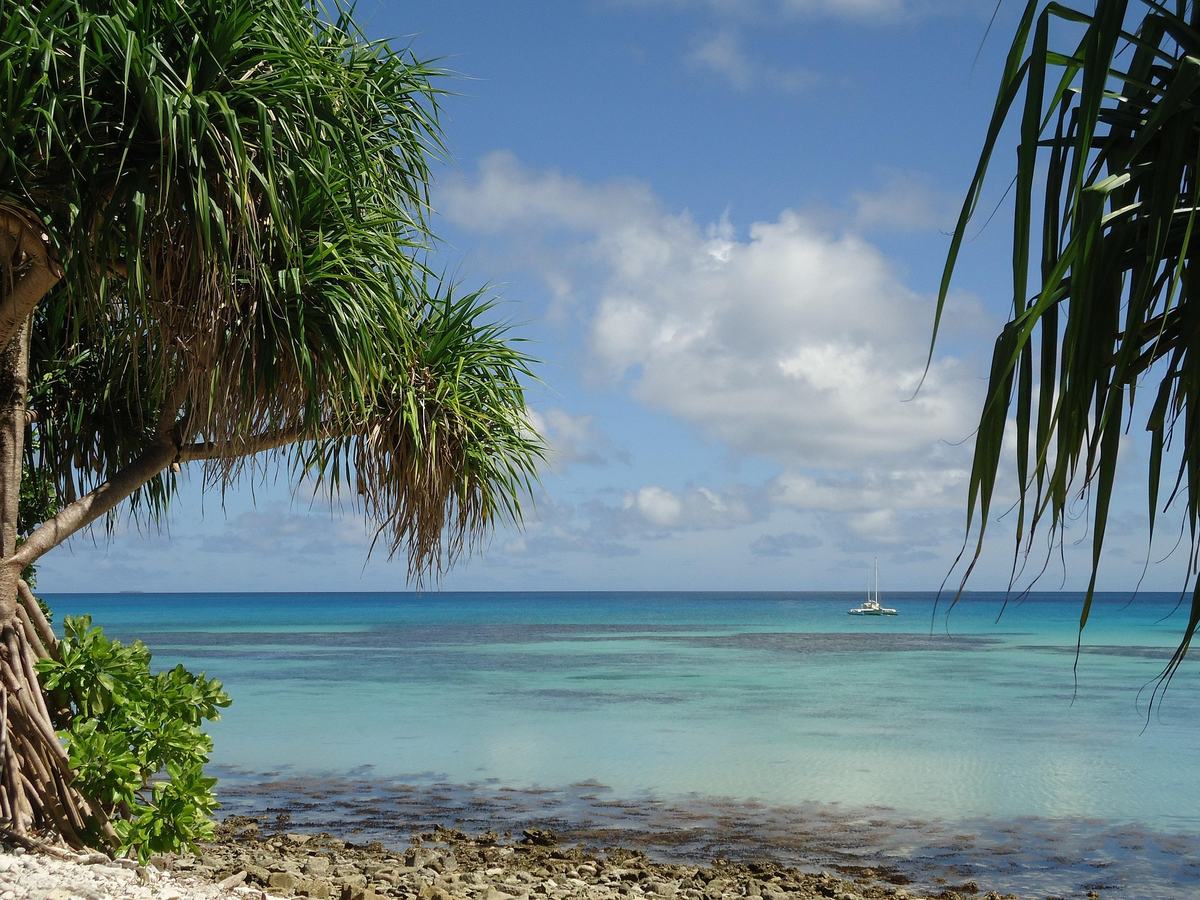
- Capital: Funafuti [1]
- Population: about 11,400 (2023 estimate) [1]
- Area: 26 square kilometers (10 sq mi), making it the fourth-smallest country on Earth [1]
- Official languages: Tuvaluan and English [1]
- Currency: Tuvaluan dollar and Australian dollar (both in circulation) [1]
- Distinguishing claim: Owns the .tv internet domain, which provides a significant share of national revenue [2]
Most people couldn't find Tuvalu on a map. That's partly because it's nine tiny islands scattered across the Pacific, and partly because on a lot of maps it doesn't really fit. I had to look this up twice when I first read about it. The whole country is smaller than the airport in Atlanta. And yet it has a flag at the UN, a national soccer team, and a plan to outlive the rising ocean by becoming a digital nation. Turns out the smallest places sometimes have the biggest ideas.
A Country Smaller Than Most American Towns
Tuvalu's total land area is 26 square kilometers [1]. To put that in perspective, the city of Bozeman, Montana, where I once spent a weekend that turned into a week, covers about 50 square kilometers. So you could fit two Tuvalus inside one mid-sized American college town and still have room for the parking lots.
The country is made up of three reef islands and six true atolls strung out over 420 miles of ocean [1]. The highest natural point on any of them is about 4.6 meters above sea level [1]. Which, if you think about it, means there is no hill in Tuvalu. No real one. The whole country is basically a sandbar with palm trees and a runway.
That runway, by the way, doubles as a public park. In the evenings on Funafuti, the main atoll, kids play soccer on it, families have picnics, and people jog around the edges. A plane lands twice a week and everyone clears off. Then it goes right back to being a park.
The .tv Domain Goldmine
Here's the thing about being a country, even a tiny one: you get a two-letter internet code. When the internet was being parceled out in the 1990s, Tuvalu drew .tv. Nobody on the islands chose it. It just happened. But "tv" turned out to be one of the most valuable two-letter combinations in the world because, well, television.
Streaming services, gaming platforms (Twitch.tv being the obvious one), and broadcasters all wanted .tv addresses. Tuvalu started licensing the domain in 2000 and the money has been flowing in ever since [2]. Recent reporting suggests the domain brings in roughly $10 million a year, which is a huge slice of national revenue for a country of 11,400 people [2]. It funds schools, paved roads, scholarships, and the country's UN dues.
And nobody talks about this, but Tuvalu joined the UN in part because the income from .tv made it possible to afford the membership fees in the first place. A two-letter code, accidentally assigned, became national infrastructure.
The First Digital Nation
Tuvalu's land sits, on average, about two meters above the sea. Climate models project that within decades, much of it could be uninhabitable or underwater [3]. The country has been raising the alarm at every international climate summit it can reach.
In 2022, the foreign minister gave a speech at COP27 standing knee-deep in seawater, where dry land used to be. The next year, Tuvalu announced something I genuinely hadn't seen before: it would build a digital twin of itself. Every island, every village, every cultural artifact, scanned and uploaded, so that if the physical country goes under, the nation, its laws, its identity, its statehood, persists in a virtual form [3].
Whether that's a metaphor or a serious legal claim is still being worked out by international lawyers. But the move forced a real question into the conversation: can a country exist without territory? Tuvalu is not waiting around for the answer.
Culture Built Around the Ocean
Tuvaluan culture is communal in ways that feel almost foreign to an American raised on driveways and front lawns. Most villages still operate by a system called falekaupule, where decisions are made by gathering, talking, and reaching consensus rather than voting [4]. Land is mostly held by extended families, not individuals.
Music and dance hold the social fabric together. The fatele is a group song-dance performed sitting on mats around a wooden box used as a drum, with the tempo building until everyone is clapping and the singers are nearly shouting. It happens at weddings, funerals, holidays, and the arrival of important guests. There is no Tuvaluan equivalent of a quiet dinner party.
The diet leans heavily on fish, coconut, breadfruit, and pulaka (a swamp taro grown in pits dug into the coral). Imported rice and canned food have crept in over the decades, but a family meal on Funafuti still often starts with someone walking down to the lagoon at dawn.
Frequently Asked Questions
Where is Tuvalu located?
Tuvalu is a small island nation in the South Pacific Ocean, roughly midway between Hawaii and Australia. It consists of nine islands and atolls and is one of the most remote countries in the world. Its nearest neighbors are Kiribati to the north and Fiji to the south [1].
How does Tuvalu make money?
Tuvalu's economy relies on three main streams: licensing fees from its .tv internet domain (worth roughly $10 million a year), fishing license sales to foreign fleets, and foreign aid [2]. Remittances from Tuvaluans working overseas also play a major role in household income.
Is Tuvalu really sinking?
Tuvalu is among the most exposed countries on Earth to sea-level rise, with its highest point only about 4.6 meters above sea level [1]. Scientific projections suggest substantial parts of it may become uninhabitable within decades, which is why the government is preparing both physical adaptations and a digital national archive [3].
What language do people in Tuvalu speak?
Tuvaluan and English are both official languages. Tuvaluan, a Polynesian language related to Samoan, is the everyday language at home and in villages. English is widely used in government, schools, and business [1].