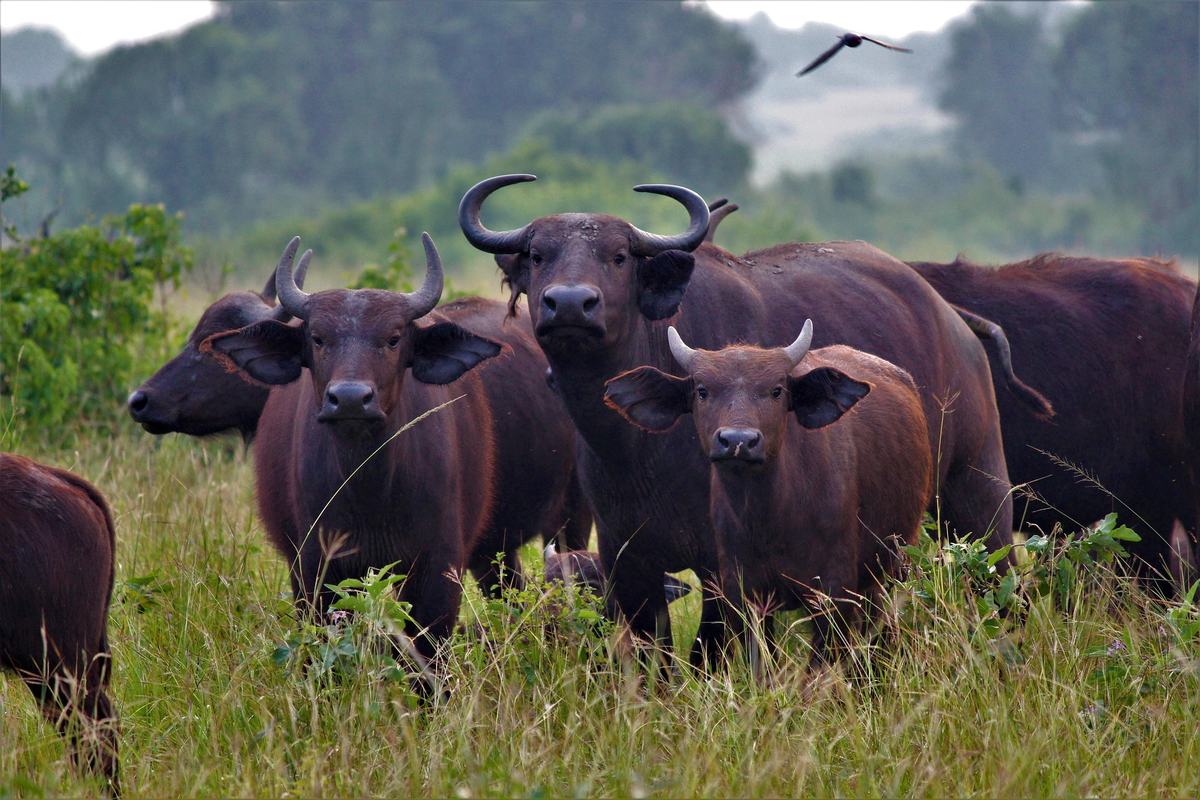
- Capital: Kampala [1]
- Population: about 48.6 million (2024 estimate) [2]
- Area: 241,038 square kilometers (93,065 sq mi) [1]
- Official languages: English and Swahili (with Luganda widely spoken) [1]
- Currency: Ugandan shilling (UGX) [1]
- Home to roughly half of the world's remaining mountain gorillas [3]
I grew up thinking the Nile started somewhere dramatic, like a thunderclap from a glacier. Then I read that the longest river on Earth actually trickles out of a calm lake in southern Uganda, and I had to look this up twice. The water that eventually carves through Egypt and meets the Mediterranean begins as a quiet ripple at Jinja, on the northern shore of Lake Victoria. That's the kind of place Uganda is. Big stories with quiet starting points.
A Country That Sits on the Equator
Uganda straddles the equator, and they actually mark it. There's a painted line, a couple of concrete monuments, and the obligatory souvenir stand near the town of Kayabwe, about 75 kilometers southwest of Kampala. Tourists stand with one foot in each hemisphere and take the photo. Locals shrug and keep walking.
What's wild is how much landscape gets packed into a country that sits squarely on that line. You'd expect uniform tropical heat. Instead, Uganda has snowcapped mountains. The Rwenzori range, sometimes called the Mountains of the Moon, climbs above 5,000 meters and holds glaciers right there on the equator. Those glaciers are shrinking fast, which is its own sad story, but for now you can still hike from steaming rainforest into snow in the span of a few days.
Winston Churchill's Famous Compliment
In 1908, Winston Churchill traveled through East Africa and later wrote a book called "My African Journey". He gave Uganda a line that has stuck for over a century: "the Pearl of Africa". He was talking about the colors, the lakes, the wildlife, the sheer density of beauty packed into a small space. Back home in Montana we measure things by how much sky you can see at once. Uganda measures by how much life fits in a single valley.
The country is roughly the size of Oregon, but it contains the source of the Nile, half a dozen national parks, two mountain ranges, ten distinct ecological zones, and more bird species (over 1,000) than the entire continental United States [4]. Birders fly in just to spend a week looking up.
The Source of the Nile
For most of the 1800s, European explorers were obsessed with finding where the Nile started. John Hanning Speke got there in 1858, stood on the shore of a vast inland sea, named it Lake Victoria after his queen, and declared this was it. Other explorers spent years trying to disprove him. He turned out to be right.
The river leaves the lake at Jinja and immediately goes to work. It cuts north through Uganda, drops over Murchison Falls (where the entire Nile squeezes through a gap about seven meters wide), and keeps going for another 6,000 kilometers before it reaches the sea. Jinja itself has become Uganda's adventure capital. White-water rafting, bungee jumping, kayaking. The Nile is shockingly fun before it becomes the Nile.
Mountain Gorillas in Bwindi
Uganda shares its mountain gorilla population with Rwanda and the Democratic Republic of the Congo. There are only about 1,063 of these animals left in the world, and roughly half live in Uganda's Bwindi Impenetrable National Park [3]. The name is honest. The forest is genuinely impenetrable in places, a tangled vertical jungle that's been growing more or less undisturbed for 25,000 years.
You can hike in with a guide and a tracker and sit a few meters from a gorilla family. The permits cost real money - $800 USD for foreigners - and that's by design. The fees fund the conservation work that brought this species back from the brink. In the early 1980s there were fewer than 250 mountain gorillas left on Earth. Now there are over a thousand, and the population is slowly climbing. It's one of the rare good-news conservation stories.
A Country of Many Languages and One Young Population
Uganda recognizes 56 languages [1]. English is official, Swahili is official, and Luganda is the lingua franca of the central region around Kampala. But out in the villages, people speak Acholi, Lango, Runyankole, Lugbara, Ateso, Karamojong, and dozens more. Radio stations broadcast in different languages depending on the region.
The other thing about Uganda that stops you cold: it has the youngest population on the planet. The median age is about 16.7 years [2]. Roughly half the country hasn't started high school. That demographic reality shapes everything - the music, the politics, the energy on the streets of Kampala, the boda-boda motorcycle taxis weaving through traffic at 11pm because the city never really winds down.
Food, Markets, and the Matoke Question
Ugandans eat a lot of matoke, which is a green cooking banana steamed and mashed into something like a savory porridge. It's the staple in much of the country. You'll also find posho (a stiff cornmeal), groundnut stew, fresh tilapia from Lake Victoria, and rolex - which is not a watch but a chapati rolled around eggs and vegetables, sold from sidewalk stands all over the country. Kampala's street food culture is one of the great cheap pleasures in East Africa.
Coffee is a huge deal here too. Uganda is the second-largest coffee producer in Africa and the world's leading exporter of robusta beans. Most of what you drink at a generic American chain coffee shop probably has Ugandan robusta blended in somewhere.
Frequently Asked Questions
What is Uganda famous for?
Uganda is best known as the source of the Nile, home to roughly half the world's mountain gorillas in Bwindi Impenetrable National Park, and as the country Winston Churchill called "the Pearl of Africa". It's also famous for its incredible biodiversity, with over 1,000 bird species packed into a country the size of Oregon.
Where does the Nile River start?
The White Nile, the longest tributary of the Nile, begins at Jinja in southern Uganda, where it flows out of Lake Victoria. From there it travels roughly 6,000 kilometers through South Sudan, Sudan, and Egypt before emptying into the Mediterranean Sea. John Hanning Speke identified this source in 1858.
What language do Ugandans speak?
Uganda has two official languages, English and Swahili, but recognizes 56 indigenous languages in total. Luganda is the most widely spoken local language, especially around Kampala. Most educated Ugandans are multilingual, often speaking English, Swahili, and one or two regional languages.
Is Uganda safe for tourists?
Uganda is generally considered safe for tourists, particularly in the main tourism circuit including Kampala, Jinja, Bwindi, Queen Elizabeth National Park, and Murchison Falls. Standard travel precautions apply, and visitors should check current advisories for the northern border region. Gorilla trekking and wildlife safaris are well-regulated.
What is the capital of Uganda?
Kampala is the capital and largest city of Uganda, with a metropolitan population of roughly 3.6 million people. The city is built across several hills and serves as the country's commercial, political, and cultural center. It sits about 75 kilometers north of the equator.