- Capital: Abu Dhabi [1]
- Population: about 10.2 million, with citizens making up roughly 11 percent [2]
- Area: 83,600 square kilometers, slightly smaller than Maine [1]
- Official language: Arabic, with English widely used in business [1]
- Currency: UAE dirham (AED), pegged to the US dollar since 1997 [3]
- Distinguishing claim: A federation of seven emirates that only became a single country in December 1971 [1]
Here is something that still surprises me. The United Arab Emirates, the country with the tallest building in the world and an airline that flies almost everywhere, is younger than my parents. It was founded on December 2, 1971, when six emirates signed a federation agreement and a seventh, Ras Al Khaimah, joined a couple of months later [1]. That is the entire timeline. Fifty-something years from a string of small Gulf ports to whatever Dubai is now.
I had to look this up twice. The pace of it is hard to wrap your head around. People who were born in mud-brick houses along the Trucial Coast are now grandparents watching their grandkids ride driverless metros. The old country has not vanished though. It is right there underneath, in the falcons, the dhows, the pearl shops in the old souks. That is the part most travelers miss.
Seven Emirates, One Federation
The UAE is not a single kingdom or a single city-state. It is a federation of seven emirates, each ruled by its own hereditary emir, who together elect a federal president. The seven are Abu Dhabi, Dubai, Sharjah, Ajman, Umm Al Quwain, Ras Al Khaimah, and Fujairah [1]. Abu Dhabi is the largest by far, holding about 87 percent of the country's land area and most of its oil reserves [4]. Dubai is the smallest of the big three by area but the most famous abroad.
Each emirate has its own personality. Sharjah is the cultural one, with museums, calligraphy, and an alcohol ban that still holds. Fujairah faces the Gulf of Oman rather than the Persian Gulf, so it has actual mountains and a different climate. Ras Al Khaimah is going hard on adventure tourism and has the world's longest zipline running off Jebel Jais [5]. Ajman and Umm Al Quwain are quieter, smaller, and feel a lot like the country looked thirty years ago.
The federal structure means that some things, like foreign policy and the military, are decided at the national level. Others, like land laws and licensing, are still up to each emirate. Which, if you think about it, is why a bottle of wine that is legal in a Dubai hotel might be a problem if you carry it into Sharjah next door.
Oil Changed Everything in a Generation
Before oil, the coast lived on pearls, fish, dates, and trade. Pearl diving in particular was the backbone of the economy from the late 1700s into the 1930s, when Japanese cultured pearls collapsed the market and the Great Depression finished off what remained [6]. Old men in Dubai still tell stories about uncles who dove on a single breath of air to 30 meters and came up bleeding from the ears.
Oil was discovered in commercial quantities in Abu Dhabi in 1958 and in Dubai in 1966 [4]. Exports started in 1962. Within a single generation, the country went from selling pearls and dried fish to sitting on the seventh-largest proven oil reserves on the planet [4]. The leadership that emerged, especially Sheikh Zayed bin Sultan Al Nahyan of Abu Dhabi, made a deliberate choice to plow the revenue into roads, schools, hospitals, and eventually airports and tourism. Sheikh Zayed is the founding father here, and his face is on everything from currency to highway billboards. Citizens speak about him the way Americans speak about Lincoln, which is to say with a tone that does not allow for jokes.
A Skyline That Did Not Exist Twenty-Five Years Ago
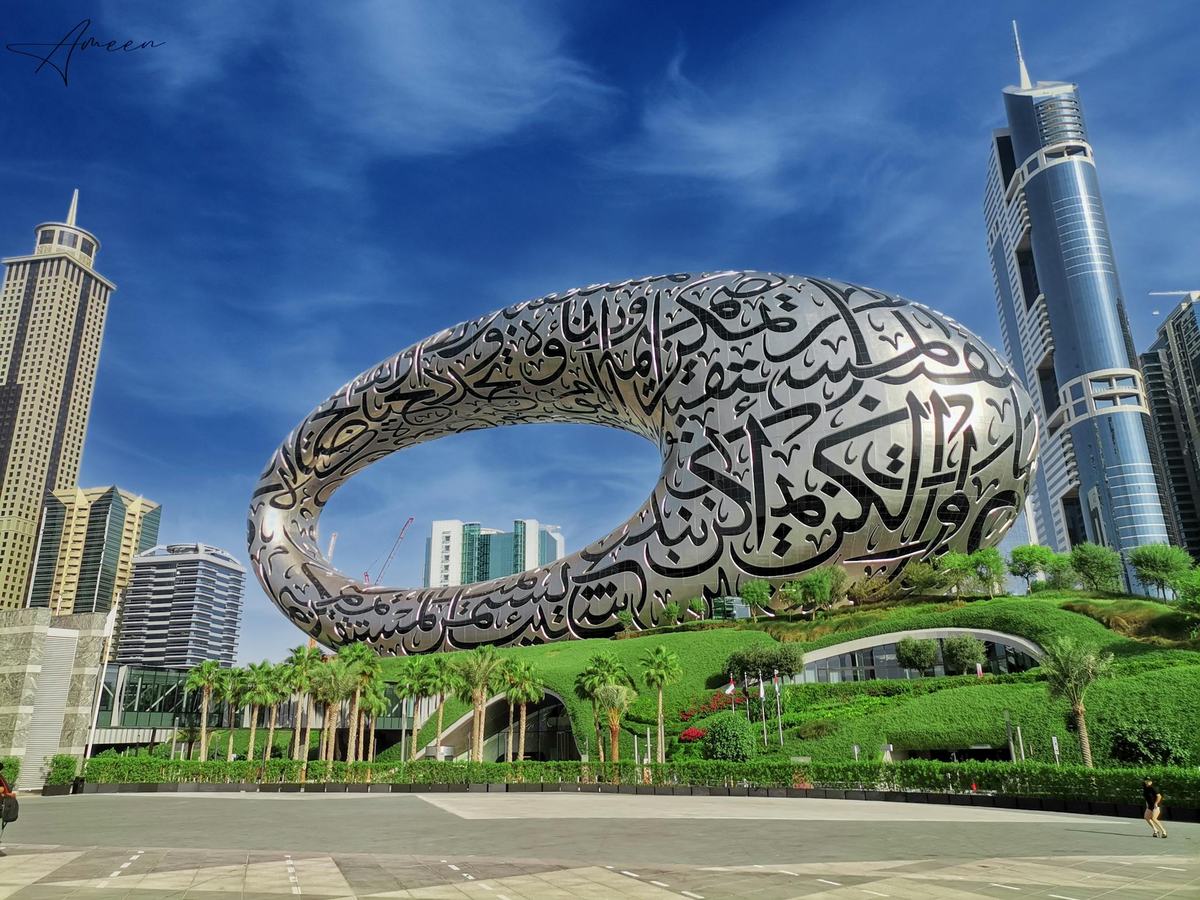
The Burj Khalifa is the world's tallest building at 828 meters, finished in 2010 [7]. It is over 60 percent taller than the previous record holder, Taipei 101, which is a margin that almost never happens in skyscraper history. The Burj Al Arab, the sail-shaped hotel built on its own artificial island, opened in 1999. The Palm Jumeirah, an artificial island shaped like a palm tree, started construction in 2001. None of it existed when I was a kid.
Dubai has roughly 200 buildings over 150 meters tall, more than New York [7]. The metro system, which opened in 2009, is fully automated and driverless. The airport is the busiest in the world for international passenger traffic and has been for over a decade [8]. The whole place runs at a tempo that takes some getting used to. Back home in Montana, you can drive for an hour and not see a stoplight. In Dubai, you can stand at one intersection and count more cranes than I saw cars in my hometown growing up.
The Older Country Underneath
Strip away the towers and there is a culture that has been on that coast for a very long time. Falconry is the national sport and a UNESCO-recognized cultural practice [9]. Working falcons get their own passports, fly in airline cabins on dedicated perches, and have a federal hospital in Abu Dhabi that treats around 11,000 birds a year. The hospital does cataract surgery and beak repair on patients that cost more than a car.
Coffee culture is older than oil and stricter than you would expect. Arabic coffee, gahwa, is served in tiny handle-less cups from a long-spouted brass pot called a dallah. You take three small cups, never more, and gently shake the empty cup side to side to signal you are done. Refuse the wrong way and you will get a fourth pour before you can blink. The whole ritual is on the UNESCO Intangible Cultural Heritage list [9].
The Arabian oryx, which once went extinct in the wild, was reintroduced largely through UAE-led breeding programs. It is now the national animal and shows up on coins and the Etihad Airways tail. The desert outside Abu Dhabi has wild herds again [9].
A Crossroads in Every Direction
About 88 percent of UAE residents are foreign nationals [2]. Walk through any neighborhood in Dubai and you can hear Hindi, Urdu, Tagalog, Arabic, English, Mandarin, Russian, and a half dozen other languages inside ten minutes. South Asians make up the largest share of the population by far. The country runs on this labor force, and the relationship between citizens and expatriates is one of the defining facts of modern Emirati life.
Geographically, the UAE sits at one of the busiest maritime crossroads on the planet. The Strait of Hormuz, just off Fujairah's coast, sees about 20 percent of the world's oil shipments pass through it [10]. Jebel Ali in Dubai is the largest port between Europe and Singapore. Dubai International airport connects more cities than almost any other hub on earth.
The federation works because it leans into being a crossroads instead of fighting it. That, more than the towers or the malls, is probably the most interesting fact about the place. A country that did not exist in 1970 figured out how to be useful to almost everyone, and built itself accordingly.
Frequently Asked Questions
Is the United Arab Emirates a country or seven countries?
The UAE is one country, a federation made up of seven emirates that each keep their own ruler. Foreign policy, defense, and currency are handled at the federal level, while local laws like alcohol licensing differ from one emirate to the next. It was formed in December 1971.
What language do people speak in the UAE?
Arabic is the official language, but English is the everyday language of business, hospitality, and most daily life because foreign residents outnumber Emirati citizens by roughly eight to one. Hindi, Urdu, Tagalog, and Malayalam are also widely spoken thanks to the large South Asian and Filipino communities.
Is Dubai the capital of the United Arab Emirates?
No. The capital is Abu Dhabi, which is also the largest emirate by land area and the seat of the federal government. Dubai is the most internationally famous emirate and the country's commercial hub, which is why people often confuse the two.
How old is the UAE as a country?
The UAE was founded on December 2, 1971, which makes it just over fifty years old. Before that, the area was known as the Trucial States, a group of sheikhdoms under British protection. Ras Al Khaimah joined the federation a couple of months after the original six.
Is the UAE safe for tourists?
The UAE consistently ranks among the safest countries in the world for travelers, with very low rates of violent crime. Visitors should be aware that local laws on alcohol, public conduct, and photography are stricter than in most Western countries, and they apply equally to tourists.
Sources
- United Arab Emirates - The World Factbook
- UAE Population Estimates - Federal Competitiveness and Statistics Centre
- Central Bank of the UAE - Monetary Policy
- UAE Country Analysis Brief - U.S. Energy Information Administration
- Jebel Jais - Ras Al Khaimah Tourism Development Authority
- Pearl Diving in the Gulf - UNESCO Intangible Cultural Heritage
- Burj Khalifa - Council on Tall Buildings and Urban Habitat
- Dubai International Airport Traffic Statistics - Dubai Airports
- Falconry, a living human heritage - UNESCO
- The Strait of Hormuz - U.S. Energy Information Administration