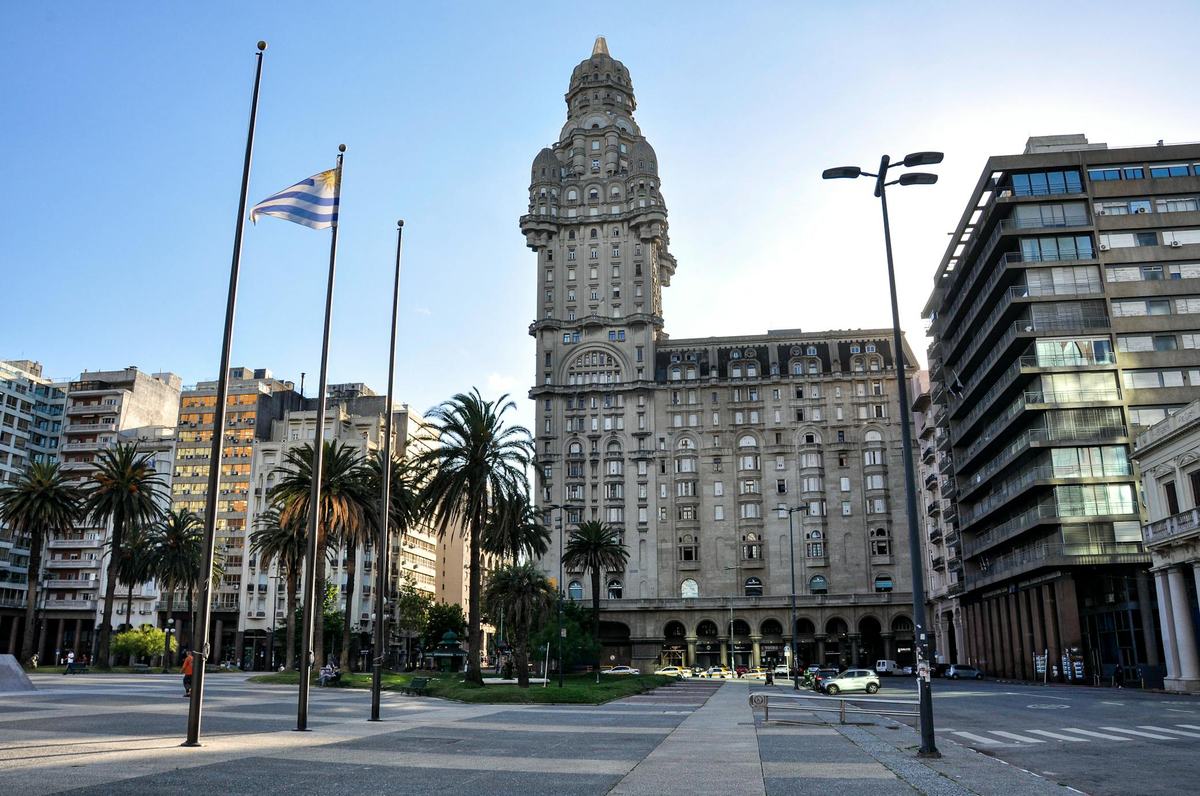
- Capital: Montevideo [1]
- Population: roughly 3.4 million (2023 estimate) [1]
- Area: 176,215 square kilometers (about the size of Washington State) [1]
- Official language: Spanish [1]
- Currency: Uruguayan peso (UYU)
- Distinguishing claim: generates around 98% of its electricity from renewable sources in a typical year, one of the highest shares on Earth [3]
I had to look this up twice. A country of fewer people than Los Angeles, wedged between Argentina and Brazil like a footnote, was the first in the world to fully legalize cannabis. It elected a president in 2010 who lived on a flower farm, drove a 1987 Volkswagen Beetle, and gave away most of his salary. It runs almost entirely on wind, sun, and water. And on any given Sunday afternoon, half the country is grilling beef in someone's backyard while sipping mate from a hollowed-out gourd.
Most Americans I know couldn't place Uruguay on a map if you spotted them three guesses. That's their loss.
A Country Built by Immigrants on Cattle Country
Uruguay's population is small but distinctly European in heritage. Spaniards and Italians arrived in waves through the 19th and early 20th centuries, joined by smaller communities of Germans, French, Russians, Lebanese, and Armenians. Walk through Montevideo's old city and you'll see Art Deco facades next to colonial Spanish ones, with pasta shops on the same block as a parrilla that's been grilling short ribs since World War II.
Cattle came first, though. The Spanish brought cows in the 1600s, and the animals thrived on the open grasslands so completely that for centuries Uruguay was essentially one enormous ranch. There are still roughly four cows for every person in the country, and Uruguay exports beef to over 100 countries [1]. The national obsession with asado, a long slow grill of every cut of beef imaginable, isn't a tourist gimmick. It's Sunday lunch.
The Smallest Country in South America That Isn't a Territory
Uruguay is, by area, the second-smallest sovereign country on the South American continent, after Suriname. It's the smallest Spanish-speaking nation in South America. Almost the entire country is gently rolling grassland, called the pampas in the south and the Cuchilla in the interior. The highest point, Cerro Catedral, is 514 meters tall. Back home in Montana, you'd call that a hill and probably name it after a rancher.
The whole country is essentially coast, river, or pasture. The Atlantic shoreline runs nearly 700 kilometers from the Brazilian border down to the wide mouth of the Río de la Plata, where the country effectively dissolves into one of the broadest river estuaries in the world. Montevideo sits on this estuary, not on the open ocean, which is why locals will argue with a straight face about whether the city is a beach town.
Mate Is Not a Drink. It's an Identity.
Uruguayans drink more yerba mate per capita than any country on Earth, including Argentina [2]. You'll see people walking down the street with a thermos tucked under one arm and a wooden or metal gourd in the hand, sipping through a metal straw called a bombilla. They drink it at work, on the bus, at the beach, on construction sites, and in the parliament chamber.
The ritual matters. You fill the gourd with loose yerba leaves, pour hot but not boiling water in slowly, and pass it around the circle. Everyone drinks from the same straw. Refilling for the next person is part of the social contract. If you refuse a sip, you'd better have a good reason. The whole ceremony is a quiet, repeating signal that says, "We have time for each other".
The President Who Lived on a Farm
Between 2010 and 2015, Uruguay was led by José Mujica, a former guerrilla turned senator turned head of state. He refused to live in the presidential palace, stayed at his small flower farm outside Montevideo, and donated roughly 90% of his salary to charity and to small entrepreneurs. He drove himself to work in an old VW Beetle. International media called him "the world's humblest president". Uruguayans mostly just called him Pepe.
Under Mujica, Uruguay legalized same-sex marriage, legalized abortion, and became the first country in the world to fully legalize and regulate the production and sale of cannabis. The cannabis law took effect in 2013, and pharmacies began selling state-controlled marijuana to registered adults in 2017 [4]. The point wasn't to encourage drug use. The point was to bankrupt the illegal market by taking it over. Whether it worked is still debated. That a country of three million quietly ran the experiment first, ahead of every wealthier nation on the planet, is the part that sticks with me.
Almost All the Power Comes From Wind, Sun, and Water
This is the fact I keep coming back to. In a typical year, Uruguay generates about 98% of its electricity from renewable sources. Wind alone supplies more than a third of national consumption [3]. There are very few oil reserves in the country and not much hydroelectric capacity beyond a handful of large dams on the Negro and Uruguay rivers, so by the early 2000s the country was importing expensive fossil fuels and going broke on electricity. A decade of aggressive policy reform later, wind farms were sprouting across the grasslands, solar arrays were being added by farmers and cooperatives, and the country had reinvented its grid almost from scratch.
And nobody talks about this, but Uruguay did it without subsidies in the conventional sense. The government signed long-term contracts with private developers, gave them stable rules, and let the open pampas do the rest. A country with no oil and no mountains turned itself into a clean-energy laboratory.
A Quiet Place to Live, By Design
Uruguay consistently ranks at or near the top of South American countries on measures of democratic health, press freedom, and quality of life. It scores high on the Human Development Index for the region and has one of the strongest middle classes in Latin America [5]. Crime exists, but homicide rates are far below those of its larger neighbors. Health care is broadly accessible. Education is free, including university.
None of this means the country is paradise. Inflation, public debt, and rural-urban inequality are real concerns. Younger Uruguayans sometimes leave for jobs in Argentina, Spain, or the United States. But the underlying social bargain, the sense that the country is a project shared by everyone who lives in it, holds up better here than in most places I've read about.
Frequently Asked Questions
What language is spoken in Uruguay?
Spanish is the official and dominant language of Uruguay. The local variety, called Rioplatense Spanish, is shared with Argentina and has a distinctive accent influenced by Italian immigration. Near the Brazilian border, a mixed Spanish-Portuguese dialect called Portuñol is also commonly spoken in everyday life.
Is Uruguay a safe country to visit?
Uruguay is one of the safer countries to visit in South America. Violent crime is uncommon by regional standards, and tourists generally have positive experiences. Petty theft can occur in parts of Montevideo and at busy beach resorts in summer, so the usual precautions about valuables and crowded areas apply.
What is Uruguay famous for?
Uruguay is famous for beef, soccer, yerba mate, and progressive social policy. It won the first FIFA World Cup in 1930 and has produced legendary players from a tiny population. It was also the first country to fully legalize cannabis and runs almost entirely on renewable electricity.
What currency is used in Uruguay?
The currency is the Uruguayan peso, abbreviated UYU and shown locally with a dollar sign. US dollars are widely accepted in tourist areas and for large purchases like real estate, but daily transactions, restaurants, and supermarkets are paid in pesos. Cards and contactless payments are common in cities.
Is Uruguay a good country to retire to?
Uruguay is often listed among the better South American destinations for retirees. It offers political stability, accessible health care, a temperate climate, and a permanent residency program that is friendlier than in most neighboring countries. Coastal towns like Punta del Este and Colonia draw a sizeable expatriate community.