- Capital: Tashkent [1]
- Population: about 36.4 million (2024 estimate) [1]
- Area: 447,400 square kilometers (172,700 square miles) [1]
- Official language: Uzbek (Russian widely spoken) [1]
- Currency: Uzbekistani som (UZS) [1]
- One of only two doubly landlocked countries in the world [2]
Here's something that'll ruin the next geography quiz you take: Uzbekistan is one of only two countries on the planet that's "doubly landlocked". That means it has no coastline, and every single one of its neighbors is also landlocked. To get to an ocean from Tashkent, you have to cross at least two borders. The only other country with this geographic quirk is Liechtenstein, which is the size of a national park back home. Uzbekistan, by contrast, is bigger than California. It sits in the middle of Central Asia like the pit of a peach, surrounded by Kazakhstan, Kyrgyzstan, Tajikistan, Afghanistan, and Turkmenistan. And yet, for most of human history, the world came to its door anyway.
The Silk Road Cities Are Still Standing
Most countries lose their old places. Wars, fires, redevelopment, time. Uzbekistan somehow held on to three of the great Silk Road cities, and you can still walk through them. Samarkand, Bukhara, and Khiva were not just stops on a trade route. They were destinations. Caravans hauling silk from China and spices from India aimed for these markets the way modern shipping aims for Rotterdam.
Samarkand's Registan square might be the most photographed spot in Central Asia, and the reason is simple. Three madrasas, built between the 15th and 17th centuries, face each other across an open plaza, their facades covered in turquoise tilework that still looks freshly fired. Tamerlane, the conqueror who built his empire from here, is buried a few blocks away under a fluted dome of the same blue. Locals will tell you the dome was the model for the Taj Mahal, and they're not wrong - the Mughals who built the Taj traced their ancestry directly back to Tamerlane [3].
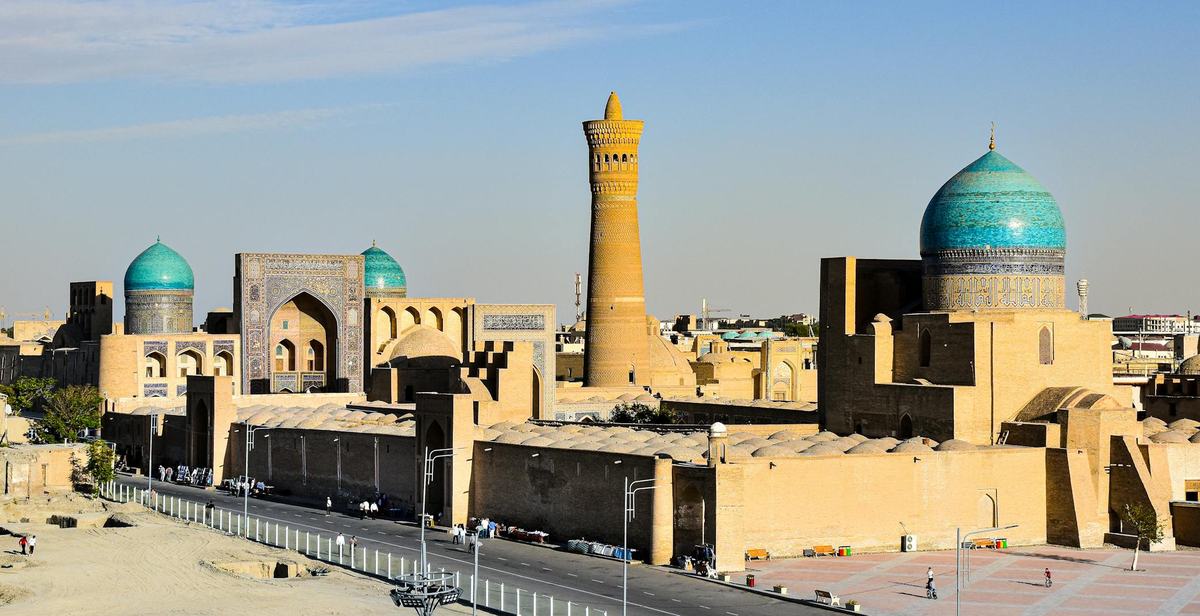
Bukhara is older and quieter. Its historic center has more than 140 protected monuments crammed into about 270 hectares, and UNESCO classifies the whole city as one continuous heritage site [4]. You can stand in a square that's been a marketplace for a thousand years and buy a melon from a guy whose family has probably been selling melons there for ten generations.
Khiva Is Basically a Museum You Can Live In
Khiva is the strangest of the three. The old walled city, Itchan Kala, is so well preserved that the whole thing was the first site in Uzbekistan to make the UNESCO list, back in 1990 [4]. Walk through the gate and you're inside roughly 26 hectares of mud brick walls, minarets, madrasas, and palaces, almost all of it predating the United States.
The thing about Khiva is that people still live inside the walls. It's not a theme park. Kids ride bikes past 18th century mosques. Old men play chess in the shadow of the unfinished Kalta Minor minaret, which was supposed to be the tallest in the Islamic world before its sponsor died and the project just stopped. The half-finished tower has been sitting there, tiled and stubby, since 1855. Nobody bothered to either finish it or take it down. I had to look this up twice.
The Aral Sea Disaster
Not every fact about Uzbekistan is charming. In the 1960s, the Aral Sea was the fourth largest inland body of water on Earth. By 2014, the eastern lobe had completely dried up. By any measure, this is one of the worst environmental catastrophes of the modern age, and it happened because of irrigation.
Soviet planners diverted the two rivers that fed the Aral - the Amu Darya and the Syr Darya - to grow cotton in the desert. Cotton needs a staggering amount of water, and the rivers were essentially drained before they could reach the sea. The sea shrank by more than 90 percent. Fishing villages that had boats in the harbor in 1960 now sit 100 kilometers from the nearest water [5]. There's a town called Moynaq where rusted trawlers still sit on what used to be the seafloor, sand drifting around their hulls.
The toxic dust from the dried lakebed - laced with salt, fertilizer, and pesticide residue - blows across Karakalpakstan and into the lungs of everyone living there. Uzbekistan has been working on restoration efforts and has planted millions of saxaul trees to stabilize the dust, but the eastern Aral isn't coming back. Some things you don't get to undo.
Cotton, Bread, and a Country That Feeds Itself
Cotton drove the disaster, but it also still drives a lot of the economy. Uzbekistan is among the top ten cotton producers in the world, and for decades the government ran a forced labor system where students, teachers, and public employees were pulled out of their jobs every fall to pick cotton by hand. International pressure and reform inside the country largely ended that practice by 2022, and the International Labour Organization confirmed that systemic forced labor in the harvest had been eliminated [6].
Food is its own story. Uzbek cuisine is built around plov - rice cooked with carrots, onions, meat, and sometimes chickpeas or raisins in a massive cast iron kazan. Every region has its own version, and arguing about whose plov is best is a national sport. There's a place in Tashkent called the Central Asian Plov Center where they cook plov in pots so big you could bathe a toddler in them. People line up around the block by noon.
Bread is sacred. Uzbek non, a round flatbread stamped with intricate patterns, is never placed upside down. Setting a loaf face down is considered bad luck, and you'll see it laid carefully on tables, propped on its edge against a wall, anything to keep it right side up. The patterns are pressed with a chekich, a small wooden stamp, and each region has its own designs.
A Culture That Was Many Cultures
For most of its history, the land that is now Uzbekistan wasn't Uzbekistan at all. It was Sogdiana, then Transoxiana, then part of empires named after men who died a thousand years ago. The Uzbek language is Turkic, but Persian flavored the literature for centuries. Tashkent has Russian-style boulevards from the Soviet era, mosaicked metro stations that look like ballrooms, and apartment blocks straight out of any post-Soviet capital. Then you turn a corner and there's a 16th century madrasa.
The country was part of the Soviet Union from 1924 until 1991, which is why everyone over 40 speaks Russian, and why the food includes both Central Asian plov and Russian borscht. Independence was declared on September 1, 1991, and that date is now the biggest holiday of the year [1].
Frequently Asked Questions
Is Uzbekistan safe to visit?
Yes. Uzbekistan is generally considered one of the safer countries in Central Asia for tourists, with low rates of violent crime against visitors. The country introduced visa-free or e-visa entry for citizens of more than 90 countries starting in 2018, which made independent travel much easier. Standard precautions for any unfamiliar destination still apply.
What language do they speak in Uzbekistan?
The official language is Uzbek, a Turkic language written in a Latin-based alphabet since 1993. Russian remains widely spoken, especially in cities and among older generations, and is used in business and government. Tajik (a Persian variety) is common in Samarkand and Bukhara, and English is increasingly taught in schools.
Why is Uzbekistan called doubly landlocked?
Uzbekistan is doubly landlocked because it has no coastline and every country bordering it - Kazakhstan, Kyrgyzstan, Tajikistan, Afghanistan, and Turkmenistan - is also landlocked. To reach an ocean, you must cross at least two international borders. Only one other country on Earth, Liechtenstein in Europe, shares this status.
What happened to the Aral Sea?
Soviet irrigation projects diverted the Amu Darya and Syr Darya rivers in the 1960s to grow cotton, cutting off the water supply that fed the Aral Sea. The sea lost more than 90 percent of its volume, exposing a toxic, salty lakebed. The eastern half had completely dried up by 2014, displacing fishing communities and damaging public health across the region.
What is plov and why is it so important?
Plov is a Central Asian rice dish cooked with carrots, onions, meat, and aromatic spices in a large cast iron kazan. In Uzbekistan, it's the national dish, served at weddings, funerals, holidays, and ordinary lunches. UNESCO added Uzbek plov culture and tradition to its list of Intangible Cultural Heritage in 2016, recognizing it as central to Uzbek identity.
Sources
- The World Factbook: Uzbekistan - Central Intelligence Agency
- Landlocked Country - Encyclopaedia Britannica
- Samarkand: Crossroad of Cultures - UNESCO World Heritage Centre
- Itchan Kala - UNESCO World Heritage Centre
- The Aral Sea Crisis - NASA Earth Observatory
- Third-party Monitoring of Child Labour and Forced Labour during the 2021 Cotton Harvest in Uzbekistan - International Labour Organization