- Capital: Caracas [1]
- Population: about 28.4 million (2024 estimate) [2]
- Area: 916,445 km² (353,841 sq mi) [1]
- Official language: Spanish (plus 30+ recognized Indigenous languages) [1]
- Currency: Bolívar soberano (VES) [3]
- Holds Angel Falls, the tallest uninterrupted waterfall on Earth at 979 meters (3,212 feet) [4]
I grew up thinking waterfalls topped out around the size of Niagara. Then I saw a photo of Angel Falls, where the water starts so high up it turns to mist before it ever hits the ground, and I had to sit down for a minute. Venezuela is full of things like that. A country that looks one way on a quick glance and completely another once you start pulling the threads. Caribbean beaches on one coast, Amazon rainforest down south, snow-capped Andes in the west, and oil reserves under the dirt that are the largest proven crude reserves in the world. You can't really sum it up. So I won't try. I'll just tell you what I found.
The Tallest Waterfall on Earth
Angel Falls drops 979 meters from the top of Auyán-tepui, a flat-topped mountain in the Canaima National Park region [4]. To put that in perspective, it's roughly 15 times taller than Niagara. The water falls so far that during the dry season most of it evaporates into mist before reaching the bottom. The falls were named after Jimmie Angel, an American bush pilot who landed on top of the tepui in 1937 and got his plane stuck for 11 days. His name stuck too, even though the Pemón people had called it Kerepakupai Merú for centuries, which roughly translates to "waterfall of the deepest place".
Getting there isn't easy, which is part of the appeal. There are no roads. You fly into Canaima, then take a motorized canoe up the Carrao and Churún rivers for several hours, and then you hike. People come back changed. I've talked to two friends who made the trip and both of them got quiet when they tried to describe it.
A Lake That Never Stops Getting Struck by Lightning
Here's something that'll ruin the next geography quiz you take. There's a spot in Venezuela where lightning strikes the same patch of sky between 140 and 160 nights a year, often for ten hours at a stretch [5]. It's called the Catatumbo lightning, and it happens where the Catatumbo River meets Lake Maracaibo. Scientists think it's caused by warm Caribbean air colliding with cold air rolling down from the Andes, mixed with methane rising from the swamps. The result is one of the most concentrated lightning displays on the planet.
Sailors used to use it to navigate. Drake's attempted sneak attack on Maracaibo in 1595 reportedly failed in part because the storms gave him away. The locals call it "Faro de Maracaibo", the Lighthouse of Maracaibo. Which, if you think about it, is a strangely poetic name for a phenomenon that is essentially the atmosphere having an extended argument with itself.
The Tepuis and Lost World Country
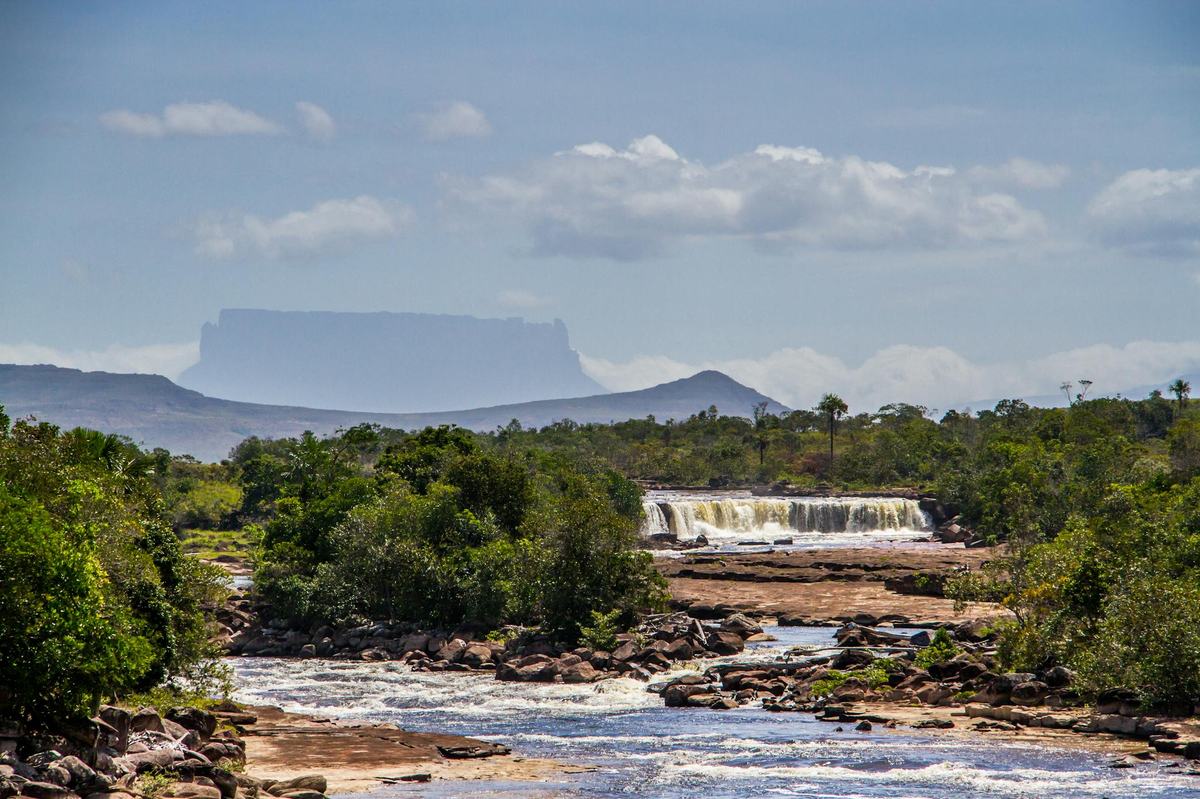
Venezuela's Gran Sabana region is studded with tepuis, these massive flat-topped sandstone mountains with sheer cliff walls that rise straight out of the jungle. Some are over two billion years old, among the oldest exposed rock surfaces on Earth [4]. They're so isolated from the lowlands below that each one is essentially its own evolutionary island. Plants and animals up top have been cut off from the surrounding ecosystem for so long they've evolved into species found nowhere else. There are carnivorous plants on some tepuis, and tiny frogs the size of a thumbnail.
Arthur Conan Doyle wrote his novel "The Lost World" inspired by these mountains, imagining that dinosaurs might still survive on top of them. The dinosaurs are fiction. The strangeness is real. Back home in Montana the mountains feel ancient too, but tepuis are a different kind of old. They predate plant life on land.
Beauty Pageants as National Sport
I had to look this up twice. Venezuela has won the Miss Universe crown seven times and Miss World six times, which puts it near the top of the all-time list despite being a country of under 30 million people [6]. For decades it was the most decorated nation in international pageantry. There were academies, training programs, an entire industry built around producing winners. Children grew up watching the pageants the way American kids watch the Super Bowl.
The program slowed during the country's economic crisis, but the cultural footprint is still huge. Telenovelas, fashion, beauty culture - it all threads back to that obsession with the pageant. It's one of those cultural things that doesn't have a clean equivalent anywhere else.
Oil, the Bolívar, and a Currency Story
Venezuela sits on the world's largest proven oil reserves, ahead of Saudi Arabia [7]. That fact alone should tell you the country's modern history is going to be complicated, and it is. Oil money built Caracas highways and middle-class neighborhoods through the mid-twentieth century, then global price swings and political crises sent things sideways. Hyperinflation in the late 2010s got so severe that the government reissued the currency twice, knocking six zeros off the bolívar in 2021 alone [3]. People were carrying grocery bags of cash to buy bread. The country has slowly stabilized in recent years, but the bolívar's story is one of the wildest currency histories of the twenty-first century.
Arepas, Hallacas, and Food That Defines a Place
Arepas are the heartbeat of Venezuelan food. They're cornmeal patties, grilled or fried, split open and stuffed with anything from black beans and cheese to shredded beef. Every family has their preferred filling, and the debates get real. The reina pepiada, stuffed with chicken and avocado, is the unofficial national favorite.
Around Christmas, families gather to make hallacas, which are corn dough parcels filled with stewed meat, olives, and raisins, wrapped in plantain leaves and tied with string. The process takes a full day. Multiple generations stand around the table folding and tying. It's the kind of food that's about the making as much as the eating.
Frequently Asked Questions
What is Venezuela most famous for?
Venezuela is best known for Angel Falls, the tallest uninterrupted waterfall in the world at 979 meters [4]. The country is also famous for holding the world's largest proven oil reserves, its dominant history in international beauty pageants, and the Catatumbo lightning phenomenon over Lake Maracaibo.
Is Venezuela safe to visit?
Many governments currently advise against non-essential travel to Venezuela due to crime, civil unrest, and limited consular services. Travelers who do go typically arrive on organized tours to natural sites like Canaima or Los Roques. Check your country's official travel advisory before planning a trip.
What language do they speak in Venezuela?
Spanish is the official language and is spoken by nearly the entire population [1]. The constitution also recognizes more than 30 Indigenous languages, including Wayuu, Pemón, and Warao. English is spoken in tourist areas and by some professionals in Caracas, but it's not widely used outside those settings.
What currency does Venezuela use?
Venezuela's official currency is the bolívar soberano (VES) [3]. After years of hyperinflation, the government redenominated the currency in 2018 and again in 2021, removing a total of 11 zeros. The US dollar is also widely accepted in many shops and for larger transactions.
What is the capital of Venezuela?
The capital of Venezuela is Caracas, located in a narrow valley about 900 meters above sea level near the Caribbean coast [1]. It is the country's largest city and its political, cultural, and economic center, home to roughly 3 million people in the metro area.