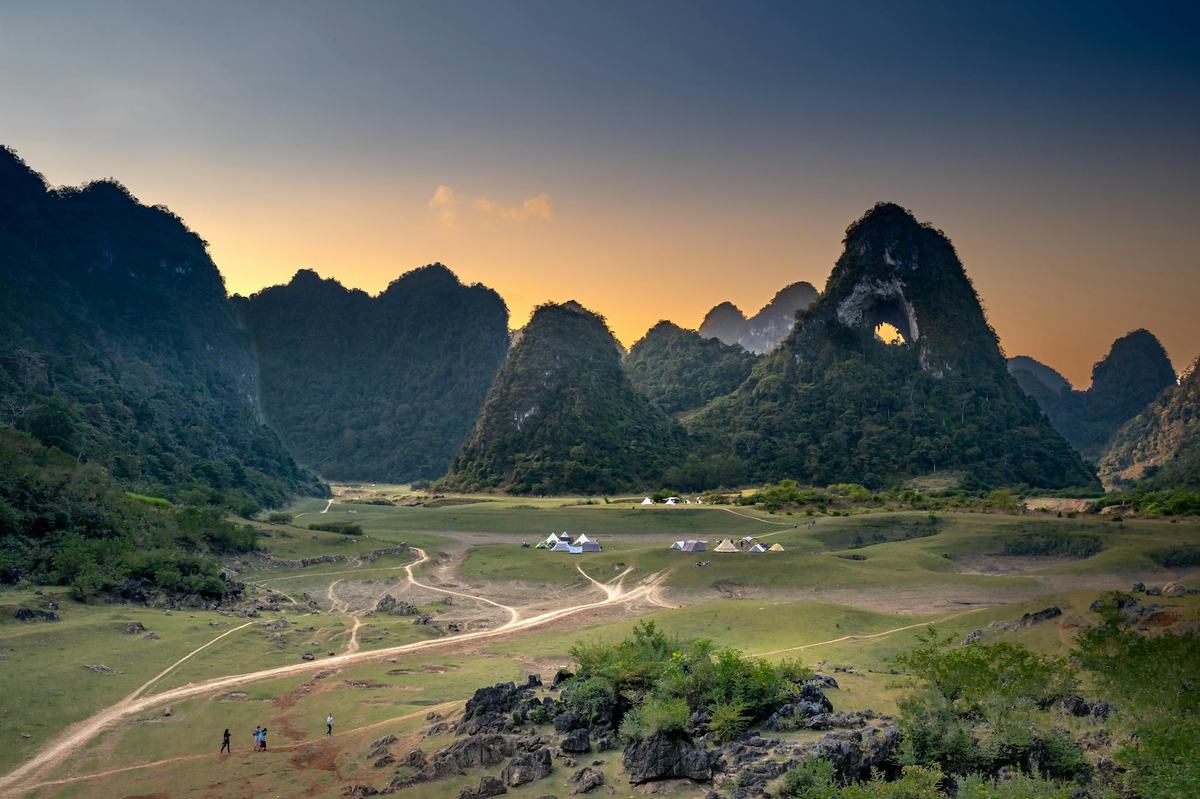
- Capital: Hanoi
- Population: about 100.3 million (2023) [1]
- Area: 331,212 km² [2]
- Official language: Vietnamese
- Currency: Vietnamese đồng (VND)
- Geographic shape: roughly 1,650 km from north to south, with a coastline of about 3,260 km [2]
I had to look this up twice. Viet Nam is so long, north to south, that if you laid it over the United States it would stretch from somewhere in Maine all the way down past Atlanta. But it's narrow. In one stretch near the middle of the country, the width from the coast to the Laos border is only about 50 kilometers. The whole nation is essentially a coastline with a country attached to it, and once you see that on a map, a lot of the food and the history and the way people talk about home starts to make sense.
Two Deltas, One Spine
Viet Nam has two great rivers and they sit at opposite ends. The Red River delta cradles Hanoi in the north. The Mekong delta fans out south of Ho Chi Minh City. In between, the Annamite mountain range runs down the spine of the country like a low fence between Viet Nam and Laos.
Those deltas are why Viet Nam can feed itself and then some. The Mekong delta alone produces more than half the country's rice [3]. That's a flat, water-stitched plain about the size of the Netherlands, threaded with canals and floating markets, where boats are sometimes more useful than roads. Back home in Montana the only "delta" I ever saw was where a creek met a slow river and made a sandbar. The Mekong delta is in a different league. It's a working landscape, and it's been one for centuries.
The rice itself isn't just a staple. Viet Nam is one of the top three rice exporters in the world, year in and year out [3]. Which, if you think about it, is a remarkable thing for a country that endured decades of war on its own soil within living memory.
The Coffee Story Nobody Sees Coming
Here's the thing. When most Americans think about coffee, they think Colombia, maybe Ethiopia. Viet Nam is the world's second-largest coffee producer, behind only Brazil, and it's been holding that spot for years [4].
The interesting part is what kind of coffee. Most of the global market wants arabica - that's what fills Starbucks bags. Viet Nam grows mostly robusta, a sturdier, more caffeinated bean with a punchier, almost cocoa-bitter taste. The French planted the first coffee trees here in the late 1800s. Today coffee grown in the central highlands ends up in espresso blends all over the world. You've probably been drinking Vietnamese coffee for years without knowing it.
Inside Viet Nam, the coffee tradition is its own thing. Drip filters over a glass with sweetened condensed milk, served hot or over ice. In Hanoi you can order cà phê trứng - egg coffee - where a whipped yolk and sugar mixture sits on top of the dark coffee like a custard. Nobody talks about this, but the egg coffee was invented in the 1940s as a workaround when fresh milk was scarce. The workaround became a beloved tradition.
A Long History That Predates the War
Most Americans my age learned about Viet Nam through the war, which is to say we learned about one decade out of a couple thousand years. The country has a written history that goes back to the Bronze Age Dong Son culture, around 1000 BCE, famous for its enormous bronze drums [5]. Chinese rule lasted for about a thousand years. Vietnamese independence dates to the 10th century, when a general named Ngo Quyen drove out the Chinese fleet by planting iron-tipped stakes in the Bach Dang River bed at low tide.
Hanoi has been a capital, off and on, since 1010. Hue, in the center of the country, was the imperial seat under the Nguyen dynasty in the 1800s. Walking around Hue today you can still see the citadel walls and the moat. The complex was modeled in part on the Forbidden City in Beijing, on a smaller scale, and it carries UNESCO World Heritage status [5].
Halong Bay and the Geology Everybody Photographs
In the north, where the Gulf of Tonkin curves up toward China, there's a stretch of water studded with about 1,600 limestone islands and pillars [5]. This is Halong Bay. The karst towers are what's left after millions of years of rain and seawater wore down a limestone plateau, leaving only the hardest cores standing.
I've seen photographs of Halong Bay since I was a kid, in old National Geographic issues my grandmother kept stacked under the coffee table. It looks like a fantasy painting. It also looks, when you read about it, exactly like the kind of place a geographer would invent if asked to design a textbook example of karst topography. UNESCO listed it as a World Heritage site in 1994. The fishermen who live in floating villages there will tell you the islands have stories attached to each shape - a dragon's tail, a pair of fighting cocks, a lone old man.
A Country That's Younger Than Its Average Tourist Thinks
Viet Nam reunified in 1976 after decades of war. Most of the people you'll meet today were born after that, into a country that's been at peace within its borders for about half a century. The median age is around 33, which is older than India but younger than China or the US [1]. The economy has been growing fast since the đổi mới reforms in 1986, which opened up private business and foreign investment.
You can feel the youth in any city. Hanoi at 7 pm is a moving sea of scooters - reportedly somewhere north of 45 million registered motorbikes in the country [1]. Whole families fit on one of them. The trick to crossing the street, every guidebook will tell you, is to walk slowly and predictably and let the scooters flow around you like water around a rock. It works.
Food, Family, and the Tet New Year
Vietnamese food is one of those cuisines that takes three or four ingredients and turns them into something you remember for years. Pho, the beef-and-noodle soup, started as a Hanoi street breakfast in the early 1900s. Banh mi, the baguette sandwich, is a direct artifact of French colonial bakeries colliding with Vietnamese pickled vegetables and pâté. Both are global now, but in their home country they're still everyday food.
The biggest holiday is Tet, the lunar new year, usually falling in late January or February. Families travel back to their hometowns - the highways and trains fill up - and homes get cleaned top to bottom before midnight. You eat banh chung, a square rice cake wrapped in green dong leaves and boiled for hours. You give kids red envelopes with money inside. You pay your debts before the new year starts, because anything carried across the line is bad luck.
That sense of going home for the holidays, of cleaning and clearing the year, isn't so different from how my own family treated Christmas in Montana. Different food, different calendar, same impulse.
Frequently Asked Questions
What is Viet Nam famous for?
Viet Nam is best known for its long S-shaped coastline, Halong Bay, the Mekong delta, and a globally exported cuisine that includes pho and banh mi. It's also the world's second-largest coffee producer and one of the top three rice exporters [3] [4].
What language do people in Viet Nam speak?
The official language is Vietnamese, a tonal language with six tones, written today in a Latin-based alphabet called quoc ngu. English is increasingly common in cities and tourist areas, especially among younger people.
Is Viet Nam a safe country to visit?
Viet Nam is generally considered safe for travelers, with low rates of violent crime. The main everyday hazards are traffic, especially scooter traffic in big cities, and standard petty theft in crowded tourist spots. Health precautions for food and water are sensible.
What is the best time of year to visit Viet Nam?
The country spans many climate zones, so timing depends on the region. North and central Viet Nam are typically pleasant from October to April. The south is warm year-round, with a dry season roughly from December to April and a rainy season the rest of the year.
How big is Viet Nam compared to other countries?
Viet Nam covers about 331,000 square kilometers, slightly larger than Italy and a bit smaller than Germany [2]. With about 100 million people, it's the 15th most populous country in the world.