- Capital: Sanaa (de jure); Aden serves as the temporary administrative capital [1]
- Population: about 34.4 million (2024 estimate) [2]
- Area: 527,968 km² (203,850 sq mi) [1]
- Official language: Arabic [1]
- Currency: Yemeni rial (YER) [1]
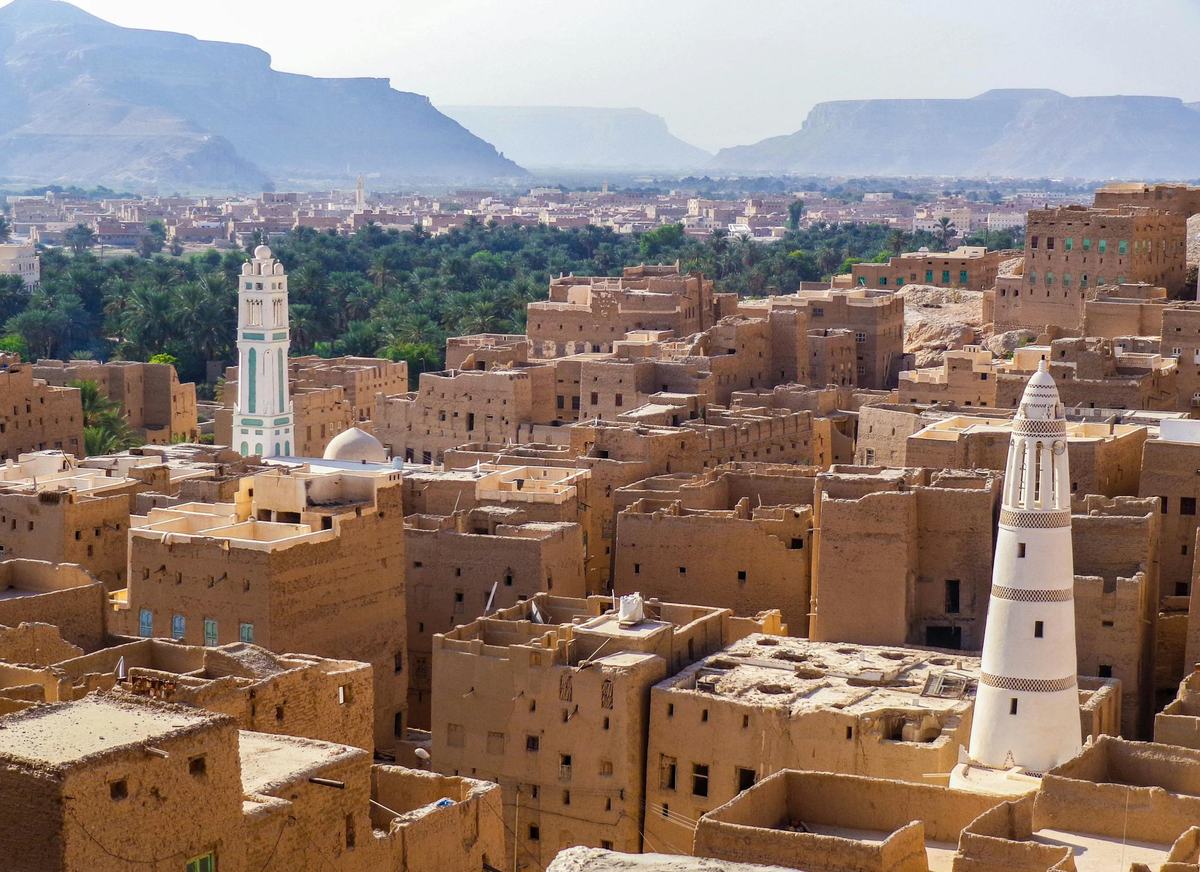
- Home to Shibam, often called the "Manhattan of the Desert", where 16th-century mud-brick towers rise up to 11 stories [3]
I grew up thinking skyscrapers were a 20th-century American invention. Then I read about Shibam, a walled town in the Yemeni desert where people built 11-story apartment blocks out of mud and straw five hundred years ago, and I had to look this up twice. Yemen is one of those places that quietly upends what you thought you knew. It sits in the southwest corner of the Arabian Peninsula, on land that has been continuously inhabited for thousands of years, and most of what makes it remarkable is older than anything in my country by a wide margin. The modern news out of Yemen is heavy, and I'll get to that. But the story of this place starts long before any of it.
The Mud Skyscrapers of Shibam
Shibam is a small walled city in the Hadhramaut Valley, and the first time you see a photo of it you don't quite believe the scale. The buildings rise straight out of the desert floor, packed so tightly that the alleys between them are barely wide enough for two people to pass. Most of the towers are five to eight stories. Some hit eleven. They were built starting in the 16th century, though parts of the city are older, and the whole place was designed defensively, with the upper floors connected by bridges so residents could move between buildings without coming down to ground level [3].
The construction material is mud brick, mixed with straw and dried in the sun. To keep the towers standing in a region with heavy seasonal rains, the residents replaster the exterior walls every few years. It's a kind of constant, communal maintenance that has kept the town alive for half a millennium. UNESCO calls it the oldest example of urban planning based on vertical construction [3]. The British explorer Freya Stark visited in the 1930s and gave it the nickname "Manhattan of the Desert", which has stuck ever since.
Socotra and the Trees That Look Like Mushrooms
Off the southern coast of Yemen, about 240 miles into the Indian Ocean, sits an island that doesn't look like it belongs on Earth. Socotra has been geologically isolated for so long that roughly a third of its plant species exist nowhere else on the planet [4]. The most famous of them is the dragon's blood tree, which grows in the shape of an upside-down umbrella and bleeds a deep red resin when its bark is cut. Walking through a grove of them looks more like a Pixar concept sketch than a real landscape.
There are also bottle trees with swollen trunks that store water, cucumber trees that look like overgrown bonsai, and a handful of bird species that don't live anywhere else either. The island has been compared to the Galapagos for the sheer concentration of unique life. About 60,000 people live there, mostly in small fishing villages, and they speak a language called Soqotri that doesn't have a written form. Getting to Socotra has become extremely difficult during the current conflict, which means the ecosystem is, for now, mostly left alone.
The Birthplace of Coffee Culture
Here's the thing nobody talks about when they're paying eight dollars for a latte. The coffee trade as we know it started in Yemen. The plant itself originated in Ethiopia, but it was Yemeni Sufi mystics who first cultivated coffee commercially and brewed it as a drink to stay awake during long nights of prayer [5]. By the 15th century, coffee houses were operating in Yemeni port cities, and the port of Mocha, on the Red Sea coast, became the central hub for exporting beans to the rest of the world. The name "mocha" comes directly from that port.
For a couple of centuries, Yemen had a near monopoly on the global coffee trade. The country guarded its seedlings carefully, but eventually beans got smuggled out to India and the Dutch East Indies, and the monopoly broke. Yemeni coffee is still grown in small terraced fields in the western highlands, and it has a distinct, almost wine-like complexity that specialty roasters pay serious money for. The trees are watered entirely by rainfall and cared for by hand, the same way they have been for centuries.
The Queen of Sheba and a Civilization Most People Forget
Most people couldn't find Yemen on a map, and that's probably exactly why they don't realize one of the great trading empires of the ancient world was based there. The Kingdom of Sheba, known in Arabic as Saba, flourished in what is now Yemen from roughly the 8th century BCE to the 3rd century CE [6]. It controlled the frankincense and myrrh trade routes that ran across the Arabian Peninsula, and at its peak it was wealthy enough that its rulers showed up in the Hebrew Bible and the Quran.
The Queen of Sheba, who according to scripture traveled to meet King Solomon in Jerusalem, is traditionally associated with this kingdom. The Sabaeans built the Marib Dam, an enormous earthwork irrigation system that turned a stretch of desert into farmland for over a thousand years. When it finally collapsed sometime around the 6th century CE, the resulting migration is mentioned in the Quran. You can still see the ruins of the dam today, along with other Sabaean temples and inscriptions across the Yemeni interior.
Khat and the Afternoon That Doesn't End
Yemen has a national habit that visitors notice within a day. Khat, a leafy plant whose fresh leaves contain a mild stimulant, is chewed by a huge portion of the adult population, mostly in the afternoons [7]. After lunch, men gather in dedicated rooms called mafraj, often with carpets and cushions along the walls, and chew khat together for hours while talking, listening to music, or discussing business and politics. The leaves are tucked into one cheek, the way American baseball players used to use chewing tobacco, and the bulge builds up over the course of the session.
It's deeply woven into social life. Deals get made over khat. Disputes get settled over khat. The downside is that the plant requires huge amounts of water to grow, and in a country facing severe water shortages, khat farming consumes a disproportionate share of what's available. It's one of those cultural practices that's both essential to daily life and, increasingly, a real strain on the country's resources.
The Old City of Sanaa
Sanaa, the capital, sits in a high mountain basin at about 2,250 meters above sea level, which makes it one of the highest capital cities in the world [1]. The old walled section of the city has been continuously inhabited for more than 2,500 years, and it looks like nothing else on Earth. The houses are built of dark basalt stone on the lower floors and decorated tower-style with white gypsum patterns on the upper stories, so the whole skyline looks like elaborate frosted gingerbread.
There are over 100 mosques and several thousand traditional houses inside the old walls, many of them still lived in by the same families that have owned them for generations [8]. UNESCO put it on the World Heritage list in 1986 and added it to the endangered list in 2015 after the war damaged parts of the city. Walking through the souks before the conflict, you could buy frankincense, silver jewelry, jambiyas (the traditional curved daggers), and spices that have been traded along these streets since before the Roman Empire existed.
Frequently Asked Questions
What is Yemen most famous for?
Yemen is most famous for its ancient civilizations, including the Kingdom of Sheba, and for cultural landmarks like the mud-brick skyscrapers of Shibam and the Old City of Sanaa [3][8]. It is also known as the historical birthplace of the commercial coffee trade and as home to Socotra, an island with a unique ecosystem.
Is Yemen safe to visit?
Yemen is not currently considered safe for travel. Most governments advise against all travel due to the ongoing armed conflict, terrorism risks, kidnapping, and a collapsed healthcare system. Travelers cannot obtain meaningful consular support inside the country, and most embassies have suspended operations.
What language do they speak in Yemen?
Arabic is the official language of Yemen and is spoken across the country [1]. Several regional dialects exist, and on Socotra island many residents speak Soqotri, a separate South Semitic language with no standard written form. English is used in some business and tourism contexts but is not widely spoken.
What religion is practiced in Yemen?
Islam is the religion of nearly all Yemenis [1]. The population is split between Sunni Muslims, who are mostly Shafi'i, and Zaydi Shia Muslims, who are concentrated in the north and historically ruled much of the country. Small communities of Christians, Hindus, and a remaining handful of Yemeni Jews also exist.
What is the capital of Yemen?
The capital of Yemen is Sanaa, located in the western highlands at about 2,250 meters above sea level [1]. Following the outbreak of civil war in 2014, the internationally recognized government relocated its administrative functions to Aden, the country's main southern port city, while Sanaa remains under the control of the Houthi movement.
Sources
- CIA World Factbook: Yemen
- World Bank: Yemen Population
- UNESCO World Heritage Centre: Old Walled City of Shibam
- UNESCO World Heritage Centre: Socotra Archipelago
- Britannica: History of Coffee
- Britannica: Kingdom of Sheba
- World Health Organization: Khat Use in Yemen
- UNESCO World Heritage Centre: Old City of Sanaa