- Capital: Harare [1]
- Population: about 16.6 million (2024 estimate) [2]
- Area: 390,757 km² (150,872 sq mi) [1]
- Official languages: 16, including Shona, Ndebele, English, and 13 others recognized in the constitution [3]
- Currency: Zimbabwe Gold (ZiG), introduced in 2024 [4]
- Named after Great Zimbabwe, a medieval stone city built without mortar that gave the modern country its identity [5]
Most countries are named after a river, a tribe, a king, or a misunderstanding by some European who showed up four hundred years ago and wrote down what he thought he heard. Zimbabwe is named after a city. A real, ancient, drystone city, built by people whose descendants still live in the country, that was thriving while medieval Europe was still figuring out cathedrals. The name itself comes from the Shona phrase dzimba dza mabwe, meaning "houses of stone". When the country chose its name at independence in 1980, it picked the most defiant possible answer to centuries of being told its history started with colonization. I had to look this up twice the first time I read it, because the school version of African history I grew up with had no room for stone cities.
The Stone City That Gave the Country Its Name
Great Zimbabwe sits in the southeastern hills of the country, about 17 miles southeast of the modern town of Masvingo. It was the capital of a powerful kingdom that flourished from roughly the 11th to the 15th centuries, controlling trade routes that ran from the gold mines of the interior all the way to the Swahili coast and out into the Indian Ocean [5]. At its peak, somewhere between 10,000 and 20,000 people lived there. The Great Enclosure, the most famous structure, has walls 36 feet high and 20 feet thick at the base, built entirely from granite blocks fitted together so tightly that no mortar was used or needed. It is the largest ancient structure in sub-Saharan Africa.
When Europeans first encountered the ruins in the late 1800s, they refused to believe Africans could have built them. Various colonial-era theories tried to credit the Phoenicians, the Queen of Sheba, anyone but the people who actually lived there. Archaeologists have long since established that the city was built by the ancestors of the Shona people, who still make up the majority of Zimbabwe's population [5]. UNESCO designated the ruins a World Heritage Site in 1986. The country's flag features a soapstone bird carved from one of the site's ancient pillars.
Sharing the Smoke That Thunders
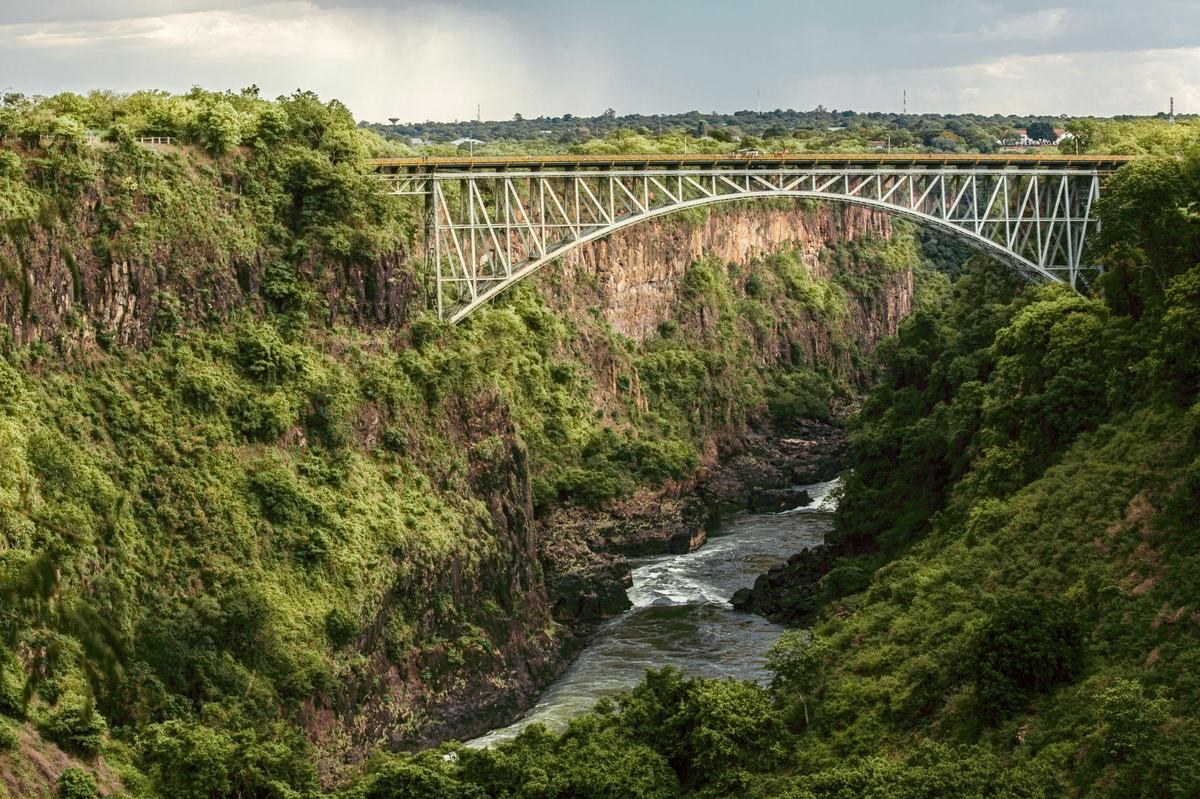
Victoria Falls sits on the Zambezi River along Zimbabwe's northwest border with Zambia, and Zimbabwe holds about three-quarters of the falls' total length on its side [6]. The local Tonga people called it Mosi-oa-Tunya, "the smoke that thunders", long before the Scottish missionary David Livingstone showed up in 1855 and renamed it after Queen Victoria. The falls are about a mile wide and 354 feet tall, making them the largest single sheet of falling water on the planet by volume and area combined.
From the Zimbabwean side, you get the panoramic views, the rainforest that grows in the constant spray, and the long footpath along the gorge that lets you see the falls from sixteen different vantage points. UNESCO listed the site in 1989, and the rainforest itself is a tiny ecosystem that exists only because of the perpetual mist [6]. Locals will tell you the best time to visit is the shoulder season around June, when the water is still high enough to be spectacular but the spray hasn't yet hidden the falls behind a wall of cloud.
Sixteen Official Languages in One Constitution
Zimbabwe's 2013 constitution officially recognizes 16 languages, which is one of the highest numbers anywhere in the world [3]. The list includes Shona, Ndebele, English, Chewa, Chibarwe, Kalanga, Koisan, Nambya, Ndau, Shangani, sign language, Sotho, Tonga, Tswana, Venda, and Xhosa. Shona is the home language of about 70 percent of Zimbabweans. Ndebele is the second largest, spoken mainly in the southwest around Bulawayo. English is the language of government, business, and education, and almost every Zimbabwean speaks at least some of it.
What's less talked about is how the constitution treats sign language as fully equal to spoken languages, which puts Zimbabwe ahead of most countries on that score. The recognition isn't just symbolic. State media broadcasts in multiple languages, official documents are translated into the major ones, and schools in different regions teach in the local mother tongue alongside English. The system isn't perfect in practice, but the legal architecture for it is unusually thorough.
The Largest Manmade Lake by Volume
Lake Kariba, on the border between Zimbabwe and Zambia, is the largest artificial reservoir in the world by water volume, holding about 185 cubic kilometers of water [7]. It was created in the late 1950s when the Kariba Dam was built across the Zambezi River to generate hydroelectric power for both countries. The lake is 140 miles long and up to 25 miles wide.
Building it meant flooding the ancestral lands of the Tonga people, who were forcibly relocated and lost most of their farmland and burial sites. It also meant a massive wildlife rescue called Operation Noah, in which conservationists captured and moved roughly 6,000 animals from the rising waters between 1958 and 1964. The drowned mopane forests left behind petrified tree trunks that still stick out of the water in places, giving parts of the lake the look of a flooded graveyard. Tigerfish swim in the warm shallows and houseboats drift on the surface, and the dam still produces more than half the electricity used in Zimbabwe.
A Currency History Like No Other
Zimbabwe holds the modern record for the worst hyperinflation outside of post-war Hungary. Between 2007 and 2009, prices doubled roughly every 24 hours, and the central bank eventually printed a 100 trillion Zimbabwe dollar note [4]. That single note, at the height of the crisis, could not buy a loaf of bread. The country abandoned its own currency in 2009 and started using a basket of foreign currencies, mostly the US dollar and the South African rand. Locals carried wads of US bills and used them for everything from school fees to bus rides.
In April 2024, Zimbabwe launched yet another new currency, the Zimbabwe Gold (ZiG), backed by the country's reserves of actual gold and foreign currency [4]. It is the sixth currency the country has used since 2008. Most ordinary Zimbabweans still prefer the US dollar for serious transactions, and shops typically display prices in both. Which, if you think about it, makes Zimbabwe one of the only places where you can hand over an old hundred trillion dollar note as a souvenir while paying for your coffee in three different currencies.
Frequently Asked Questions
What is Zimbabwe most famous for?
Zimbabwe is most famous for Victoria Falls, which it shares with Zambia along the Zambezi River [6], and for the medieval stone ruins of Great Zimbabwe that gave the country its name [5]. It is also known for Hwange National Park, Lake Kariba, and the historic hyperinflation episode of the late 2000s.
What language do they speak in Zimbabwe?
Zimbabwe's constitution recognizes 16 official languages, which is among the highest of any country in the world [3]. Shona is spoken by about 70 percent of the population, Ndebele by around 15 percent, and English serves as the language of government, business, and education across the entire country.
What currency is used in Zimbabwe?
Zimbabwe introduced the Zimbabwe Gold (ZiG) in April 2024, a currency partially backed by gold and foreign reserves [4]. The US dollar is also widely used and accepted in everyday transactions, including at supermarkets, fuel stations, and tourist sites. Many prices are displayed in both ZiG and US dollars.
Is Great Zimbabwe really that old?
Great Zimbabwe was built starting in the 11th century and reached its peak between the 13th and 15th centuries [5]. Archaeologists have confirmed it was built by the ancestors of the Shona people, with the stone walls of the Great Enclosure standing 36 feet tall without any mortar holding the granite blocks together.
What is the capital of Zimbabwe?
The capital of Zimbabwe is Harare, located in the northeast of the country at about 4,865 feet above sea level [1]. It was founded in 1890 as Fort Salisbury and renamed Harare at independence in 1980. The city has a population of around 1.5 million and is the political, cultural, and commercial center of Zimbabwe.
Sources
- CIA World Factbook: Zimbabwe
- World Bank: Zimbabwe Population
- Constitution of Zimbabwe Amendment (No. 20) Act, 2013
- Reserve Bank of Zimbabwe: Monetary Policy Statement
- UNESCO World Heritage Centre: Great Zimbabwe National Monument
- UNESCO World Heritage Centre: Mosi-oa-Tunya / Victoria Falls
- Britannica: Lake Kariba