Why Benin Is One of the Most Historically Significant Nations You've Never Fully Explored
The Kingdom of Dahomey: A Pre-Colonial Empire That Rivaled European Powers
How Dahomey's Bureaucratic System Outpaced Many Contemporary African States
The Kingdom of Dahomey, which dominated the region from roughly 1600 to 1894, operated with a level of administrative sophistication that challenges comfortable narratives about pre-colonial Africa. The kingdom maintained a standing army - including the legendary Agojie, an all-female military unit of several thousand soldiers that European visitors documented with a mixture of awe and alarm. Beyond military organization, Dahomey ran a centralized tax collection system, maintained a network of royal spies, and conducted regular population censuses using physical tokens stored in gourds, a system that predated many comparable European bureaucratic tools in sub-Saharan governance.
The Kingdom's Annual Revenue From the Slave Trade and What It Funded
Dahomey's participation in the transatlantic slave trade was neither peripheral nor passive. At its peak in the 18th century, the kingdom exported between 10,000 and 20,000 enslaved people annually through the port of Ouidah, generating revenue that financed military expansion, royal court infrastructure, and diplomatic relationships with European trading powers including Portugal, Britain, and France. The monarchy effectively held monopoly control over slave exports, meaning independent trading was punishable by death. This history complicates simple victim-perpetrator frameworks and remains a subject of serious scholarly and political reckoning - one that the Beninese government has formally acknowledged in recent years.
Benin's Role as the Cradle of Vodun: The Religion the World Misunderstands
How Vodun Traveled From Benin to Haiti, Brazil, and New Orleans
The word "voodoo" conjures Hollywood imagery that bears almost no resemblance to its source. Vodun - meaning "spirit" in the Fon language - originated in the coastal regions of present-day Benin and traveled to the Americas embedded in the cultural memory of enslaved people, primarily those transported through Ouidah. In Haiti, it became Vodou; in Brazil's Bahia state, it evolved into Candomblé; in Louisiana, it fractured into practices loosely called Voodoo. These are distinct traditions, but they share a common theological architecture rooted in southern Benin.
The Official Vodun National Holiday That No Other Country Celebrates
On January 10th each year, Benin observes a national public holiday dedicated entirely to Vodun. Established in 1996, the day draws tens of thousands of practitioners and tourists to Ouidah for ceremonies, processions, and rituals. No other country in the world has institutionalized a Vodun-specific national holiday, making Benin's gesture both culturally significant and diplomatically notable in how it frames indigenous religion as national heritage rather than something to suppress or export.
Why Benin Is Called the 'Latin Quarter of Africa' - And What That Really Means
Cotonou vs. Porto-Novo: A Tale of Two Capitals That Confuses Even Scholars
Benin operates with a split capital arrangement that genuinely puzzles outsiders. Porto-Novo is the official constitutional capital; Cotonou functions as the economic and administrative capital where government ministries actually operate. This divide is not merely symbolic - it reflects colonial-era infrastructure decisions and ethnic political dynamics that have never been fully resolved.
How French Colonial Policy Shaped Benin's Intellectual Identity
French colonial administrators invested disproportionately in education infrastructure in the territory then called Dahomey, producing a density of trained civil servants and intellectuals that exceeded neighboring colonies. By independence in 1960, Beninese graduates were filling administrative posts across Francophone West Africa, earning the country its "Latin Quarter" designation. This intellectual export economy had real geopolitical weight, though it also reflected the extractive logic of colonial education designed to produce administrators, not autonomous citizens.
Fascinating Facts About Benin Culture That Most Travel Guides Ignore
The Agojie: The Real-Life Amazon Warriors Who Inspired a Hollywood Film
Military Structure and Combat Techniques of the Female Dahomey Army
The Agojie were not ceremonial soldiers. Between the 17th and 19th centuries, this all-female military corps served as the frontline shock troops of the Kingdom of Dahomey, numbering between 1,000 and 6,000 fighters at their peak under King Ghezo's reign (1818–1858). They were organized into distinct regiments: hunters (gbeto), razor women (agbarya), and elephant hunters (gohento), each with specialized weapons and tactical roles.
Their training was deliberately brutal. Recruits underwent obstacle courses involving acacia thorn barriers, practiced silent night raids, and were conditioned to suppress pain responses through prolonged physical stress. European observers who witnessed Agojie fighters in the 1840s-including French naval officer Jean Bayol-documented their discipline as superior to male soldiers in the same army. In the Franco-Dahomean Wars of 1890–1894, Agojie units inflicted significant casualties on French Foreign Legion troops despite being outgunned by modern repeating rifles.
How the Agojie Compare to Other Historical Female Fighting Forces Worldwide
Female combat units appear in isolated historical records across cultures-Viking shield-maidens remain archaeologically contested, and the Trưng Sisters of Vietnam commanded armies rather than forming organic female units-but the Agojie stand nearly alone as an institutionalized, professionally trained, standing female army maintained continuously for roughly 200 years. The 2022 film The Woman King brought global attention to this history, though historians like Dr. Leonard Wantchekon note the film softened the kingdom's documented role in the transatlantic slave trade, a complex reality the Beninese government itself has publicly acknowledged.
Benin's Living Traditions of Royal Courts and Their Unbroken Ceremonial Chains
The Fon People's Oral History Tradition Older Than Many Written Archives
The Fon people encode genealogical, political, and cosmological knowledge in a tradition called hwenoho, practiced by specialized oral historians attached to royal courts. These accounts trace the Dahomey kingdom back to the early 1600s with a level of internal consistency that historians cross-referencing Portuguese and Dutch colonial records have found remarkably reliable. Some lineage accounts extend to figures predating European contact entirely-oral archives that predate many regional written sources by generations.
Benin's 'Zangbeto' Night Watchmen: Guardians Between the Living and the Dead
Zangbeto are traditional Yoruba-rooted guardians found primarily in southern Benin. Visually, they appear as tall, spinning haystacks of raffia grass-but their social function is deeply serious. Historically tasked with nighttime policing in communities without formal law enforcement, Zangbeto operate through Vodoun authority rather than state power. Initiates who "become" Zangbeto enter a ritual state considered non-human during performance. Documented instances from ethnographic fieldwork show communities still deploying Zangbeto as conflict mediators in villages where state institutions have limited reach, functioning as living legal-spiritual institutions.
Music, Dance, and the Specific Rhythms Benin Gave to the World
How Beninese Percussion Patterns Became the Foundation of Afrobeat
Afrobeat's rhythmic DNA traces directly to Yoruba and Fon ceremonial drumming traditions, and Benin sits at the geographic and cultural intersection of both. The agbadja rhythm-a syncopated 12/8 pattern used in Fon ceremonial contexts-appears structurally intact in early Fela Kuti recordings. Kuti spent formative years absorbing West African traditional music alongside his jazz and funk influences, and ethnomusicologists including Christopher Waterman have traced specific polyrhythmic layering techniques to Dahomean ceremonial music rather than exclusively Nigerian sources.
Tchinkoumè and Other Indigenous Music Styles Unknown Outside the Country
Tchinkoumè originates among the Bariba people of northern Benin and functions as both entertainment and historical documentation. Performed at funerals, harvests, and royal ceremonies, it combines a distinctive bowed lute (the goge) with call-and-response vocals that encode local histories. It has no commercial recording industry behind it and virtually no international distribution. Similarly, Sato drumming from the Agonlin region is performed exclusively every three years during a specific agricultural ceremony-making it one of the rarest living music traditions on the continent by performance frequency.
Beninese Cuisine: Fermented, Fiery, and Deeply Functional
Dawadawa and Afitin: The Fermented Locust Bean Condiments That Predate Soy Sauce in Complexity
Afitin is Benin's locust bean ferment-known as dawadawa across West Africa-produced by fermenting Parkia biglobosa seeds through a 3–5 day controlled bacterial process. The result contains measurable levels of glutamic acid that produce genuine umami flavor, with fermentation profiles comparable in biochemical complexity to Japanese miso. Afitin predates any documented soy fermentation tradition in West Africa, with evidence of locust bean processing dating back over 1,000 years in the Sahel region. It functions as protein supplementation, flavor base, and preservative simultaneously-nutritional technology developed entirely independently of Asian fermentation traditions.
How Benin's Coastal and Inland Food Cultures Differ More Than Most People Realize
The culinary gap between Cotonou's coast and Parakou in the north is substantial enough to constitute nearly distinct food cultures. Coastal Beninese cuisine centers on smoked and fresh fish, palm oil, and akassa-a fermented corn paste wrapped in leaves. Northern cuisine, shaped by Bariba and Fulani traditions, relies on millet, sorghum, dried meat, and dairy-ingredients and techniques with stronger Sahelian than Atlantic roots. The spice profile shifts dramatically too: southern cooking uses more piment (scotch bonnet variants), while northern dishes incorporate tamarind and soumbala more prominently. Most Beninese restaurants outside the country serve only a coastal approximation of this far more diverse national palate.
Political and Social Facts About Benin That Deserve Global Attention
Benin's 1990 Democratic Transition: A Model the World Forgot to Study
The National Conference Model: How Benin Peacefully Dismantled a Marxist Dictatorship
In February 1990, Benin accomplished something political scientists still struggle to fully categorize. President Mathieu Kérékou, who had ruled under a Marxist-Leninist framework since 1972, agreed to convene a sovereign national conference - a ten-day assembly of roughly 500 delegates representing civil society, religious groups, political movements, and the military. The conference declared itself sovereign, stripped Kérékou of executive authority, appointed a transitional prime minister (Nicéphore Soglo), and scheduled multiparty elections - all without a single shot fired.
This wasn't improvisation. The national conference model became a deliberate export across francophone Africa, influencing similar transitions in Mali, Niger, Congo, and Togo throughout the early 1990s. What made Benin's version distinctive was its binding authority: delegates voted to override the sitting head of state, and Kérékou accepted the outcome. That voluntary abdication of power remains genuinely rare in African political history.
Comparing Benin's 1990 Transition to South Africa's and Eastern Europe's Democratic Shifts
Western media coverage fixated on South Africa's negotiated transition and the fall of the Berlin Wall during the same period, largely overlooking Benin's parallel achievement. The comparison is instructive. South Africa's CODESA negotiations ran from 1991 to 1993 - three years of structured bargaining with international mediation and enormous economic pressure. Eastern European transitions frequently involved mass street mobilization, sometimes violence, and external geopolitical pressure from a collapsing Soviet bloc.
Benin had none of those accelerants. Its GDP per capita in 1990 was approximately $380. It had no significant international media attention and no Cold War strategic value driving Western intervention. The transition emerged almost entirely from domestic civic exhaustion with economic mismanagement and political repression - making it arguably a purer case of homegrown democratic agency.
How Benin Became One of Africa's Most Stable Democracies - Then Faced New Questions
The 2019–2021 Political Reforms: Democratic Backsliding or Structural Modernization?
For nearly three decades, Benin held a justified reputation as one of West Africa's most reliable democracies. That reputation became contested after 2019, when electoral reforms introduced a controversial new party certification system requiring parties to secure endorsement from a minimum number of elected officials before standing in elections. The practical effect: opposition parties were excluded from the 2019 parliamentary elections entirely. Protests followed, with Amnesty International documenting at least four deaths and dozens of arrests. Freedom House downgraded Benin's status from "Free" to "Partly Free" in 2020 - a significant symbolic shift for a country that had served as a democratic benchmark.
Press Freedom Index Rankings: Where Benin Stands Compared to Its Neighbors
Reporters Without Borders ranked Benin 113th globally in press freedom in 2023, a notable decline from its position in the 80s range earlier in the decade. For context, Ghana ranked 49th and Senegal 104th in the same index. Benin still outperforms Nigeria (112th) and Togo (72nd) inconsistently depending on year, but the downward trajectory concerns media watchdogs who once cited Benin as a regional standard-bearer.
Child Trafficking and the Vidomègon System: A Cultural Practice With Complex Roots
Historical Origins of Vidomègon and How It Differs From Modern Child Labor
Vidomègon - loosely translated as "child placed with someone" - is a centuries-old practice in Benin in which rural families send children, predominantly girls, to live with wealthier urban relatives or acquaintances. Historically, the arrangement offered children education, social mobility, and vocational training unavailable in their home villages. The host family gained domestic assistance; the child gained opportunity. In its original form, vidomègon was a structured kinship network, not exploitation.
The practice deteriorated significantly as urbanization accelerated and kinship ties weakened. UNICEF estimates that tens of thousands of children in Benin remain in vidomègon-type arrangements today, with a meaningful percentage experiencing conditions that meet international definitions of forced labor - no schooling, no compensation, restricted movement.
NGO Interventions in Benin Versus Similar Issues in Togo and Ghana
Benin has made measurable legislative progress. The 2006 Child Protection Code explicitly criminalized trafficking and exploitative domestic placement. UNICEF and local organizations like Wildaf-Bénin have operated community education programs targeting source villages in the Zou and Atlantique departments. Togo faces a structurally similar problem - its confiage system mirrors vidomègon closely - but has fewer operational NGO networks at the village level. Ghana's response has focused more heavily on lake-based child fishing labor (particularly Lake Volta), drawing comparatively more international funding and attention, which some regional analysts argue has left Beninese interventions chronically underfunded relative to need.
Geographic and Environmental Facts About Benin You Won't Find in a Textbook
Benin's Landscape: Four Distinct Ecological Zones in a Country Smaller Than Pennsylvania
Benin covers just 114,763 square kilometers - slightly smaller than Pennsylvania - yet compresses four ecologically distinct zones along its 700-kilometer north-south axis. The coastal strip features lagoons, mangroves, and sandy barrier islands. Moving north, a fertile clayey plateau supports intensive agriculture around Abomey. Further north, the Atacora mountain range introduces laterite soils and deciduous woodland. The far north transitions into Sudano-Sahelian savanna, where rainfall drops below 900mm annually and the dry season stretches nearly eight months.
The W National Park: Benin's Shared Transboundary Biosphere Reserve
The W National Park - named for the W-shaped bends the Niger River carves along Benin's northeastern border - spans approximately 10,000 square kilometers across Benin, Niger, and Burkina Faso. Designated a UNESCO Biosphere Reserve in 2002 and listed as a World Heritage Site in 1996, it protects one of the largest continuous ecosystems in West Africa. Benin's portion alone covers roughly 5,630 square kilometers. The park shelters hippopotamuses, African buffalo, and significant populations of West African crocodiles, making it ecologically irreplaceable in a sub-region where wildlife corridors have been largely severed.
How Benin's North-South Rainfall Gradient Creates Two Almost Separate Agricultural Worlds
The coastal south receives a bimodal rainfall pattern - two rainy seasons totaling 1,200–1,400mm - enabling double-cropping of maize, cassava, and oil palm. The north operates on a single rainy season of 700–1,000mm, forcing farmers into a short cultivation window suited to sorghum, millet, and yams. This gradient isn't merely agricultural; it shapes market calendars, migration patterns, and food security risks in fundamentally different ways across a single country.
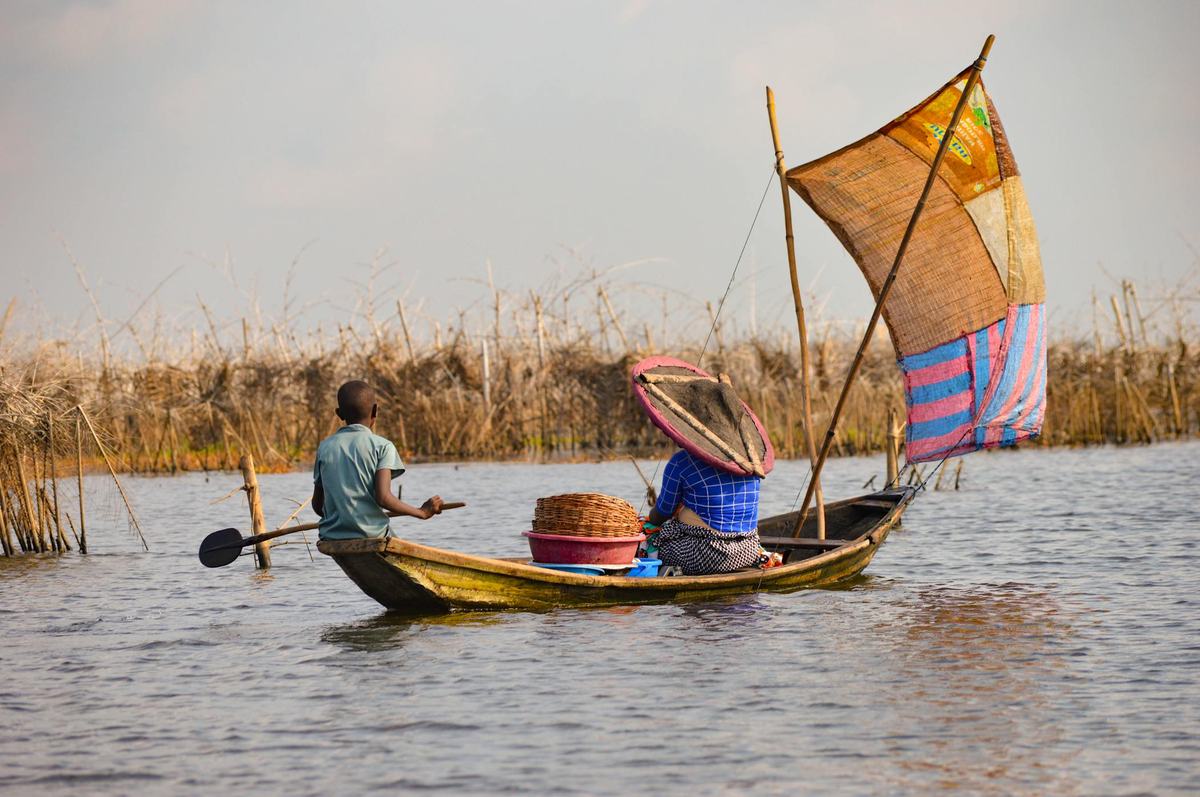
Ganvié: The Venice of Africa Built Entirely on Lake Nokoué
Ganvié sits roughly 15 kilometers north of Cotonou on Lake Nokoué, a brackish lagoon covering approximately 150 square kilometers. The settlement contains an estimated 20,000–30,000 residents living in stilt houses connected by canoe, making it one of the largest lake villages in Africa.
Why the Tofinu People Built Their City on Water - The Real Historical Reason
The founding of Ganvié wasn't romantic - it was survival strategy. The Tofinu people fled to the lake between the 16th and 18th centuries specifically because Fon warriors supplying the Dahomey slave trade were prohibited by religious custom from entering water. The lake was a literal legal boundary that slavers wouldn't cross. "Ganvié" translates roughly as "we survived" in Fon, a name that encodes this history directly.
Ganvié's Population Density Compared to Amsterdam and Other Canal Cities
With roughly 20,000 people concentrated on approximately 2 square kilometers of water surface, Ganvié's density reaches around 10,000 people per square kilometer - comparable to Amsterdam's densest canal districts and significantly higher than Venice's historic center, which averages closer to 4,600 per square kilometer.
The Pendjari Biosphere Reserve: One of West Africa's Last Lion Strongholds
Pendjari, covering 4,800 square kilometers in northwestern Benin, holds conservation significance far exceeding its size. African Parks took over management in 2017, and subsequent counts estimated the park holds approximately 250–350 lions - representing perhaps the largest lion population in West Africa and among the most genetically significant given regional fragmentation.
Lion and Elephant Population Data in Pendjari Compared to East African Parks
Pendjari's lion density of roughly one lion per 15–20 square kilometers compares modestly to Kenya's Maasai Mara, which sustains densities near one lion per 5 square kilometers. However, context matters: West African lions (Panthera leo leo) represent a genetically distinct subspecies. Pendjari also supports an estimated 2,500–3,000 elephants, a figure that would be unremarkable in Tanzania but represents a critical anchor population in a sub-region where elephants have been largely extirpated.
How Local Fulani Communities Co-Exist With Predators in Ways Kenyan Models Don't
Fulani pastoralists in Pendjari's buffer zones have historically managed livestock predation through nocturnal corralling and communal herding rotations rather than retaliatory killing - practices rooted in centuries of mobile pastoralism rather than externally imposed conservation programs. African Parks has built on these existing behaviors through direct compensation schemes and community ranger employment, a model that differs meaningfully from Kenya's more top-down conservancy structures where land leasing often displaces traditional land use entirely.
Economic Facts About Benin That Reveal a Surprisingly Strategic Nation
Why Cotonou Port Is More Important to West Africa Than Most People Know
Cotonou's autonomous port punches well above its weight in regional logistics. Sitting on the Gulf of Guinea with a draft capacity of around 13.5 meters, it processes approximately 10–12 million tonnes of cargo annually, handling not just Beninese imports and exports but serving as a critical gateway for several landlocked neighbors.
Landlocked Niger, Mali, and Burkina Faso: How Much They Depend on Benin's Infrastructure
Niger alone routes an estimated 70–80% of its formal import traffic through Cotonou, making Benin's port infrastructure existentially important to a country of 25 million people. Burkina Faso and Mali also use the corridor, though they divide traffic with ports in Lomé, Abidjan, and Dakar. The Cotonou-Niamey corridor stretches over 1,000 kilometers and is supported by formal transit agreements that waive certain duties for landlocked cargo-an arrangement that makes Benin a de facto logistics state rather than simply a coastal one.
Comparing Cotonou Port Throughput to Lomé and Lagos
Lomé's container terminal, operated by Bolloré, handles roughly 1.4 million TEUs annually and is often considered Cotonou's primary regional competitor. Cotonou handles closer to 500,000–600,000 TEUs per year-smaller in volume, but strategically differentiated by its road corridors into the Sahel. Lagos's Apapa Port, meanwhile, handles over 1 million TEUs but is chronically congested, which has historically pushed Nigerian importers to use Cotonou as an overflow gateway, particularly for vehicles and electronics.
Re-Export Trade: How Benin Built an Economy on Being a Commercial Middleman
The Unofficial Economy of Goods Moving Between Benin and Nigeria
Benin's re-export sector-predominantly goods entering through Cotonou and moving informally into Nigeria-has at times accounted for as much as 20–30% of GDP by some economist estimates, though formal statistics systematically undercount it. Vehicles, used electronics, textiles, and frozen foods flow across the porous 773-kilometer border. When Nigeria periodically closes land borders, as it did from 2019 to 2020, Benin's informal traders absorb significant economic shocks almost overnight, revealing how structurally dependent the model is on Nigerian demand.
Why Economists Study Benin's Informal Trade Networks as a Case Study in Resilience
The IMF and World Bank have used Benin as a reference point for understanding how informal cross-border trade can sustain livelihoods where formal employment is thin. The density of market women, motorcycle taxi networks (known locally as zémidjans), and small warehousing operations around Dantokpa Market-one of West Africa's largest open-air markets-illustrates a self-organizing economic system that formal policy frameworks struggle to replicate or replace.
Benin's Digital Ambitions: Surprising Tech and Governance Innovations
The ARCH Social Protection Program: A Biometric Safety Net Ahead of Its Regional Time
Launched in 2019 under President Patrice Talon, ARCH (Assurance pour le Renforcement du Capital Humain) combines health insurance, microfinance access, vocational training, and retirement support into a single biometrically registered platform targeting informal workers. The program enrolled over 600,000 beneficiaries in its initial phase, using national ID integration to reduce duplication-a level of administrative coordination rare in the region.
How Benin's Land Registry Digitization Became a World Bank Model for Africa
Benin digitized its land registry through the Registre Foncier Urbain (RFU) system, first piloted in Cotonou and later scaled nationally. The World Bank cited it as a replicable framework for francophone Africa, specifically for reducing land disputes, improving municipal tax collection, and providing collateral clarity for small business lending. By formalizing urban land titles at scale, Benin addressed one of the continent's most persistent barriers to private investment without requiring legislative overhaul.
Rare and Surprising Facts About Benin's People, Language, and Identity
Over 50 Languages in a Country of 13 Million: Benin's Linguistic Complexity
Fon, Yoruba, and Bariba: How Three Languages Shape Three Different Worlds Within One Border
Benin recognizes French as its sole official language, yet the country contains approximately 55 indigenous languages across a territory roughly the size of Pennsylvania. This isn't superficial diversity - it represents fundamentally distinct cultural operating systems coexisting within a single passport.
Fon dominates the south, spoken by around 24% of the population and forming the linguistic backbone of Vodun religious practice. Yoruba, shared with neighboring Nigeria, anchors the southeast and connects roughly 12% of Beninese citizens to a trans-border identity that predates colonial cartography. Bariba controls the north, spoken by approximately 9% of the population and tied to a warrior aristocracy tradition that shaped the Borgou region's political history for centuries. These aren't merely communication tools - they determine marriage networks, land inheritance systems, and spiritual authority.
Comparing Benin's Language Diversity Index to Switzerland and Papua New Guinea
Linguists use the Greenberg Linguistic Diversity Index (LDI) to quantify this complexity, scoring countries from 0 (complete uniformity) to 1 (maximum diversity). Benin scores approximately 0.79, placing it well above Switzerland at roughly 0.54, a country frequently cited in European discussions of multilingualism. Papua New Guinea remains the global outlier at 0.99, but Benin's score comfortably exceeds most nations its size, making it one of the most linguistically dense countries in West Africa per capita.
Benin's Name Has Nothing to Do With the Kingdom of Benin in Nigeria
The Historical Confusion Between the Republic of Benin and the Benin Kingdom of the Edo People
The Benin Kingdom - the sophisticated pre-colonial state famous for its bronze castings and centered in present-day Edo State, Nigeria - has no territorial, ethnic, or historical connection to the Republic of Benin. The confusion misleads students, journalists, and occasionally diplomats. The Edo people of Nigeria built Benin City; the Republic of Benin's population consists primarily of Fon, Yoruba, Bariba, and dozens of other ethnic groups who never governed from Benin City and share no dynastic lineage with it.
Why the Country Was Renamed From Dahomey to Benin in 1975 and the Political Motivation Behind It
President Mathieu Kérékou renamed the country from Dahomey to Benin in 1975, one year after seizing power in a Marxist-Leninist coup. The motivation was explicitly political: "Dahomey" referenced only the Fon-dominated Dahomey Kingdom, alienating northern ethnic groups essential to Kérékou's power base. The Bight of Benin, the coastal waters bordering the country, provided a geographically neutral alternative with no ethnic favoritism attached.
The Diaspora Connection: How Benin's Slave Trade Legacy Shapes Its Modern Foreign Relations
Official Apologies and Reparation Discussions With Brazil, Haiti, and the United States
Ouidah served as one of the Atlantic slave trade's most active embarkation points, with historians estimating over one million people departed through its ports between the 16th and 19th centuries. President Patrice Talon issued a formal apology in 2017 acknowledging Beninese royal complicity in slave trading - a rare act of governmental self-reckoning that opened substantive diplomatic conversations with Brazil, Haiti, and African-American advocacy organizations in the United States around restitution frameworks.
The Annual Ouidah Voodoo Festival as a Diaspora Reconnection Event Unlike Any Other
Every January 10th, Ouidah hosts the International Voodoo Festival, drawing practitioners from Brazil, Cuba, Haiti, and the United States - nations where Vodun survived the Middle Passage and evolved into Candomblé, Santería, and Haitian Vodou respectively. This isn't cultural tourism. It functions as a living archaeological site where fragmented religious traditions are actively cross-referenced against their Beninese origins, making Ouidah arguably the most consequential diaspora reunion site in the Atlantic world.
Fun and Unexpected Facts About Benin That Make It Truly Unique
Ouidah's Python Temple: A Sacred Sanctuary Where Pythons Roam Free Among Visitors
The Danxome Royal Python Cult and Its Centuries-Old Theological Foundations
The Temple des Pythons in Ouidah is not a tourist gimmick - it is an active Vodoun worship site where roughly 50 royal pythons (Python regius) live communally with priests and initiates. The cult traces its origins to the 17th-century Fon Kingdom of Dahomey, where the python deity Dangbé was considered a divine protector of the royal lineage. According to oral tradition, a python guided the founder of Abomey, Dako, to a militarily strategic location, cementing the species' sacred status for generations.
Visitors who enter the temple are encouraged to allow pythons to drape across their shoulders - a ritual act of blessing rather than spectacle. Priests feed the snakes weekly and conduct ceremonies aligned with the Vodoun liturgical calendar. Killing a royal python in Benin, even accidentally, traditionally required a full funeral rite comparable to that of a human being.
How the Python Temple Compares to Animal Sanctuaries in India and Southeast Asia
India's Shetpal village in Maharashtra is frequently cited as a parallel - cobras live freely in homes there, also protected by Hindu religious belief. Thailand's Wat Mangkon Kamalawat in Bangkok houses sacred animals under Buddhist protection. What distinguishes Ouidah is the theological integration: the pythons are not simply protected animals but active participants in ritual. The temple functions as both a living shrine and a theological institution, making it structurally closer to a functioning church than a wildlife sanctuary.
Benin Has One of the World's Highest Rates of Twin Births - and Here's the Scientific Reason
The Yoruba-Fon Dietary Hypothesis Linking Yams to Hyperovulation
Benin, particularly its southern Fon and Yoruba-adjacent communities, records twin birth rates approaching 27 per 1,000 births in some regional surveys - roughly three times the global average of approximately 9 per 1,000. The leading scientific hypothesis centers on wild yams (Dioscorea species), which contain phytoestrogens and a natural analog to the hormone gonadotropin. Elevated gonadotropin levels stimulate hyperovulation - the simultaneous release of multiple eggs - directly increasing dizygotic (fraternal) twin rates. Studies published in The Lancet have linked yam-heavy diets to elevated twinning rates across the West African yam belt.
How Twin Birth Rates in Benin Compare to Igbo-Ora in Nigeria and Kodinji in India
Igbo-Ora in Oyo State, Nigeria - often called the "Twin Capital of the World" - records rates above 45–50 per 1,000 births, still the global benchmark. Kodinji in Kerala, India, records approximately 45 per 1,000, with no clear dietary explanation yet confirmed. Benin's rates, while lower, are remarkable given their geographic consistency across multiple ethnic groups rather than one isolated community.
The Door of No Return at Ouidah: A Physical Monument to One of History's Greatest Crimes
Estimating the Number of Enslaved People Who Passed Through Ouidah Compared to Other Ports
Between approximately 1650 and 1860, an estimated 1 million enslaved people were shipped from the port of Ouidah alone - roughly 20% of all enslaved Africans transported across the Atlantic. The Trans-Atlantic Slave Trade Database (slavevoyages.org) documents Ouidah as one of the three busiest embarkation points globally, alongside Luanda in Angola and the Bight of Biafra ports. The symbolic arch known as the Door of No Return was erected in 1992 at the beach terminus of the 4-kilometer "slave road," marking the exact shoreline where captives were loaded onto ships.
The 1992 UNESCO Slave Route Project and Why It Started in Benin
UNESCO launched the Slave Route Project formally in Ouidah in 1994, two years after the Door of No Return's construction, choosing Benin deliberately because the country had by then conducted the most systematic archaeological and archival documentation of the trade on the African continent. The project's mandate - to break the silence around the slave trade through education and memory - found its most concrete physical expression in Benin, where the route from the slave market to the sea remains walkable and partially intact. Benin's government has since invested in heritage infrastructure along this corridor, making Ouidah one of the most historically legible slave trade sites anywhere in the Atlantic world.