Geography Facts About Bangladesh That Defy Expectations
Bangladesh Contains the World's Largest River Delta - And It's Still Growing
The Ganges-Brahmaputra-Meghna (GBM) Delta covers approximately 105,000 square kilometers, making it the largest river delta on Earth by a significant margin. For context, the Nile Delta spans roughly 24,000 square kilometers, and the Mississippi Delta covers around 28,000 square kilometers. The GBM Delta isn't just larger - it's an order of magnitude more hydrologically active, draining a combined catchment area of nearly 1.75 million square kilometers across five countries.
How the Ganges-Brahmaputra-Meghna Delta Compares to Other Deltas Worldwide
Most major deltas are contracting due to sediment starvation caused by upstream dams. The GBM Delta is a rare exception. While the Nile Delta is actually shrinking - losing land to Mediterranean erosion since the Aswan Dam cut off sediment supply - the GBM system still receives an estimated 1 billion tonnes of sediment annually from Himalayan erosion, one of the highest sediment loads of any river system globally.
Why the Delta Grows by Several Kilometers Each Year
New land - called chars locally - continuously emerges from sediment deposition in the Bay of Bengal. Some chars accumulate at rates of 2–5 kilometers per year in the delta's seaward fringe. These landforms are unstable, frequently disappearing and reemerging, but the net effect is measurable land gain in specific zones, even as other coastal areas face erosion and sea-level rise pressures.
The Sundarbans: Bangladesh Owns the Largest Mangrove Forest on Earth
The Sundarbans covers roughly 10,000 square kilometers total, with approximately 6,017 square kilometers falling within Bangladesh and the remainder in India. It is a UNESCO World Heritage Site and the most biologically productive mangrove ecosystem documented anywhere.
How the Sundarbans Compares to the Amazon Rainforest in Biodiversity Density
The Amazon dwarfs the Sundarbans in absolute size, but per square kilometer, the Sundarbans rivals it in vertebrate species density. The forest supports over 260 bird species, 42 mammal species, and more than 300 plant species - all within a single tidal ecosystem adapted to salinity gradients most forests cannot survive.
The Unique Saltwater Tigers That Swim Between Bangladesh and India
The Sundarbans Bengal tigers - estimated at 114 individuals on the Bangladesh side as of recent surveys - have behaviorally adapted to a semi-aquatic life, regularly swimming several kilometers between islands. Their regular saltwater swimming is documented across both national boundaries, making conventional wildlife reserves functionally inadequate without bilateral conservation coordination.
Bangladesh Has More Inland Waterways Than Almost Any Country Its Size
Over 700 Rivers: How This River Network Compares to the Netherlands
Bangladesh's 700-plus rivers comprise approximately 24,000 kilometers of navigable waterways. The Netherlands, often cited for its canal infrastructure, maintains roughly 6,200 kilometers of navigable inland water. Bangladesh's network - largely natural rather than engineered - serves as the primary transport infrastructure for millions of rural residents.
Why Rivers in Bangladesh Change Course Dramatically Every Monsoon Season
Annual monsoon discharge in major Bangladeshi rivers can increase 20-fold between dry and wet seasons. This hydraulic force routinely shifts river channels by hundreds of meters, eroding established banks and depositing new land elsewhere. The Jamuna River, the Bangladeshi distributary of the Brahmaputra, has shifted its main channel westward by over 10 kilometers in the past century alone.
Cox's Bazar: The World's Longest Natural Sea Beach and Why It's Largely Unknown
Comparing Cox's Bazar to Copacabana and Ninety Mile Beach
Cox's Bazar stretches an uninterrupted 120 kilometers along Bangladesh's southeastern coast. Copacabana measures just 4 kilometers. Australia's Ninety Mile Beach in Victoria runs approximately 151 kilometers but is interrupted by inlets and is partially estuarine. Cox's Bazar's claim to a continuous, unbroken natural sandy shoreline remains geographically defensible under strict criteria.
The Geological Forces Behind Its Unbroken 120-Kilometer Stretch
The beach's continuity results from a specific geological configuration: a long, gently sloping continental shelf that dissipates wave energy evenly, combined with sediment input from the Naf and Matamuhuri rivers that consistently replenishes the shoreline. The absence of major rocky headlands along this coastal segment - itself a product of regional tectonic history - prevents the formation of bays and promontories that fragment beaches elsewhere.
Little-Known Historical Facts About Bangladesh
Bengal Was the Wealthiest Region on Earth Before British Colonization
How Bengal's GDP Compared to Britain Itself in the Early 18th Century
In 1700, Bengal accounted for approximately 12% of global GDP - more than the entire British economy at the time. Economic historian Angus Maddison's research places Mughal India's share of world output at around 24.4% in 1700, with Bengal as its most productive province. Dhaka alone generated more textile revenue than all of England's manufacturing combined. This was not a subsistence economy; it was a sophisticated commercial network with trade routes extending to Europe, Persia, and Southeast Asia.
The Deliberate Deindustrialization of the Muslin Trade by the East India Company
Bengali muslin - particularly the legendary Dhaka muslin called woven air - was so fine that Mughal emperors wore it as a display of wealth. By the early 19th century, the East India Company systematically dismantled this industry through punitive tariffs of 70–80% on Indian textiles entering Britain, while British goods entered India at 2–3%. Some colonial accounts, though disputed by historians, allege weavers had their thumbs cut off. What is documented is economic strangulation: Dhaka's population collapsed from an estimated 150,000 in 1800 to under 30,000 by 1840 as the industry died.
Dhaka Was Once Called the 'City of Mosques' and Rivaled Amsterdam in Commerce
Dhaka's Population in 1600 Versus London's Population at the Same Time
At its Mughal peak around 1600–1650, Dhaka housed roughly 1 million residents, making it comparable in scale to Constantinople and larger than London, which had approximately 200,000 at the time. As the provincial capital of Bengal under Mughal Subahdar Islam Khan, it functioned as a major administrative and commercial hub with a thriving river port on the Buriganga.
The Forgotten Mughal Architecture Still Hidden Beneath Modern Dhaka
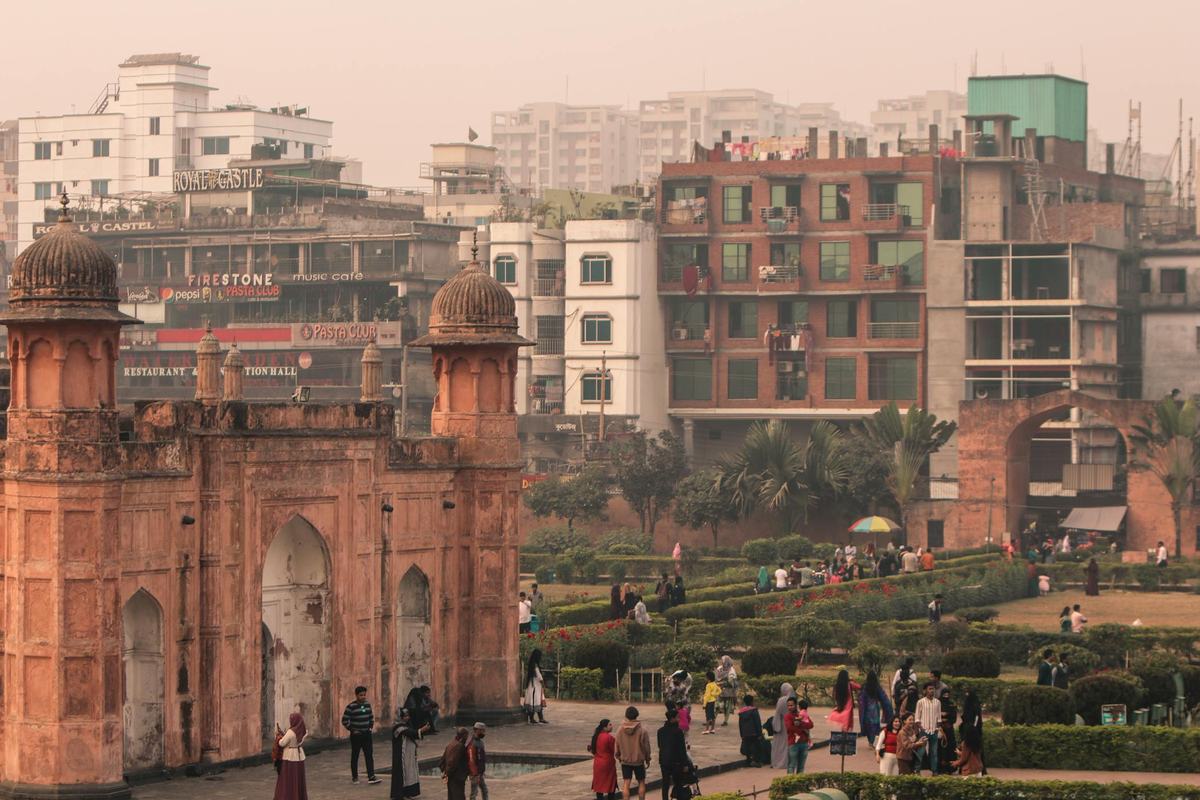
Over 800 mosques were reportedly built during the Mughal period. The Lalbagh Fort (1678), Chawk Mosque, and Sat Gambuj Mosque survive, but dozens of structures remain buried under urban development. Archaeological surveys have identified Mughal-era foundations beneath several Old Dhaka neighborhoods that have never been formally excavated.
Bangladesh Fought and Won Its Independence in Just Nine Months in 1971
Why the 1971 Liberation War Is One of the Fastest Successful Independence Movements in History
From the declaration of independence on March 26, 1971, to Pakistani surrender on December 16, Bangladesh achieved full military victory in 266 days - extraordinarily fast for any modern independence conflict. Indian military intervention in December was decisive, but the Mukti Bahini guerrilla network had already degraded Pakistani control across rural Bangladesh for months prior.
The Role of the Only Officially Recognized Genocide of the 20th Century Outside Europe
The 1971 atrocities carried out by the Pakistani military are estimated to have killed between 300,000 and 3 million Bengalis - figures still debated by scholars. Bangladesh, India, and several other nations officially recognize it as genocide. The Hamoodur Rahman Commission, Pakistan's own post-war inquiry, acknowledged systematic killings, though Pakistani governments have never issued a formal apology.
Wari-Bateshwar: A 2,500-Year-Old Urban Civilization Discovered in Bangladesh
How This Ancient City Compares to Mohenjo-Daro in Urban Planning
Excavations at Wari-Bateshwar in Narsingdi district, beginning seriously in the 1990s under archaeologist Habibullah Pathan, revealed a planned city dating to roughly 450 BCE. Fortified ramparts, punch-marked coins, semi-precious stone beads, and evidence of trade with Rome and Southeast Asia confirm this was a sophisticated urban center - not a simple settlement. Its grid-like layout parallels early Indus Valley planning principles.
What Wari-Bateshwar Tells Us About Pre-Islamic Bengal
The site conclusively proves Bengal had advanced urban civilization over a millennium before Islam arrived in the subcontinent. Artifacts include Roman carnelian beads and rouletted ware pottery consistent with Indo-Pacific trade networks, placing Bengali merchants in a global commercial system as early as the 1st century BCE - rewriting the standard narrative of Bangladesh as a civilization defined solely by its medieval Islamic heritage.
Remarkable Facts About Bangladesh Culture Few Outsiders Know
Bengali Is the Only Language for Which People Died to Protect Its Right to Be Spoken
The Language Movement of 1952 and How It Created International Mother Language Day
On February 21, 1952, Pakistani authorities opened fire on student protesters at the University of Dhaka who were demanding official recognition of Bengali alongside Urdu. At least five people died - Abul Barkat, Rafiquddin Ahmed, Abul Jabbar, Shafiur Rahman, and Abdul Aus - making them the only recorded martyrs in history to die specifically for the right to speak their mother tongue.
The dispute began in 1948 when Pakistan's founder Muhammad Ali Jinnah declared Urdu the sole national language, despite Bengali being spoken by over 56% of the new nation's population. The imposition was widely perceived as cultural suppression by West Pakistan over its eastern half, and the 1952 killings transformed linguistic identity into the founding grievance of what would eventually become Bangladesh's independence movement in 1971.
How UNESCO Elevated February 21 to a Global Celebration Because of Bangladesh
In 1999, UNESCO formally designated February 21 as International Mother Language Day, a direct acknowledgment of the 1952 martyrs. The proposal was submitted by Bangladesh and Canada jointly, driven largely by Bangladeshi diaspora activist Rafiqul Islam. The day is now observed in 193 UNESCO member states, promoting linguistic diversity and the preservation of endangered languages globally - of which there are approximately 7,000, with one disappearing roughly every two weeks.
No other language in the world has generated an internationally recognized UN memorial day through the deaths of its speakers.
Bangladeshi Muslin Was So Fine That Mughal Emperors Called It 'Woven Air'
The Technique Behind Dhaka Muslin That Made It Impossible to Mass Produce
Dhaka muslin - known historically as woven air (baft hawa) or running water (flowing water in Persian) - was produced exclusively from a specific cotton variety called Phuti karpas (Gossypium arboreum), grown only in a narrow stretch along the Meghna River near Dhaka. At its finest, a single sari could measure nine meters yet weigh under 100 grams and pass through a finger ring. Mughal Emperor Aurangzeb reportedly reprimanded his daughter for indecency - she was wearing seven layers.
The weaving required handlooms of exceptional precision and fingers conditioned by years of work in humid conditions, since the thread broke under dry heat. Thread counts reached 1,200 per inch, compared to 400–600 in premium contemporary cotton.
Why Artisans Are Attempting to Revive a Craft Nearly Wiped Out 200 Years Ago
British colonial taxation and deliberate suppression of local textile industries devastated Dhaka muslin production by the early 19th century. Some accounts - contested but widely cited - allege that weavers had their thumbs cut off to eliminate competition with Lancashire mills.
By the 20th century, the original Phuti karpas cotton was considered extinct. However, a Bangladeshi government-backed project rediscovered the plant in 2013 at Dhaka's botanical garden. By 2021, artisans had produced small quantities of authenticated muslin, with a single sari taking up to six months to complete and valued at tens of thousands of dollars.
Bangladesh Has a Distinct New Year Celebration That Predates the Islamic Calendar in the Region
Pohela Boishakh: How the Bengali New Year Compares to Thai Songkran and Iranian Nowruz
Pohela Boishakh, celebrated on April 14 (or 15 in West Bengal), marks the first day of the Bengali solar calendar - a system introduced by Mughal Emperor Akbar in 1584 to rationalize agricultural tax collection. Unlike the Islamic Hijri calendar, which is lunar and shifts annually, the Bengali calendar is solar and fixed to the harvest cycle, placing it in the same category as Iran's Nowruz and Thailand's Songkran as pre-Islamic, agrarian new year traditions.
The celebration is secular by design, involving large public processions (Mangal Shobhajatra), traditional music, street food, and wearing white and red - colors associated with the Bengal identity rather than any religious tradition. In 2016, UNESCO inscribed the Mangal Shobhajatra procession on its Intangible Cultural Heritage list.
The Political Dimension of Pohela Boishakh During and After the Liberation War
During Pakistani rule, Pohela Boishakh became an act of cultural resistance. The Pakistani state's promotion of Urdu and Islamic identity made Bengali cultural assertion inherently political. Following independence in 1971, the day was institutionalized as a national celebration, reinforcing a secular Bengali identity distinct from religious nationalism. In recent decades, the holiday has occasionally faced pressure from conservative religious groups who view its Hindu cultural roots as incompatible with Bangladeshi Islamic identity - a tension that reflects the ongoing negotiation between the country's secular founding principles and its majority Muslim population.
Facts About Bangladesh Culture: A Rare Harmony of Hindu, Buddhist, Muslim and Indigenous Traditions
How Baul Music Blends Sufi Islam with Hindu Bhakti Philosophy
The Bauls are a syncretic religious community and musical tradition unique to Bengal. Their philosophy draws simultaneously from Sufi Islam's emphasis on direct experience of the divine and Hindu Bhakti devotionalism's rejection of ritual hierarchy. Baul songs - performed with a one-stringed ektara and a small drum - address the moner manush ("man of the heart"), a concept with no direct parallel in orthodox Islam or Hinduism. UNESCO recognized Baul music as Intangible Cultural Heritage in 2008. The tradition is notable for explicitly rejecting caste, gender hierarchy, and organized religion, making it historically radical within South Asian culture.
The Chakma, Marma and Other Indigenous Communities of the Chittagong Hill Tracts
The Chittagong Hill Tracts (CHT) in southeastern Bangladesh is home to 13 recognized indigenous groups, including the Chakma, Marma, Tripura, and Tanchangya, with a combined population of approximately 600,000. These communities practice Theravada Buddhism, animism, and indigenous religions entirely distinct from the Bengali Muslim majority. Their traditional governance systems, woven textiles, and agricultural practices represent a cultural continuity stretching back centuries. The CHT Peace Accord of 1997 formally recognized many indigenous land rights, though implementation remains incomplete - a significant ongoing human rights concern documented by Amnesty International and the UN Special Rapporteur on Indigenous Peoples.
Economic Facts About Bangladesh That Shock Development Experts
Bangladesh Grew Faster Than India and China in Per Capita Income Over the Last Decade
How a Country Once Called a 'Basket Case' Became a Development Model
Henry Kissinger's 1971 dismissal of Bangladesh as an "international basket case" aged poorly. Between 2011 and 2021, Bangladesh's per capita income grew at an average annual rate exceeding 6 percent, outpacing both India and China during the same period. By 2020, Bangladesh's per capita GDP ($2,227) had actually surpassed India's ($1,961) - a fact that stunned economists who had spent decades treating India as the regional benchmark. The World Bank now formally categorizes Bangladesh as a lower-middle-income country, and projections point toward upper-middle-income status before 2031.
Comparing Bangladesh's GDP Growth Rate to Vietnam and Ethiopia
Among the few peer comparisons that hold up, Vietnam and Ethiopia stand out. Bangladesh maintained GDP growth above 7 percent for six consecutive years before the COVID-19 disruption, a trajectory matching Vietnam's and exceeding Ethiopia's in consistency. Unlike Ethiopia, Bangladesh achieved this without heavy reliance on a single commodity export. Unlike Vietnam, it did so with substantially weaker institutional infrastructure - making the performance more, not less, remarkable to development economists.
Bangladesh Is the Second Largest Garment Exporter in the World After China
Why Bangladesh Produces 60 Percent of the World's Denim Yet Most Consumers Don't Know It
Bangladesh exports roughly $42 billion worth of garments annually, accounting for approximately 84 percent of the country's total export earnings. It holds around 6.3 percent of global apparel market share - second only to China. The denim concentration is particularly striking: Bangladesh manufactures an estimated 60 percent of the world's denim fabric, supplying brands including H&M, Zara, and Levi's. Supply chain opacity keeps this invisible to most consumers.
How the Garment Industry Employs More Women Than Any Sector in South Asia
Approximately 4 million workers are employed in Bangladesh's garment sector, with women comprising around 60 to 65 percent of that workforce. No other industry in South Asia employs women at this scale or density. Labor economists link this directly to improvements in female literacy, delayed marriage age, and household bargaining power - outcomes that compound across generations.
Bangladesh Invented the Modern Concept of Microfinance Through Grameen Bank
How Muhammad Yunus's Model Has Been Replicated in Over 100 Countries
Grameen Bank, founded by Muhammad Yunus in 1983, pioneered collateral-free lending to the rural poor. The model has since been replicated across more than 100 countries, including the United States. Yunus received the Nobel Peace Prize in 2006. Grameen itself serves over 9 million borrowers, with a loan recovery rate consistently above 97 percent.
Comparing Grameen Bank's Reach to Traditional Banking Systems in Rural Economies
In rural Bangladesh, Grameen and similar microfinance institutions reach communities where traditional banks have no physical presence. BRAC, founded in Bangladesh, operates in 11 countries and is considered the world's largest NGO by employee count.
Bangladesh Has Cut Child Mortality Faster Than Most Countries in the World
How Bangladesh Outperformed Its Neighbors India, Pakistan and Nepal on Health Metrics
Bangladesh reduced its under-five mortality rate from 144 per 1,000 live births in 1990 to under 30 by 2022 - a reduction exceeding 79 percent. This outpaced India, Pakistan, and Nepal across the same timeline despite Bangladesh having lower per capita health expenditure than all three.
The Specific Community Health Worker Model That Drove These Results
The BRAC community health worker program deployed over 100,000 trained female volunteers - called Shasthya Shebikas - into rural households, delivering oral rehydration therapy, vaccination support, and maternal health education. This decentralized, low-cost model is now studied in public health curricula globally as a replicable template for resource-constrained health systems.
Environmental and Climate Facts About Bangladesh
Bangladesh Is One of the Countries That Has Contributed Least to Climate Change Yet Faces Its Worst Effects
Few injustices in global environmental politics are as stark as Bangladesh's climate position. The country emits approximately 0.56 metric tons of CO₂ per capita annually. Compare that to Germany at roughly 8 tons, the United States at over 14 tons, and Australia at nearly 15 tons per capita, and the disparity becomes difficult to overstate. Bangladesh contributes less than 0.4% of global greenhouse gas emissions, yet climate scientists consistently rank it among the five most climate-vulnerable nations on Earth.
How Rising Sea Levels Could Submerge 17 Percent of Bangladesh's Land by 2050
Bangladesh sits on the world's largest river delta, the Ganges-Brahmaputra-Meghna system, with roughly 80% of its landmass classified as floodplain. According to projections from Climate Central and the IPCC, a one-meter rise in sea levels - a realistic scenario under moderate emissions trajectories - could permanently inundate approximately 17% of the country's total land area by 2050. That represents territory home to an estimated 20 million people, concentrated primarily in the coastal districts of Khulna, Satkhira, and Barisal.
Bangladesh Has More People Displaced by Climate Events Per Year Than Any Other Nation
The Internal Displacement Monitoring Centre (IDMC) consistently records Bangladesh as the country with the highest annual internal displacement from weather-related events. In 2022 alone, over 7.1 million displacement events were recorded within Bangladesh due to floods, cyclones, and riverbank erosion - a figure that routinely surpasses the total displaced by conflict globally in individual years.
How the Annual Number of Climate Displaced Persons Compares to Syrian Refugee Numbers
To contextualize the scale: the Syrian refugee crisis, one of the defining humanitarian emergencies of the past decade, produced approximately 6.6 million refugees at its peak. Bangladesh internally displaces a comparable or greater number of people every single year - yet receives a fraction of the international humanitarian attention or funding.
The Floating School Innovation Bangladesh Developed in Response to Annual Flooding
In response to the reality that flooding regularly cuts off children from education for months at a time, Bangladeshi NGO Shidhulai Swanirvar Sangstha developed a network of solar-powered floating schools operating across the river-dense northwest. Over 20,000 students now access education via boats fitted with libraries, internet access, and climate-resilient learning materials. The model has since been replicated in Cambodia, Nigeria, and the Philippines.
Bangladesh Has Planted More Trees in a Single Day Than Any Other Country on Record
The National Tree Plantation Campaign and How It Compares to Ethiopia's Record
While Ethiopia gained global attention in 2019 for planting 350 million trees in a single day, Bangladesh's National Tree Plantation Campaign has logged comparable single-day figures in coordinated drives, with some estimates placing participation across millions of households simultaneously during annual monsoon plantation seasons.
Why Community-Led Afforestation in Bangladesh Is Studied by Environmental Scientists Globally
What distinguishes Bangladesh's afforestation model is its community-ownership structure. Rather than government-top-down planting drives, local councils, schools, and women's cooperatives take direct custodianship of planted trees, producing significantly higher survival rates - an area now studied by researchers at institutions including the World Agroforestry Centre as a replicable model for tropical afforestation.
Surprising Social and Demographic Facts About Bangladesh
Bangladesh Is More Densely Populated Than Any Large Country Except Singapore and Monaco
Comparing Bangladesh's Population Density to Japan, the Netherlands and South Korea
Bangladesh packs approximately 170 million people into 147,570 square kilometers, producing a population density of roughly 1,150 people per square kilometer. To contextualize that figure: Japan averages around 334 people per square kilometer, the Netherlands approximately 423, and South Korea about 516. Bangladesh nearly doubles South Korea's density and is more than three times as crowded as the United Kingdom. Among nations with populations exceeding 10 million, only city-states like Singapore and Monaco register higher densities - and neither functions as an agricultural nation feeding its own population.
How 170 Million People Sustain Food Security in a Territory the Size of Iowa
Iowa covers roughly 145,746 square kilometers and supports about 3.2 million people. Bangladesh uses nearly identical land to sustain 53 times that population - and has largely achieved food self-sufficiency in doing so. Rice yields have tripled since independence, driven by adoption of high-yield varieties and expanded irrigation. The country now produces approximately 36 million metric tons of rice annually. Seasonal flooding, rather than working purely against agriculture, deposits nutrient-rich silt that maintains soil fertility without heavy fertilizer inputs. Bangladesh has also become one of the world's largest producers of vegetables and freshwater fish, both critical protein and caloric sources at the household level.
Bangladesh Has Had Female Leadership for Longer Than Almost Any Democracy in the World
The Unique Phenomenon of Two Women Alternating as Prime Minister for Over Three Decades
Sheikh Hasina of the Awami League and Khaleda Zia of the Bangladesh Nationalist Party have dominated Bangladeshi politics since 1991, alternating as Prime Minister across multiple terms. This means Bangladesh sustained female executive leadership - held specifically by women - for the majority of the past three decades. No comparable democracy has maintained that pattern for as long with two distinct female leaders trading power within a competitive electoral system.
Comparing Female Political Leadership Continuity in Bangladesh Versus the UK, Germany and USA
Germany had Angela Merkel for 16 consecutive years - exceptional by global standards. The UK has had two female Prime Ministers across its entire history. The United States has never elected a female president. Bangladesh, by contrast, has had a woman serving as Prime Minister for the vast majority of the time since 1991. The drivers are complex: both leaders inherited political dynasties from assassinated male relatives, meaning patriarchal structures paradoxically elevated women to power. Regardless of mechanism, the durational record is empirically striking.
Dhaka Has More Rickshaws Than Any City on Earth
The Estimated 400,000 Rickshaws of Dhaka and Why the City Could Not Function Without Them
Dhaka's registered rickshaw count officially sits around 80,000, but operational estimates consistently range between 400,000 and 600,000 when unregistered vehicles are included. They move an estimated 40 percent of the city's daily passenger trips, navigating alleyways that buses and cars cannot access.
How Rickshaw Art in Bangladesh Became a Recognized Folk Art Form
Bangladeshi rickshaw painting - vivid scenes of nature, film stars, and rural life applied to the vehicle's hood and body panels - has been submitted for UNESCO Intangible Cultural Heritage recognition. Artists train for years under master painters, and original decorated rickshaws now appear in international folk art collections, including institutions in Europe and North America.
Fun Facts About Bangladesh That Make It Uniquely Fascinating
Bangladesh Has a Hilsa Fish So Important It Has Cultural, Economic and Diplomatic Significance
No single species defines a nation's food culture quite like the hilsa (Tenualosa ilisha) defines Bangladesh. The country produces roughly 60 percent of the world's total hilsa catch, contributing over 1 percent of national GDP and employing approximately 5 million people across fishing, processing, and trade sectors.
Why the Hilsa Became a Diplomatic Gift Between Bangladesh and India
Hilsa runs up both Bangladeshi and Indian rivers to spawn, making it a genuinely transboundary resource. Bangladesh periodically exports hilsa to India as a formal diplomatic gesture, particularly around Durga Puja when Bengali Hindu communities in West Bengal consider the fish essential. In 2019, Bangladesh gifted 500 metric tons to India specifically timed to the festival season. These shipments carry symbolic weight far beyond their commercial value-they signal the temperature of bilateral relations in a way that formal communiqués cannot.
The Festival Calendar and Rituals Built Around a Single Species of Fish
Pahela Baishakh, the Bengali New Year celebrated on April 14, is structurally incomplete without panta ilish-fermented rice served with fried hilsa. Restaurants in Dhaka charge premium prices for hilsa on that single day, and the dish functions almost as a national sacrament. The monsoon arrival triggers a seasonal ban on hilsa fishing to protect juvenile stocks, and lifting that ban is itself treated as a minor cultural event. Entire communities in coastal districts like Chandpur and Barisal organize their annual economic calendars around hilsa migration patterns.
The World's Largest Ship-Breaking Industry Operates on Bangladesh's Coast
How Chittagong Handles Over 50 Percent of the World's End-of-Life Ocean Vessels
The beaches of Sitakunda, just north of Chittagong, receive and dismantle more retired ocean vessels than anywhere else on earth. In peak years, Bangladesh accounts for roughly 50 to 60 percent of global ship-breaking tonnage. Workers using cutting torches and manual labor break down supertankers that are sometimes 300 meters long, recovering steel that feeds the country's construction industry-estimates suggest ship-breaking supplies 20 percent of Bangladesh's domestic steel needs.
Comparing Chittagong's Ship-Breaking Yards to Alang in India and Aliaga in Turkey
Alang in Gujarat handles significant volume and operates under slightly stricter environmental protocols. Aliaga in Turkey focuses on smaller vessel classes and serves European decommissioning contracts. Chittagong dominates because labor costs remain exceptionally low, beach gradients allow vessels to be driven directly ashore at high tide, and regulatory enforcement has historically been limited. The trade-off is severe: occupational fatality rates in Sitakunda are among the highest of any industrial sector in South Asia.
Bangladesh Has a Village That Produces 80 Percent of the World's Hand-Embroidered Kantha Quilts
The Ancient Tradition of Recycling Worn Saris Into Works of Art
Kantha is not decorative textile production in the conventional sense-it originated as practical recycling. Women layered worn cotton saris and stitched them together using a simple running stitch, creating quilts that were both functional and visually intricate. The tradition is concentrated in Rajshahi and Jessore districts, where specific villages have developed distinct regional motifs passed down across generations.
How Kantha Embroidery Compares to Japanese Sashiko and Indian Phulkari as a Global Textile Tradition
Sashiko uses indigo-dyed fabric with white thread in geometric patterns, originating from Japanese rural reinforcement techniques. Phulkari from Punjab features dense floral silk embroidery on coarse cotton. Kantha distinguishes itself through narrative density-panels often depict cosmological scenes, folk stories, and daily life in compositions that function as visual literature. Unlike Phulkari, which remains primarily ceremonial, kantha quilts were everyday household objects elevated to art by necessity.
Bangladesh's National Anthem Was Written by a Hindu Poet Who Also Wrote India's National Anthem
How Rabindranath Tagore's Dual Legacy Connects Two Nations
Rabindranath Tagore wrote Amar Shonar Bangla in 1905 during the first partition of Bengal, as a protest against British administrative division of the region. Bangladesh adopted it as its national anthem upon independence in 1971. Tagore also wrote Jana Gana Mana, adopted by India in 1950. He remains the only person in history to have authored the national anthems of two sovereign nations.
The Rare Historical Circumstance of One Person Authoring Anthems for Two Different Countries
The circumstance was not engineered-it emerged from the specific geography of Tagore's emotional and political loyalties. Both songs were written decades before either nation existed in its current form. Sri Lanka's national anthem was composed by Ananda Samarakoon, a student of Tagore, extending his cultural reach to a third country indirectly. The symmetry is historically unrepeatable: no geopolitical realignment is likely to again produce conditions where a single poet's work serves as the sovereign musical identity of multiple independent states.