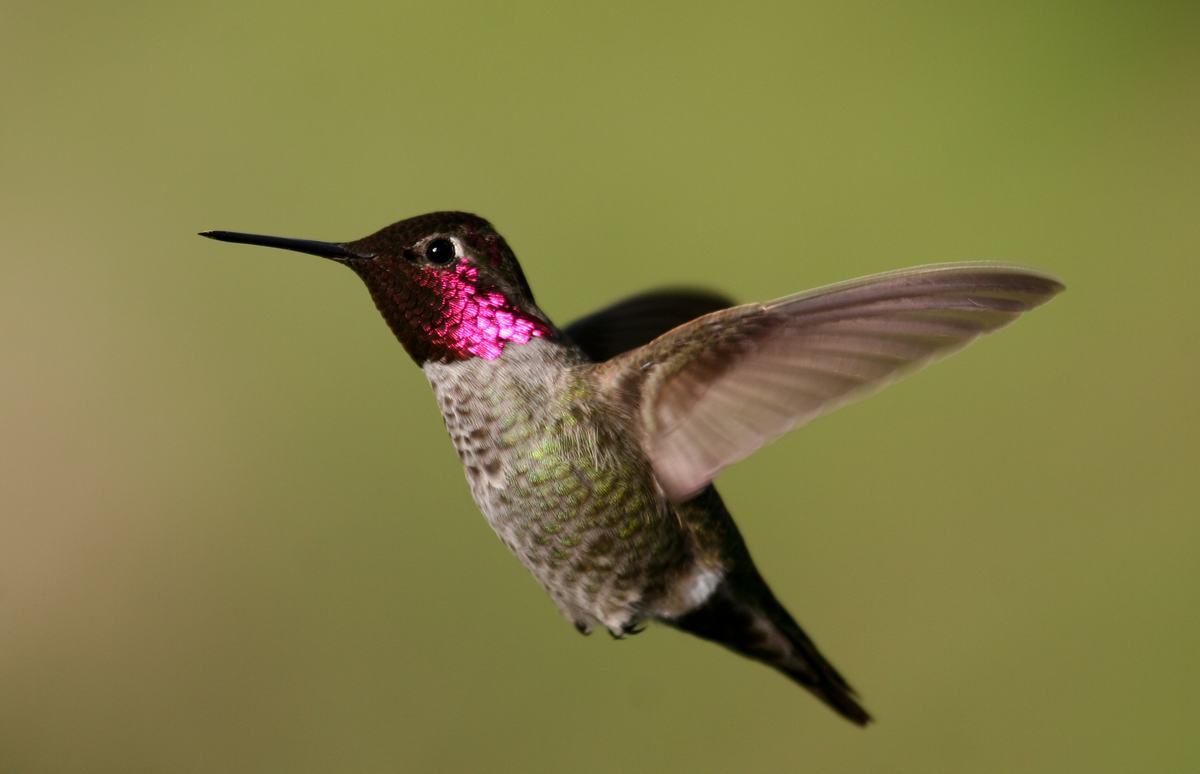
If you asked my Year 4 class to draw the smallest bird in the world, they would draw something you could cup in one hand. They would still be too generous. Hummingbirds are barely there. And yet, gram for gram, they are some of the hardest-working animals on the planet. Here are a few things worth knowing about them.
Smaller Than a Single Penny
The bee hummingbird of Cuba is the smallest bird alive. It measures about 5 to 6 centimetres from beak to tail and weighs roughly 2 grams [4], which is lighter than a single penny. A good deal of that length is just beak and tail feathers, so the actual bird is tinier still. There are more than 360 species in the family, and every last one of them lives only in the Americas [1]. Nowhere else. Somehow.
The Only Birds That Reverse
Most birds go forwards. Hummingbirds do as they please. They are the only birds able to hover in one spot for long stretches and fly properly backwards [4], which they manage by rotating their wings in a figure-of-eight rather than simply flapping up and down. My kids find this genuinely unfair, given how long it takes them to learn to ride a bicycle. The wings can beat up to around 80 times every second in some species [4], fast enough that all you see is a blur and all you hear is the hum they are named after.

A Heart Going Like the Clappers
All that flying has to be paid for somewhere, and the bill lands on the heart. A hummingbird's heart can beat more than 1,200 times a minute when the bird is active [4]. For comparison, a calm human heart plods along at 60 to 100. Their tiny chests are essentially tiny engines running at full throttle, which is why the rest of their lives is a constant scramble to find enough fuel to keep the thing turning over.
The Tongue Was a Mystery for 180 Years
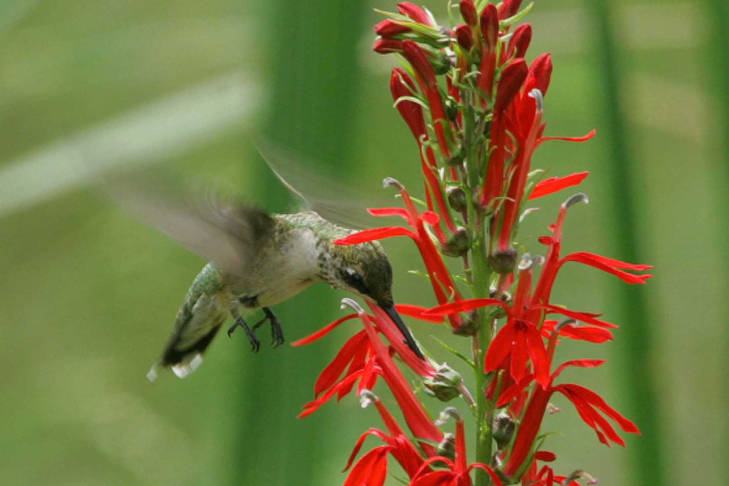
For nearly 180 years, scientists were quietly wrong about how hummingbirds drink [5]. Everyone assumed the nectar simply wicked up the grooved tongue like liquid up a straw. Then high-speed cameras had a look. It turns out the tongue works like a tiny elastic pump: the grooves are squeezed flat inside the beak, then spring open the instant they touch nectar, pulling the liquid up [2]. A hummingbird can do this up to 20 times a second [5]. Two centuries of textbooks, quietly corrected.
Living on the Edge of Empty
A hummingbird is almost always a little bit hungry. To keep those engines running, they visit hundreds of flowers a day and eat roughly their own body weight in nectar over the course of it [4]. Imagine eating your own weight in sugar before teatime. They also snap up small insects and spiders for protein, because nectar alone will not build a bird. It is a life lived very close to running out, refuelled again and again.
They Switch Themselves Off at Night
Here is the part nobody warned me about. A hummingbird cannot eat while it sleeps, and it cannot afford to burn fuel at its normal frantic rate all night. So it more or less powers down. It drops into a deep sleep called torpor, letting its body temperature fall and its heart rate slow dramatically [3]. A bird that ran at 1,200 beats a minute by day can idle far lower by night. In the morning it warms back up and starts again.

A Tiny Bird, a Very Long Sea
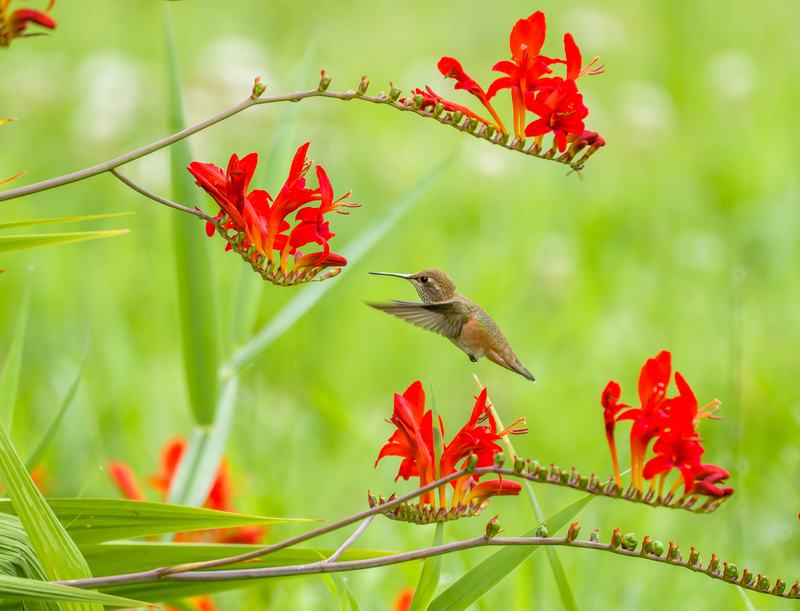
You would not send something this small across an ocean. Nobody told the hummingbirds. Many ruby-throated hummingbirds fly nonstop across the Gulf of Mexico on migration, a crossing of hundreds of kilometres of open water with nowhere to land [1][3]. To manage it they fatten up beforehand, sometimes nearly doubling their body weight in stored fuel [3]. A bird lighter than a penny, crossing a sea. Which, fair enough, is one of the more absurd things a body can do.
Colours That Are Not Really There
The dazzling throat of a male hummingbird is a bit of a trick. Those blazing reds and greens are not pigment in the usual sense. They come from the microscopic structure of the feathers, which bends light so that the colour flares and vanishes as the bird turns [4]. Watch one shift its head and the fiery throat can wink out to plain grey in an instant. The colour was never really there in the paint. It was there in the light.
Nests the Size of a Walnut
Everything about a hummingbird is scaled down, nursery included. The nest is often around the size of a walnut, built from plant down and spider silk so it can stretch as the chicks grow [1]. The eggs are about the size of a small pea. Two of them is a typical clutch. It is, I think, the most delicate thing I have ever squinted at through binoculars, and I have looked at a lot of nests.
Frequently Asked Questions
What is the smallest hummingbird?
The bee hummingbird of Cuba is the smallest, at about 5 to 6 centimetres long and roughly 2 grams in weight [4]. That also makes it the smallest bird species in the world. Much of its length is beak and tail, so the body itself is tinier still.
Can hummingbirds really fly backwards?
Yes. Hummingbirds are the only birds that can hover in place for long periods and fly backwards [4]. They do it by moving their wings in a rapid figure-of-eight rather than a simple up-and-down flap, which lets them push air in almost any direction.
How fast does a hummingbird's heart beat?
A hummingbird's heart can beat more than 1,200 times a minute when it is active [4]. At night it enters torpor, a deep sleep in which the heart rate and body temperature drop steeply to save energy [3]. This lets it survive without feeding until morning.
What do hummingbirds eat?
Mostly nectar from flowers, plus small insects and spiders for protein [4]. Because their metabolism is so fast, they visit hundreds of flowers a day and eat close to their own body weight in food. They cannot go long without refuelling.
How do hummingbirds drink nectar?
Their tongue works like a tiny elastic pump [2]. The grooves along it are pressed flat inside the beak and spring open when they touch nectar, drawing the liquid up, up to about 20 times a second [5]. Scientists misunderstood this for nearly 180 years.
Sources
- Ruby-throated Hummingbird Overview - Cornell Lab of Ornithology, All About Birds
- Hummingbird tongues are elastic micropumps - Proceedings of the Royal Society B
- NETN Species Spotlight: Ruby-throated Hummingbird - U.S. National Park Service
- Hummingbirds - Pollinator Partnership
- Long Misunderstood, Hummingbird Tongue Works Like Micropump - Live Science