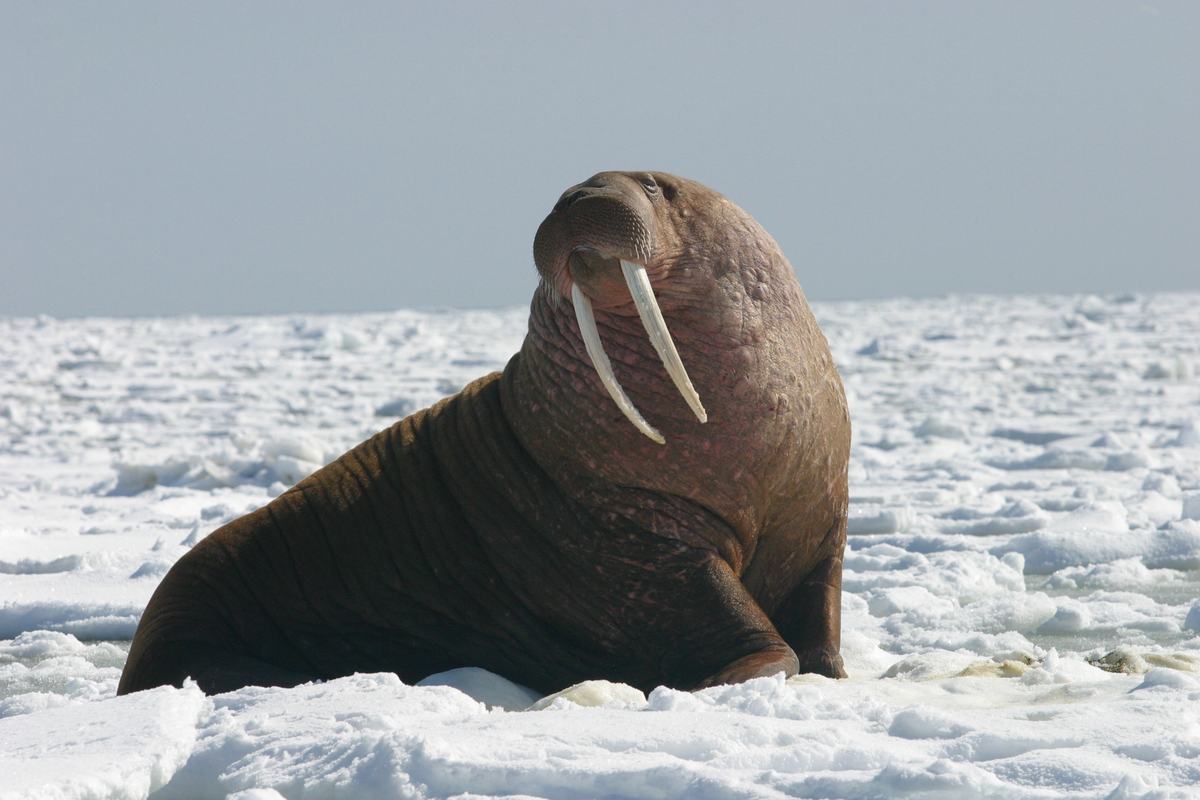
If you asked my Year 4 class to draw a walrus, you would get tusks, a moustache, and a lot of wobble. They would not be wrong. But the tusks are teeth, the moustache is a precision instrument, and the wobble is roughly a tonne of blubber doing a very important job. Walruses look comic. They are, on closer inspection, extremely well engineered.
A Two-Tonne Animal on Ice
A big male Pacific walrus can weigh around 1,500 kilograms, and some tip past 1,800 [1]. That is car territory. And yet they spend much of their lives hauling that bulk out of freezing water and onto ice or rock, over and over. The body is mostly blubber, which can be several centimetres thick [2]. It keeps the heat in, stores energy, and doubles as a rather generous cushion. Handy, when you weigh as much as you do.
Those Tusks Are Teeth
The tusks are not weapons the walrus went shopping for. They are canine teeth that never stopped growing, and both males and females have them [1]. They can reach about a metre in a large bull [3]. Walruses use them to haul their bodies up onto the ice, which is why the scientific name, Odobenus, roughly means "tooth-walker" [3]. They also settle arguments over space and status. As it turns out, a good set of tusks is less about hunting and more about parking.

The Moustache Does the Hunting
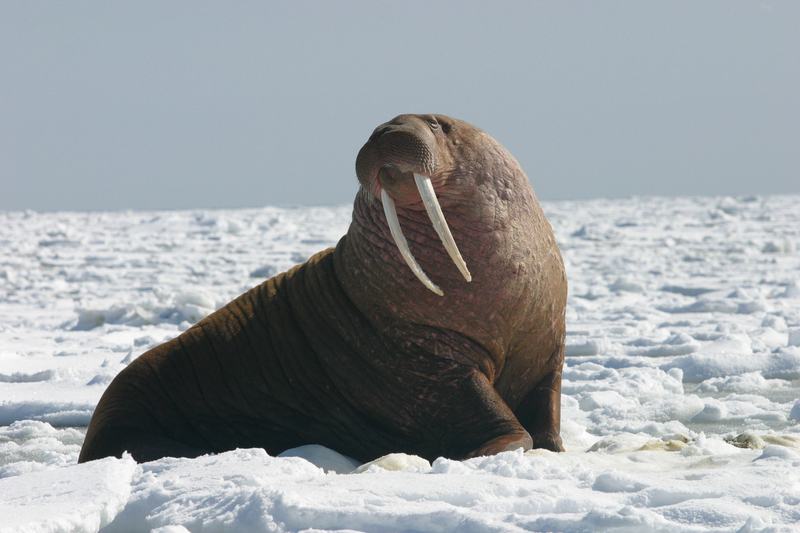
That splendid moustache is called a mystacial pad, and it holds a few hundred stiff, sensitive whiskers called vibrissae [4]. Down in the dark, murky seabed, a walrus cannot see much. So it feels. It sweeps its snout across the mud and reads the shape of a clam through the whiskers alone [4]. The eyes are almost off duty. The moustache is the sensor. My kids would love this: the walrus basically hunts dinner by touch, like fishing about in a bag for your keys.
Dinner Is Eaten by Suction
Once a walrus finds a clam, it does not crunch through the shell. It seals its lips over the shell, draws its tongue back like a piston, and sucks the soft body straight out [4]. The empty shell drops back to the seabed. A single walrus can hoover up thousands of clams in one feeding session [2]. All that whisker-work, all that diving, and the meal itself takes about a second per clam. Efficient, if slightly rude at the table.
Skin That Changes Colour
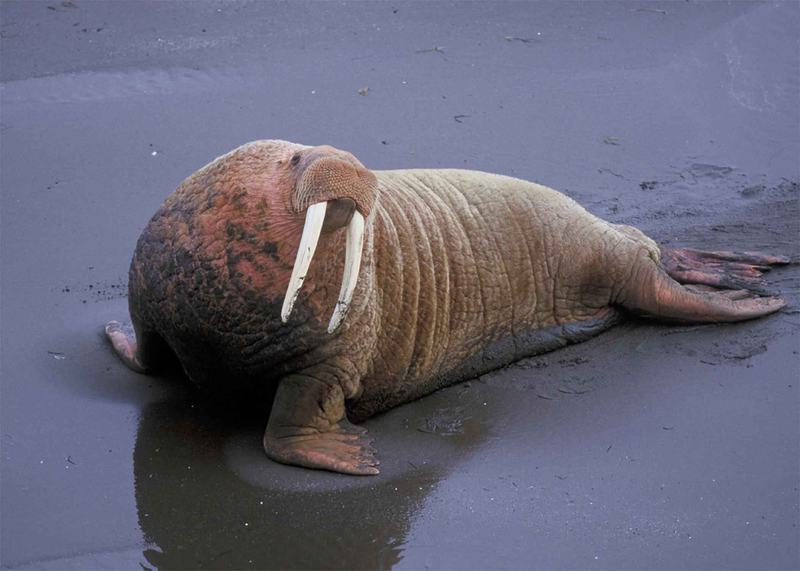
Here is one that surprises people. A walrus resting on cold ice can look pale, almost greyish white. Warm it up in the sun, or after a swim, and it flushes a ruddy pinkish brown [2]. This is not mood or magic. In cold water the blood vessels near the skin clamp down to save heat, so the animal looks pale. Warm again, the vessels open, blood rushes back to the surface, and the walrus turns rosy. A living thermometer, basically.

They Sleep in the Water
Walruses do not always need dry land for a nap. They have two air sacs in the throat, pouches they can inflate like built-in armbands [3]. Filled with air, these let a walrus bob upright at the surface, head above water, and doze off without sinking [3]. So a herd can be resting on the ice, and a few members can be quietly asleep, floating, out in the open sea. Nobody warned me about this one.
Loud, and Proud of It
Walruses are noisy. They grunt, they bellow, they whistle, and males in the breeding season produce a strange bell-like sound using those throat pouches [4]. A big haul-out of thousands of animals is, by all accounts, deafening. Underwater the males keep up long, rhythmic sequences of knocks and pulses to impress females [4]. It is less a song and more a percussion solo that goes on for hours. Which, fair enough, if it works.
Devoted Mothers
Walrus calves are looked after longer than you might expect. A mother nurses her calf for two years or more, and the youngster often rides on her back through the water while it is small [2]. In a group, females are notably protective of the young, their own and sometimes others too [2]. For an animal this heavy, the tenderness catches you off guard. Two years is a long school run.
Frequently Asked Questions
How big can a walrus get?
Large male Pacific walruses commonly weigh around 1,500 kilograms and can exceed 1,800. Females are smaller, typically around 800 to 900 kilograms. Both sexes carry a thick layer of blubber, which makes up much of that weight and keeps them warm in Arctic waters.
What do walruses eat?
Walruses mainly eat clams and other soft seabed invertebrates such as worms and snails. They find prey in the dark using their sensitive whiskers, then suck the soft body out of the shell rather than biting through it. A single feeding session can involve thousands of clams.
Why do walruses have tusks?
Tusks are overgrown canine teeth found in both males and females. Walruses use them to haul their heavy bodies out of the water onto ice, to break breathing holes, and to display dominance. They are not primarily hunting tools, despite their fearsome look.
Are walruses endangered?
The walrus is currently listed as Vulnerable by the IUCN. The main long-term concern is the loss of sea ice, which walruses rely on for resting, giving birth, and reaching feeding grounds. Reduced ice forces larger, more crowded haul-outs on land.