Since 2012, the astronomical unit has not been measured — it has been declared. Astronomers stopped chasing an ever more precise value for the average Earth-Sun distance and simply fixed it at 149,597,870,700 metres, full stop. That is the strange ending to a puzzle people started poking at more than two millennia ago.
The astronomical unit is one of astronomy's basic yardsticks, a stand-in for Solar System distances that would otherwise drown in zeros. Getting its value right took observers through ancient geometry, a Flemish astronomer redoing century-old sums, a rare planetary crossing watched from opposite sides of the globe, and eventually a passing asteroid. The story below traces how a number now treated as a fixed constant was, for most of its history, one of the hardest things in the sky to pin down.
A Distance Fixed by Definition, Not by Measurement
Today the astronomical unit is defined as a length equal to exactly 149,597,870,700 metres — no error bars, no uncertainty. Before the 2012 redefinition, it was understood more loosely: the average of Earth's closest and farthest points from the Sun over a year, a figure that shifted slightly every time measuring technique improved.
That older, physically grounded version is also why the unit shows up in a discussion of light. Under the IAU's 2009 standard, a beam of light needs 499.0047838061 seconds — a little over 8 minutes and 19 seconds — to cross one astronomical unit. Fixing the unit's metre value by decree, rather than by observation, meant that travel time could finally be stated to ten decimal places instead of chasing a moving target forever.
Ancient Geometry, Centuries of Correction
The earliest known attempt to size up the Earth-Sun gap is startlingly old. Around 280 BCE, Aristarchus measured the angle between the Moon, Earth and Sun at the exact moment the Moon showed a first-quarter phase, then used that angle to work out how far away the Sun had to be. The geometry behind the method was sound; the instruments of the era were not, and the resulting distance fell far short of reality.
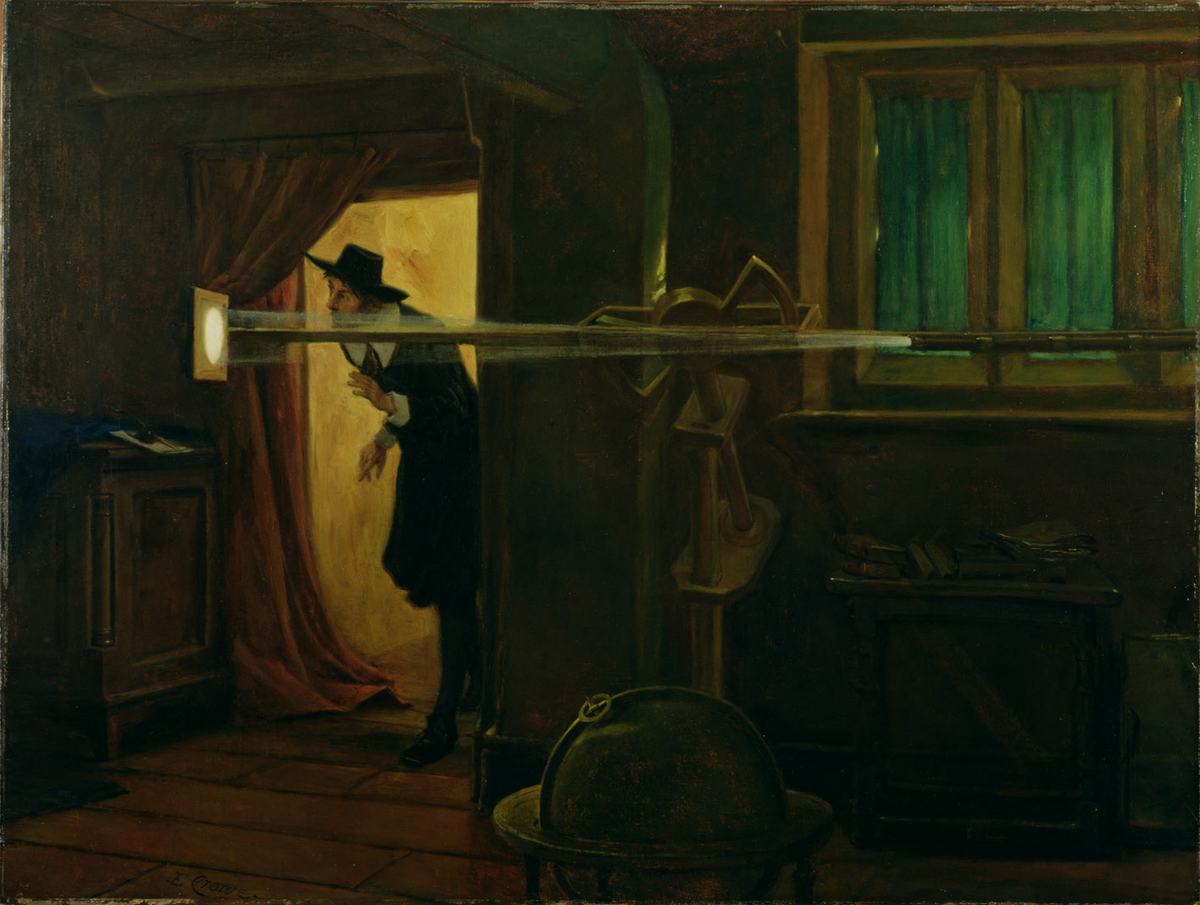
It took a long while for anyone to seriously challenge that error. In 1635, the Flemish astronomer Godefroy Wendelin repeated Aristarchus' observation and found that Ptolemy's figure was off by at least a factor of eleven. A few decades on, two more pieces slotted into place: in 1669, Jean Picard produced a trustworthy measurement of Earth's own radius, putting it at 3,269,000 toises, and in 1676, astronomer Ole Romer showed that light itself takes measurable time to travel — a discovery so useful that astronomers began describing the Sun-Earth gap in terms of light travel time, a habit that stuck.
Naming the Ruler, Then Sharpening It
For a concept astronomers had been leaning on since antiquity, the label came surprisingly late: the term "astronomical unit" was first used only in 1848.
The value behind that name kept getting refined well into the twentieth century. One particularly useful nudge came from a passing space rock: astronomers used the newly discovered near-Earth asteroid 433 Eros, and its close pass by Earth in 1900-1901, to sharpen parallax measurements and refine the astronomical unit's figure considerably.
Venus Crosses the Sun
Separate from the asteroid chase, one recurring celestial event became astronomers' favorite tool for pinning down the unit: a transit of Venus, when the planet crosses directly in front of the Sun as seen from Earth. Once astronomers became aware of these transits in 1631, their rarity — and their potential to help measure the Solar System — kept drawing expeditions back to them for centuries.
The first person to actually record one was the English astronomer Jeremiah Horrocks, watching the Sun from his home in Much Hoole on 4 December 1639. More than a century later, the 1761 transit produced its own breakthrough: the Russian scientist Mikhail Lomonosov, watching from the Imperial Academy of Sciences in St. Petersburg, is the figure long credited with discovering that Venus has an atmosphere at all.
Transits of Venus arrive on an irregular rhythm rather than a tidy schedule, which is part of why a Smithsonian exhibition built its story around them: it marked the sixth observed transit, which took place in June 2004, as the latest entry in a chase that had run for centuries.

The Newcomb Numbers
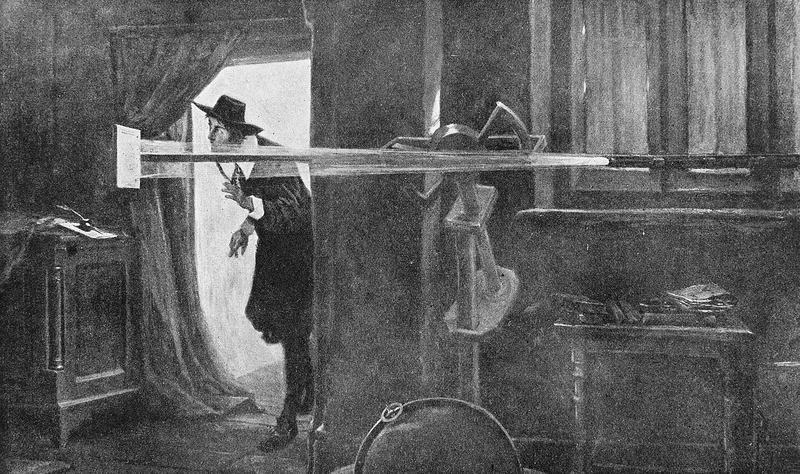
The American astronomer Simon Newcomb tackled this question from two different directions, and both results are worth knowing. Working through older solar-parallax data, he deduced a value of 8″.87 — a figure contemporaries judged far more dependable than a competing calculation by Powalky. Approaching the problem from a different angle, Newcomb also pooled the observational data from the last four transits of Venus and arrived at an Earth-Sun distance of 149.59 plus or minus 0.31 million kilometres, a range that already bracketed the value astronomers use today.
Earth's Own Orbit, Measured in AU
The astronomical unit is ultimately a description of Earth's own path, so it is worth looking at that orbit directly. Earth's path keeps it about 149.60 million kilometres from the Sun on average, equivalent to roughly 8.317 light-minutes — close enough to the defined astronomical unit that the two figures describe essentially the same measurement.
Covering that orbit takes speed most objects on Earth never approach: our planet moves at an average of 29.78 kilometres per second, fast enough to cross its own diameter in 7 minutes and to cover the entire distance to the Moon in about 4 hours.
Neighbors Near and Far
Once the astronomical unit was pinned down, it became the natural ruler for describing everything else in the Solar System, planets included.
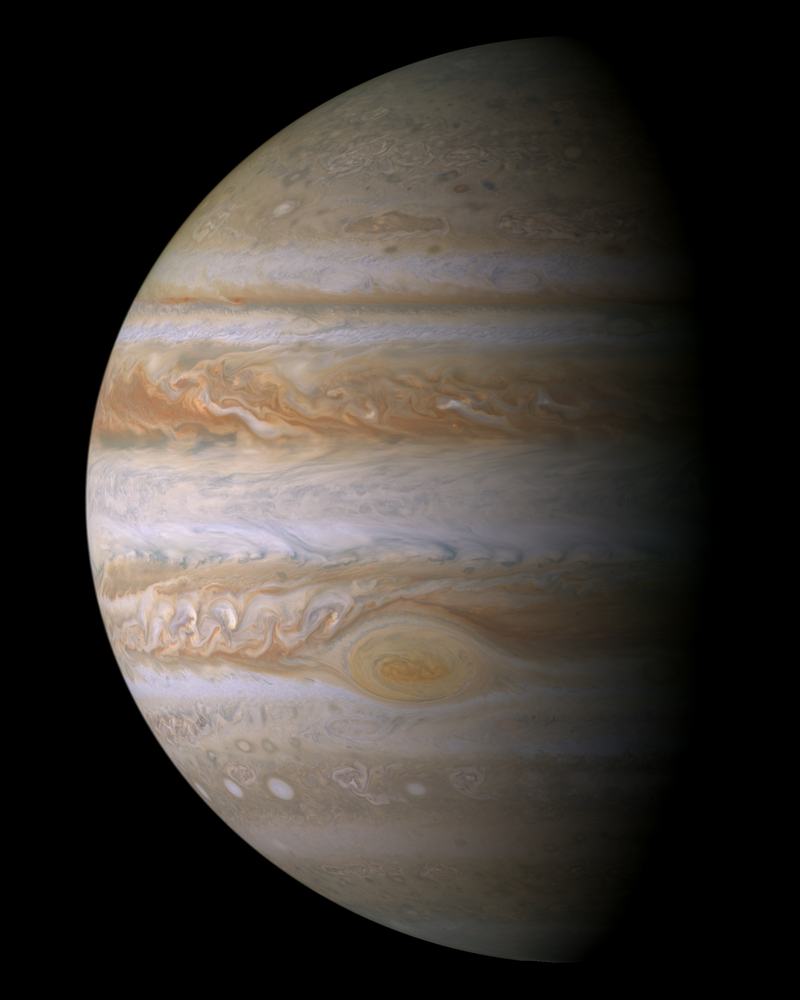

Jupiter, the largest planet, sits 5.2 AU from the Sun. Neptune, the most distant planet, orbits more than five times farther out, at 30 AU — a distance that would otherwise require writing out Earth-Sun-sized numbers over and over, planet after planet.
That is the quiet payoff of a very long effort: a single fixed number, arrived at through ancient triangles, transits, and a stray asteroid, that now lets astronomers describe an entire Solar System in one consistent unit.