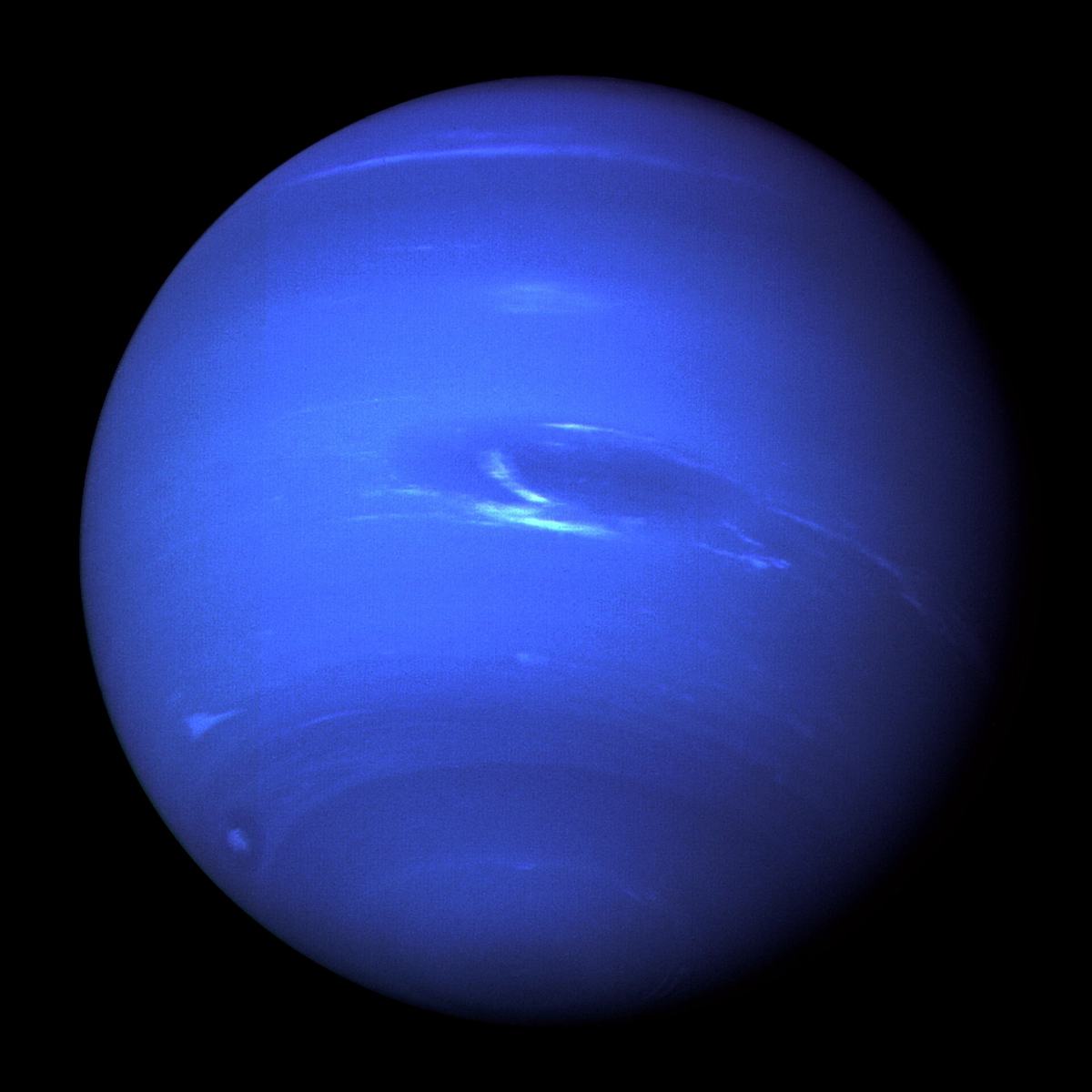
Neptune is the eighth and farthest known planet orbiting the Sun, circling once every 164.8 years at a distance of 30.1 astronomical units — about 4.5 billion kilometres out. It is also the only planet in the Solar System that nobody actually spotted first. Astronomers calculated where it had to be, pointed a telescope there, and found it waiting.
That backwards discovery story is only the start. Neptune hides diamond rain under crushing pressure, throws the fastest winds ever measured on a planet, and keeps a moon that orbits it backwards and is slowly doomed to be torn apart. None of it is visible from Earth without a telescope — Neptune is too faint to see with the naked eye — which makes the fact that we know any of this at all a small miracle of physics and patience.
A Planet Found by Mathematics, Not by Looking
Unexpected changes in the orbit of Uranus led astronomer Alexis Bouvard to hypothesize that Uranus's path was being disturbed by the gravity of an unknown planet further out. After Bouvard's death, the position of that hypothetical planet was worked out independently by two mathematicians, John Couch Adams and Urbain Le Verrier, using nothing but Uranus's wobble and Newton's equations.
Neptune is the only planet in the Solar System that was not initially observed by direct empirical observation. It was first seen through a telescope on 23 September 1846, when astronomer Johann Gottfried Galle pointed his instrument at the Berlin sky and found the planet within a degree of the position Le Verrier had predicted on paper. In other words, Neptune was discovered by arithmetic before it was discovered by eyesight.
There is an even stranger footnote. Some of the earliest known telescopic observations ever made — Galileo's own drawings from 28 December 1612 and 27 January 1613 — contain plotted points that match what we now know were the positions of Neptune on those exact dates. Galileo almost certainly saw Neptune more than two centuries before anyone recognized it as a planet, and simply logged it as a background star.
Named for the Color, Not the God
Once Neptune was confirmed, it needed a name, and the process was less obvious than the Roman-god pattern suggests. The first suggestion came from its discoverer, Galle, who proposed calling it Janus. It was another astronomer, Struve, who argued instead for the name Neptune, on 29 December 1846 — not primarily for mythological reasons, but after the colour of the planet as viewed through a telescope.
A Small Giant with Real Muscle
Despite sitting fourth in line by diameter among the planets, Neptune punches well above its size. Its mass is 17.15 times that of Earth but just 1/19th that of Jupiter — putting it firmly between the rocky worlds and the true giants. It is the third-most-massive planet in the Solar System and, among the four giant planets, the densest one of all.
That density shows up in its gravity, too. At the 1-bar pressure level, Neptune's gravity measures 11.27 m/s², which is 1.15 times the surface gravity of Earth — and among all the planets, it is surpassed only by Jupiter. Stand on Neptune's cloud tops (if you somehow could) and you would weigh more than you do on Earth, despite the planet being made almost entirely of fluid and gas.
The Fastest Winds Anywhere
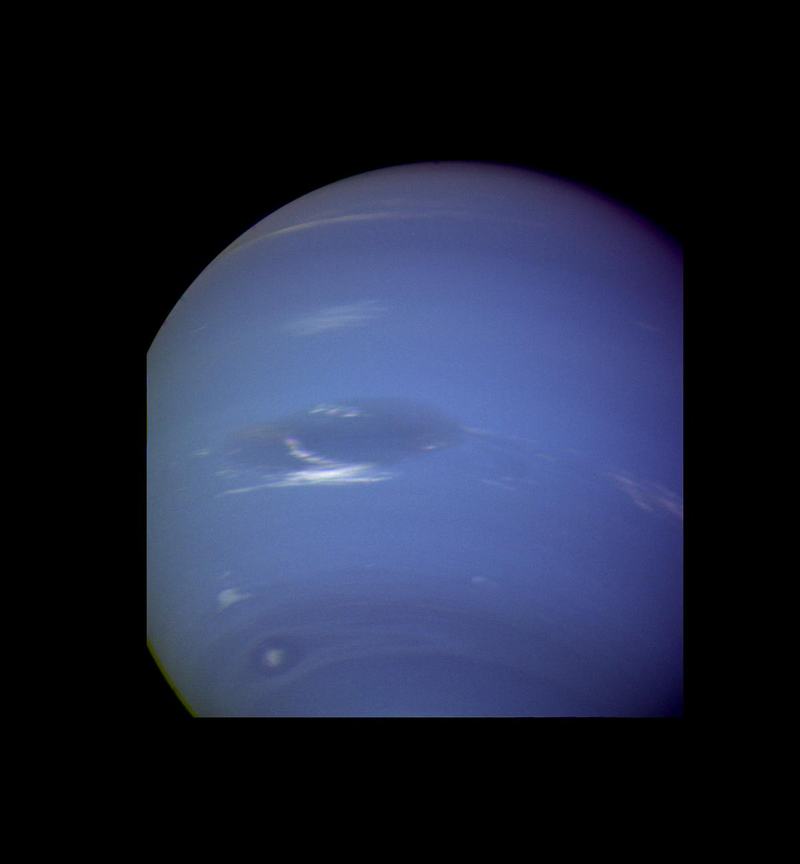
Neptune's weather is where the numbers get genuinely extreme. Around the edges of its storm systems, winds have been measured at up to 2,100 kilometers per hour (1,300 mph) — the fastest winds recorded anywhere in the Solar System. And Neptune is rarely calm: the planet appears to spend somewhat more than half its time hosting a storm known as a Great Dark Spot.
The first Great Dark Spot was found in 1989, when NASA's Voyager 2 spacecraft photographed an anticyclonic storm system spanning 13,000 km × 6,600 km — roughly the size of Earth, embedded in the clouds of another world. But when the same patch of sky was photographed again in November 1994 by the Hubble Space Telescope, the storm had disappeared completely. That is the key difference from Jupiter's famous Great Red Spot, which has lasted for hundreds of years: Neptune's dark spots form and dissipate within just a few years, then get replaced by new ones somewhere else on the planet.

Diamond Rain and a Mystery Furnace
Neptune receives only a fraction of the sunlight that closer planets get, and yet something inside it keeps generating serious heat. Uranus, its near-twin ice giant, radiates only 1.1 times as much energy as it receives from the Sun. Neptune radiates about 2.61 times as much — a far bigger surplus, even though Neptune sits over 50% farther from the Sun than Uranus and receives only about 40% of the sunlight Uranus gets. Nobody fully knows where that extra internal heat comes from, but it is strong enough to drive the fastest planetary winds anywhere in the Solar System.
Deep inside that furnace, the pressure does something almost unbelievable. At a depth of around 7,000 km, conditions may be extreme enough that methane molecules break apart and reassemble as diamond crystals, which then rain downward through the planet's interior like hailstones. It is one of the few places in the Solar System where a normal weather event might involve actual gemstones falling from the sky — just not anywhere a human could ever stand to watch it.
Rings Named After a Revolution
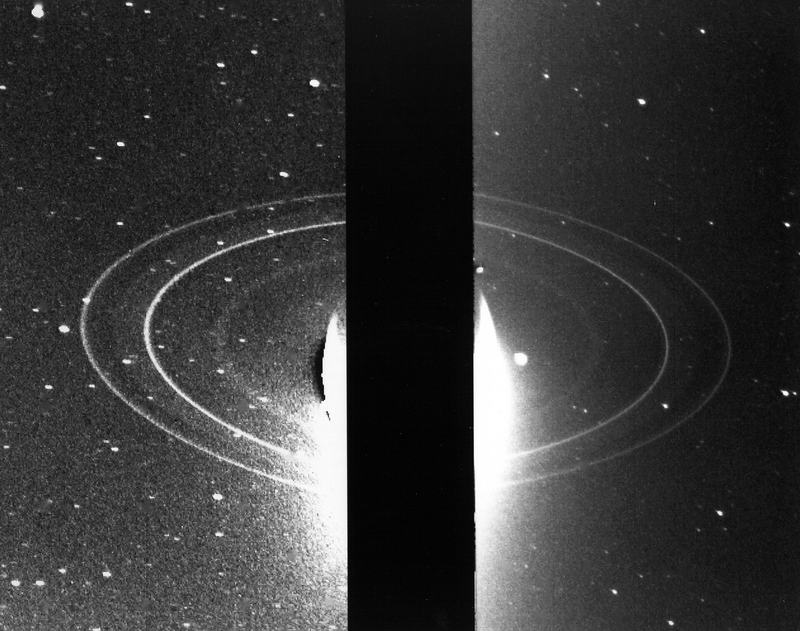
Neptune has its own ring system, though a much fainter one than Saturn's, and it was not confirmed by imaging until the Voyager 2 spacecraft photographed it in 1989. The rings carry an unusually personal set of names. The innermost is the Galle ring, named after Johann Gottfried Galle, the very astronomer who first saw Neptune through a telescope. The next ring out is the Le Verrier ring, honoring Urbain Le Verrier, who calculated where Neptune had to be. Further out still is the Lassell ring, named for William Lassell, the English astronomer who discovered Neptune's largest moon.
.jpg)
Even the brightest clumped segments of Neptune's rings — its ring arcs — got a distinct naming theme. Proceeding counterclockwise, they are called Fraternité, Égalité 1 and 2, Liberté, and Courage. The first four names come from "liberty, equality, fraternity," the motto of the French Revolution and Republic, discovered and named by French-led observation teams working from Earth.
Triton, the Moon That Shouldn't Be There
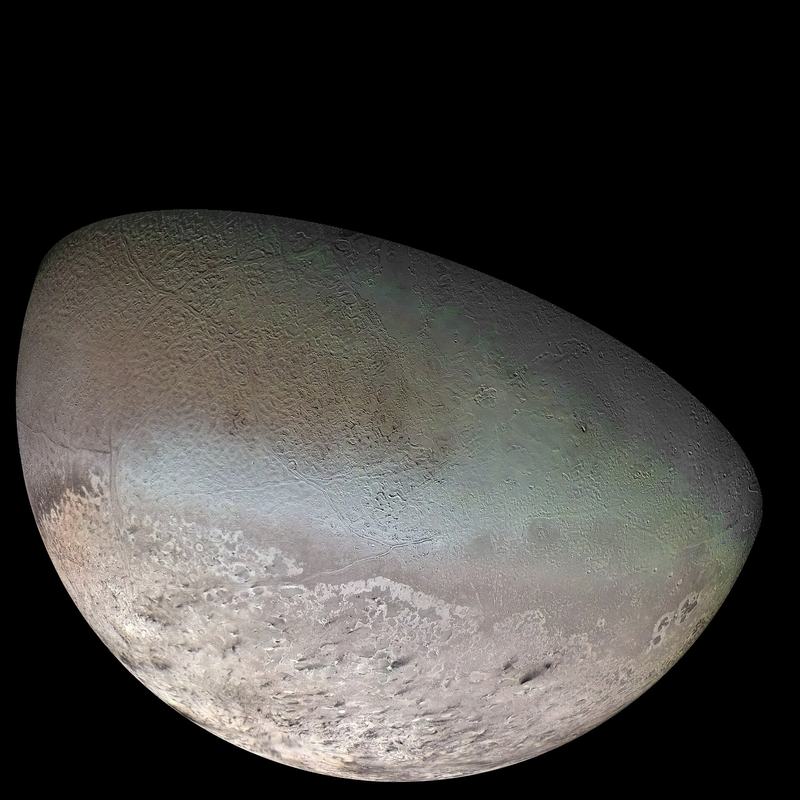
Neptune's largest moon, Triton, was discovered by British astronomer William Lassell on 10 October 1846 — just 17 days after Neptune itself was found. That speed is no accident: Triton is bright and close enough that a keen observer chasing the new planet was bound to notice it quickly.
.jpg)
What makes Triton strange is its orbit. Triton circles Neptune in a retrograde orbit, revolving in the opposite direction to the planet's own rotation — the only large moon in the Solar System to do this. That backwards motion is a strong clue that Triton was not born alongside Neptune at all, but was instead captured later by the planet's gravity. It is also a slow-motion death sentence: because Triton's orbit works against Neptune's rotation rather than with it, the moon is gradually spiraling inward, and it will eventually be torn apart, in about 28 billion years, when it reaches the Roche limit.
Triton is also geologically alive in ways few icy moons are. One of its largest features is Leviathan Patera, a caldera-like structure roughly 100 km in diameter, surrounded by a massive frozen lava plain called Cipango Planum that covers at least 490,000 km2. On top of that, the Voyager 2 probe caught the moon in the act: in 1989 it observed geyser-like eruptions of nitrogen gas and dust bursting from beneath Triton's surface in plumes up to 8 km high — active venting on a moon so cold it hosts nitrogen ice.
One Spacecraft, One Shot
Almost everything close-up we know about Neptune's storms, rings, and Triton's geysers comes from a single flyby. Voyager 2, launched by NASA on 20 August 1977, just 16 days before its twin Voyager 1, remains the only spacecraft to have ever visited either of the Solar System's ice giants. No other mission has been back since.
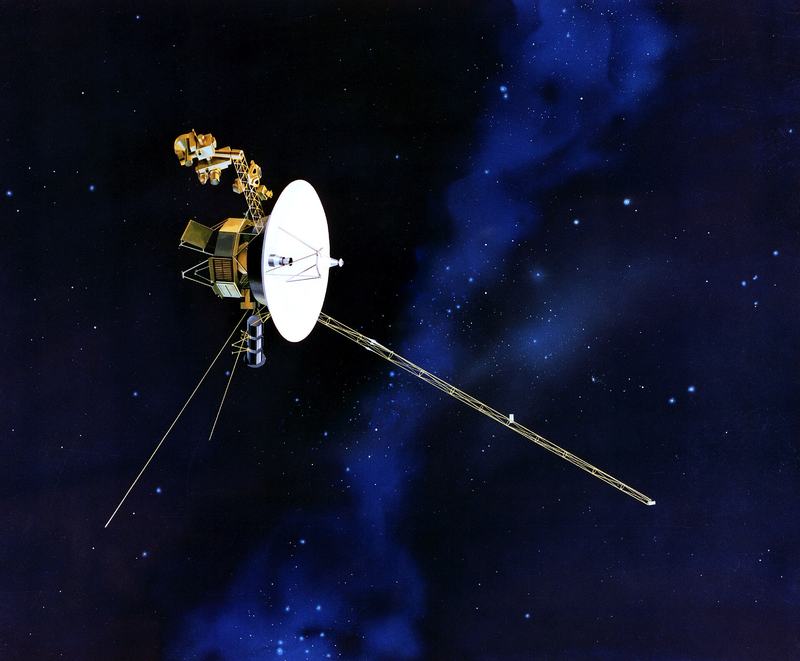

That flyby is also responsible for a color myth that stuck for decades. Neptune's atmosphere is actually only faintly blue in the optical spectrum — just slightly more saturated than the pale blue of Uranus's atmosphere. But when Voyager 2 swept past Neptune on 25 August 1989, its image renderings greatly exaggerated the colour contrast to better reveal the clouds, bands, and winds. The result made Neptune look deep blue next to Uranus's near-white, and that dramatic contrast is why most people still picture Neptune as a vivid azure world, even though its real color is much closer to its icy neighbor's.