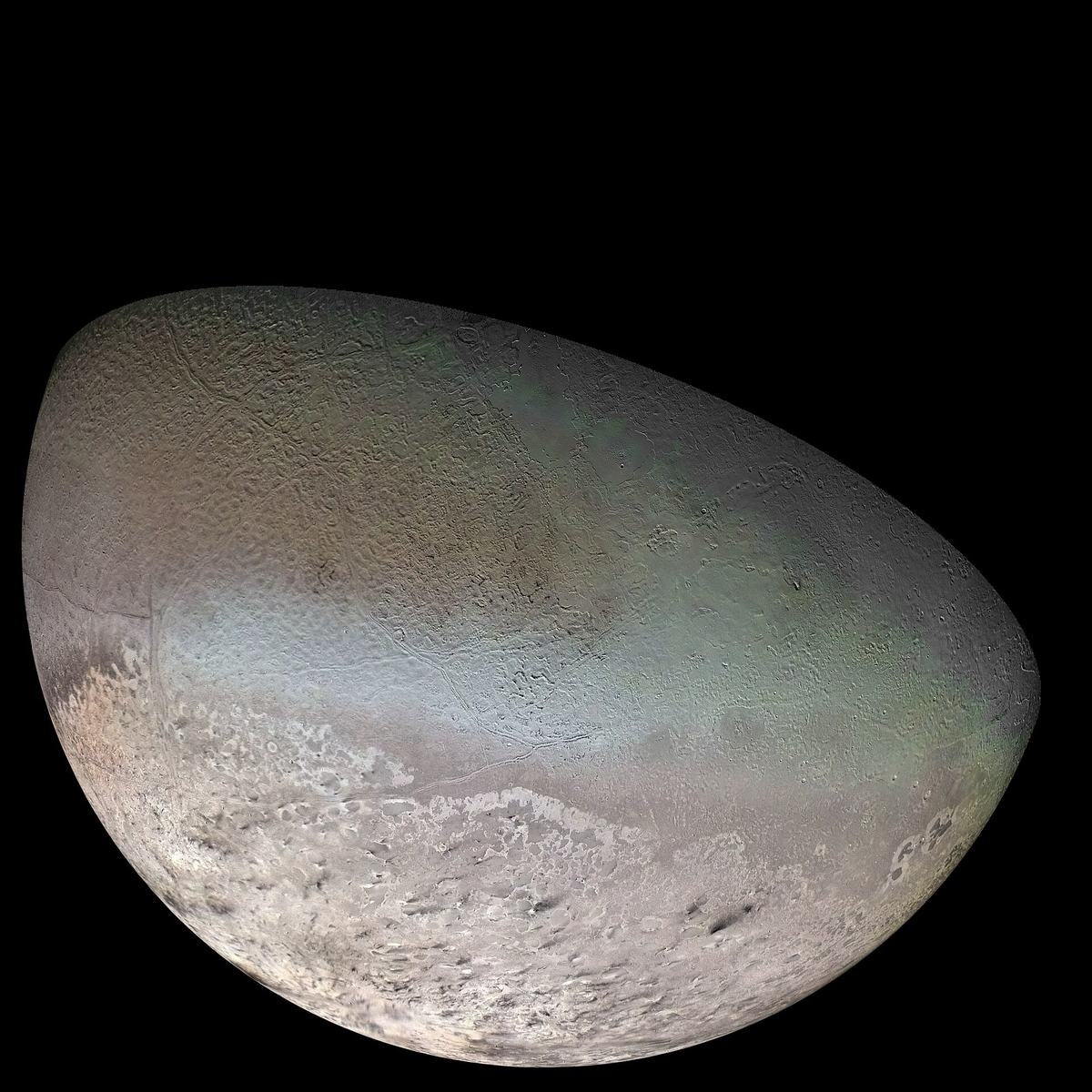
Triton is the largest natural satellite of Neptune and the only moon of Neptune massive enough to be rounded under its own gravity; it hosts a thin, hazy atmosphere. That alone would make it a notable moon. What makes it strange is its orbit: Triton orbits Neptune in a retrograde orbit, revolving in the opposite direction to the planet's rotation, the only large moon in the Solar System to do so.
Every other major moon in the Solar System orbits the same direction its planet spins, a natural consequence of forming from the same swirling disk of material. Triton didn't form that way. It arrived from somewhere else entirely, and Neptune's gravity caught it going the wrong way — a capture event so violent it likely melted the moon and reshaped its interior.
At 2,710 km in diameter, Triton is the seventh-largest moon in the Solar System, the second-largest planetary moon in relation to its primary after Earth's Moon, and larger than all of the known dwarf planets. It is, in short, a world-class object that ended up as someone else's satellite.
A Backward Orbit Unlike Anything Else Nearby
Retrograde motion isn't unheard of among moons — Jupiter and Saturn both have small outer moons that circle backward. But those moons are tiny and distant. The largest of them, Saturn's Phoebe, has only 8% of Triton's diameter and 0.03% of its mass, making Triton by far the largest moon with a retrograde orbit. Nothing else in the Solar System combines Triton's size with its backward path.
That mismatch between Triton's mass and its unusual orbit is the strongest clue to its origin. Triton is thought to have originated in the Kuiper belt, a ring of small icy objects extending from just inside Neptune's orbit to about 50 AU from the Sun, before being captured into orbit by Neptune's gravity. The Kuiper belt itself is a big place: it is similar to the asteroid belt but far larger, 20 times as wide and 20 to 200 times as massive — a vast reservoir of icy bodies, and Triton is thought to be one that wandered too close to Neptune and never left.
A World Related to Pluto
The comparison to the Kuiper belt isn't just about location. Triton is only slightly larger than Pluto and nearly identical in composition, which has led to the hypothesis, supported by a 2024 study of their chemical composition, that the two share a common origin. Triton may effectively be a sibling of Pluto that took a very different path through the Solar System — one that stayed independent, and one that got captured.
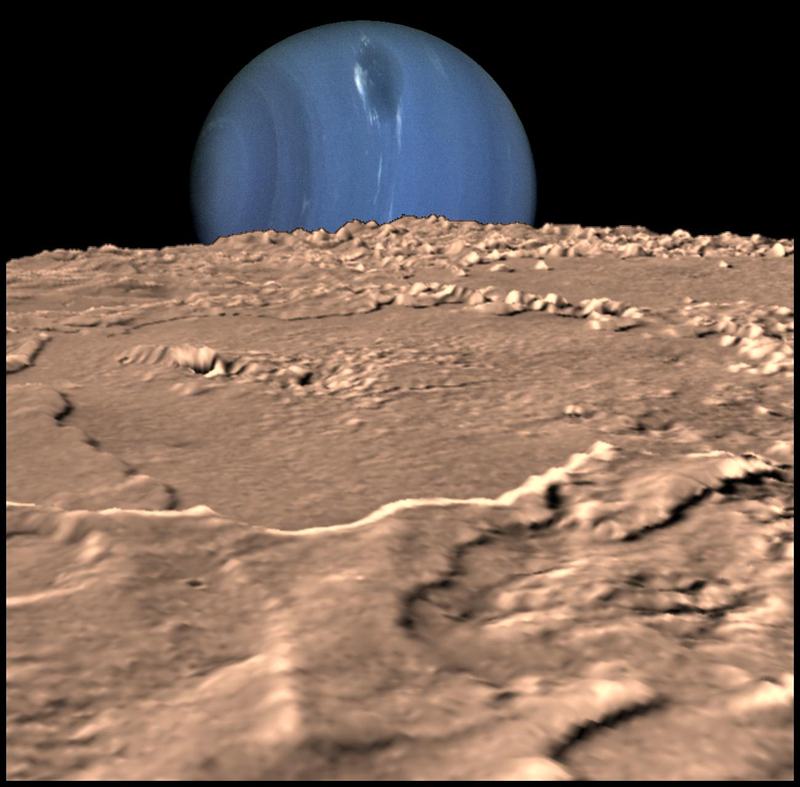

Once captured, Triton came to utterly dominate its new system. It accounts for more than 99.5% of all the mass known to orbit Neptune, including the planet's rings and its fifteen other known moons — a single captured world outweighing everything else Neptune has ever collected, combined.
Cold Enough to Freeze Nitrogen Solid
Triton's surface temperature is at least 35.6 K, colder than Pluto's average equilibrium temperature of 44 K, and its surface atmospheric pressure is only about 1.4 to 1.9 pascals — a wisp of an atmosphere, thousands of times thinner than Earth's. At those temperatures, nitrogen itself freezes solid, and that frozen nitrogen dominates the landscape: fifty-five percent of Triton's surface is covered with frozen nitrogen, with water ice comprising 15 to 35% and frozen carbon dioxide forming the remaining 10 to 20%.

A Single Visit From a Legendary Spacecraft
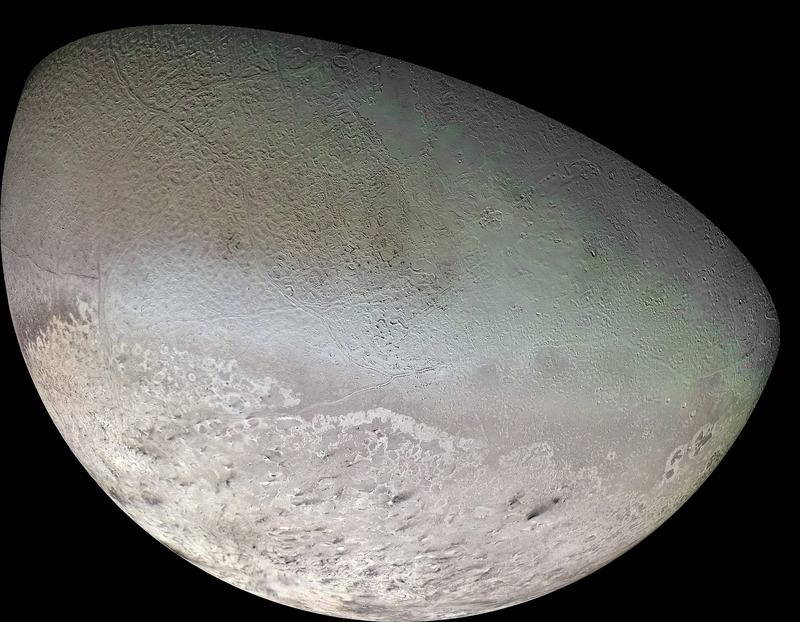
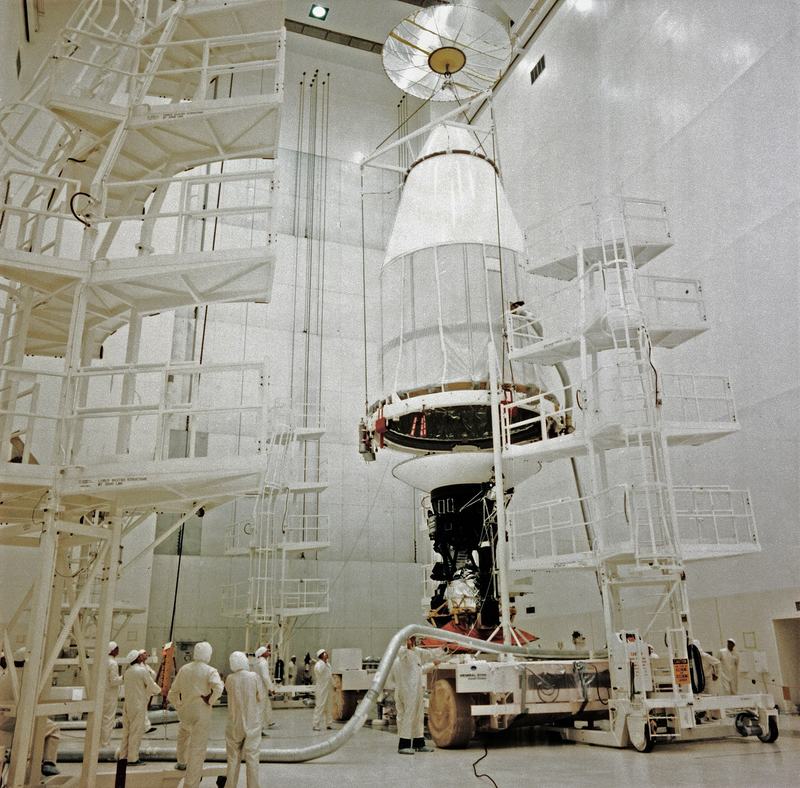
Almost everything we know about that surface comes from a single visit. All detailed knowledge of the surface of Triton was acquired from a distance of 40,000 km by the Voyager 2 spacecraft during a single encounter in 1989, and that flyby imaged only 40% of the moon's surface. Voyager 2 itself is a spacecraft of considerable pedigree: it launched on August 20, 1977 and remains the only spacecraft to have visited either of the Solar System's ice giant planets — Triton's brief close-up is part of a much longer, unmatched journey.
Ice Volcanoes and Nitrogen Geysers
What Voyager 2 did see was startling. One of the largest cryovolcanic features on Triton, Leviathan Patera, is a caldera-like feature roughly 100 km in diameter, surrounded by a cryovolcanic plain, Cipango Planum, that spans at least 490,000 km2 — an area of icy "lava" larger than many countries, produced by volcanism that erupts slush and ice instead of molten rock.

Even more striking were the moon's active geysers. Voyager 2 observed a handful of geyser-like eruptions of nitrogen gas or water and entrained dust from beneath Triton's surface in 1989, in plumes up to 8 km high, with an estimated output possibly exceeding 400 kilograms per second, a rate similar to what is estimated for Enceladus's plumes at 200 kg per second. Triton, sitting billions of kilometers from the Sun in near-total darkness, turned out to be one of the most geologically active places we had ever photographed.
A Surface Almost Too Young
The evidence for that activity is written across Triton's face in the form of missing craters. A census of Triton's craters imaged by Voyager 2 found only 179 confirmed impact craters, compared with 835 found on Uranus's moon Miranda, which has just 3% of Triton's surface area. The largest confirmed impact crater on Triton is a 27-kilometre-diameter feature called Mazomba — a relatively modest scar for a world that should, statistically, have accumulated far more.
That scarcity of craters points to a surface that keeps erasing its own history. Analysis of crater density suggests Triton's surface is extremely young in geological terms, with regions ranging from an estimated 50 million years old to just an estimated 6 million years old — a moon that, despite being a captured relic from the early Solar System, wears a face that is geologically almost brand new.