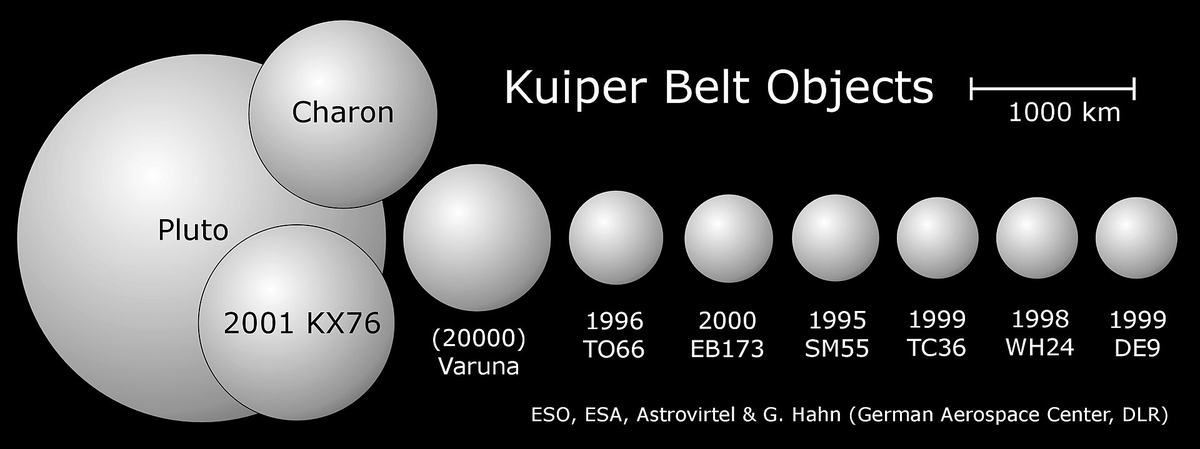
The Kuiper belt is a circumstellar disc in the outer Solar System, extending from Neptune's orbit at 30 AU to approximately 50 AU from the Sun. It is often introduced as the outer cousin of the asteroid belt between Mars and Jupiter, and the comparison is useful, but the scale is not remotely similar: the Kuiper belt is 20 times as wide as the asteroid belt and 20 to 200 times as massive.
The two regions are also built from different material. While many asteroids are composed primarily of rock and metal, most Kuiper belt objects are composed largely of frozen volatiles — "ices" such as methane, ammonia, and water — left over from the Solar System's formation. That composition is a big part of why the region stayed hidden for so long: cold, dark, icy bodies scattered across tens of billions of kilometers do not exactly announce themselves.
What follows is the story of how that hidden region got predicted, argued over, finally found, and then visited — plus what its structure and its strangest resident, a snowman-shaped world called Arrokoth, reveal about the far edge of the Solar System.
A Name That Predates the Evidence
The Kuiper belt is named in honor of Dutch astronomer Gerard Kuiper, who conjectured the existence of a version of the belt in 1951. Kuiper is remembered for more than that one guess. The same astronomer discovered carbon dioxide in the atmosphere of Mars and, in 1944, the existence of a methane-laced atmosphere on Saturn's moon Titan — credentials that had nothing to do with the frozen region that would eventually carry his name.
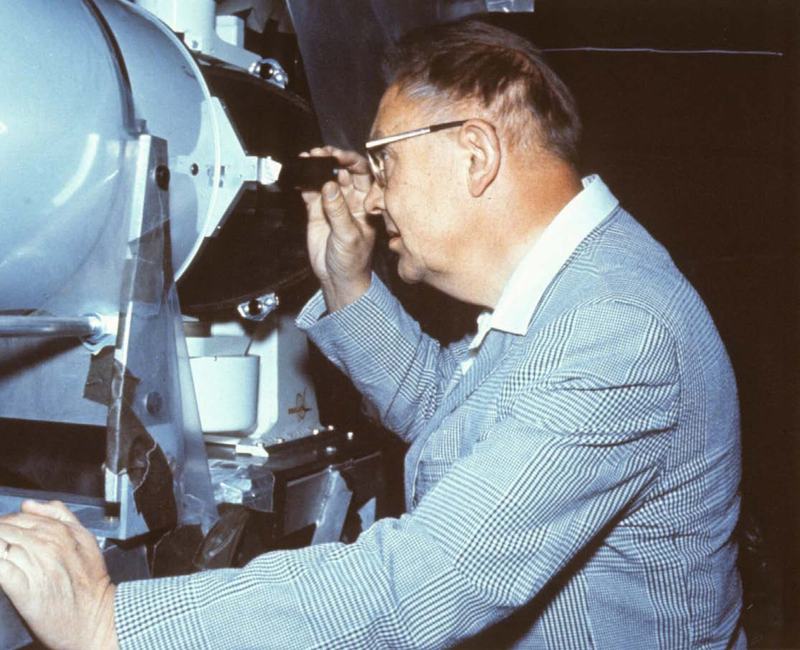

Kuiper was also not the only, or even the first, person to guess something like this belt was out there — and giving him sole credit understates a genuinely contested history. Kenneth Edgeworth hypothesized in 1943 that the region beyond Neptune held a myriad of smaller bodies rather than a planet, since the material in the primordial solar nebula out there was too widely spaced to condense into anything larger. Decades later, astronomer Julio Ángel Fernández, publishing in 1980, is considered to have made the most direct prediction of the belt as it is actually observed today. The belt's name settled on Kuiper largely by convention, not by a clean claim to priority.
Found After a Five-Year Search
None of those hypotheses became evidence until 1992. The first Kuiper belt object was found on 30 August 1992, when astronomers Jewitt and Luu announced the discovery of candidate object 1992 QB1, the result of five years of dedicated searching with telescope technology that had only recently become sensitive enough for the job. That gap between prediction and confirmation — decades of theorizing followed by one specific night in 1992 — is a useful reminder of how much of astronomy is a waiting game against the limits of available instruments.
How Much Is Actually Out There
Even with confirmation in hand, pinning down the belt's true size took much longer. In 2018, the most recent mass estimate put the Kuiper belt's total mass at (1.97 ± 0.30) × 10⁻² Earth masses, calculated from the small gravitational influence the belt exerts on the motion of the planets — not from directly weighing the objects themselves, which remains impossible for a region this diffuse.
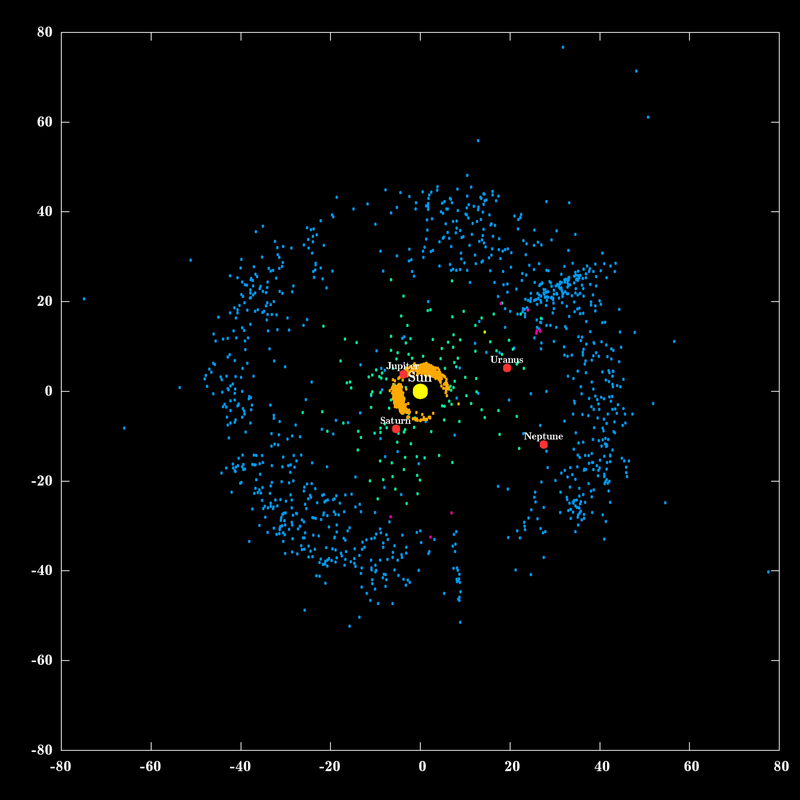

The belt also does not fade out gradually. The 1:2 resonance at 47.8 AU appears to be an edge beyond which few objects are known, a boundary astronomers call the "Kuiper cliff." Research has confirmed that the rapid decline in objects 100 km or more in radius beyond 50 AU is real, not an artifact of how hard those distant objects are to spot — meaning something genuinely thins the belt out at that distance, rather than telescopes simply losing the ability to see further.
A Region That Lost Almost Everything
That abrupt edge fits into a much larger story about loss. Most of the Kuiper belt's original planetesimals were scattered outward by Jupiter's gravity during the Solar System's early history and, in most cases, ejected from the Solar System entirely, reducing the primordial Kuiper belt population by 99% or more. What astronomers study today, in other words, is roughly one percent — or less — of what was originally there. The belt is less a preserved fossil of the early Solar System and more a heavily pruned remnant of one.
Not Every Frozen World Out There Belongs to the Belt
That pruning also explains why some of the most famous "Kuiper belt" objects in popular science writing are not, technically, in the Kuiper belt at all. Eris, now known to be 27% more massive than Pluto, is actually an object of the scattered disc far beyond the Kuiper belt rather than a Kuiper belt object itself — a distinction that mattered enormously, since it was Eris's discovery that brought the question of what counts as a planet to a head in the first place.
The scattered disc is a separate, more chaotic region that overlaps the Kuiper belt's inner edge and spills much farther outward. Scattered-disc objects have orbital eccentricities as high as 0.8, inclinations as high as 40 degrees, and perihelia greater than 30 AU — far more elongated, tilted paths than the relatively orderly orbits that define the classical Kuiper belt proper. The two regions get lumped together in casual conversation, but they are dynamically distinct neighborhoods.
A Captured Cousin Close to Home
Not every Kuiper belt object stayed out at the edge of the Solar System, either. Neptune's largest moon, Triton, is thought to be a large Kuiper belt object captured during Neptune's migration; it is only 14% larger than Pluto and is the only large moon in the Solar System with a retrograde orbit, meaning it circles Neptune backward relative to the planet's own rotation. Spectral analysis shows Triton's surface is largely composed of similar materials to Pluto's, including methane and carbon monoxide — a chemical fingerprint linking a moon orbiting Neptune today to the same population of bodies still drifting in the Kuiper belt.
Worlds That Come in Pairs
Kuiper belt objects also turn out to be unusually social. The most notable example is the Pluto-Charon binary, but it is estimated that around 11% of Kuiper belt objects exist in binaries — a far higher rate of paired bodies than is typical closer to the Sun. Two icy worlds locked in mutual orbit, born from the same slow, cold process of accretion, is a routine outcome out at the edge of the Solar System rather than an exception.
The Only Spacecraft to Make the Trip
Everything described so far was worked out from telescopes on or near Earth. Only one mission has ever actually traveled into the region. New Horizons, the first spacecraft to explore the Kuiper belt, launched on 19 January 2006 at a speed of about 16.26 km/s relative to the Sun — the fastest average speed of any human-made object ever launched from Earth, a record it needed just to reach the outer Solar System within a human lifetime.
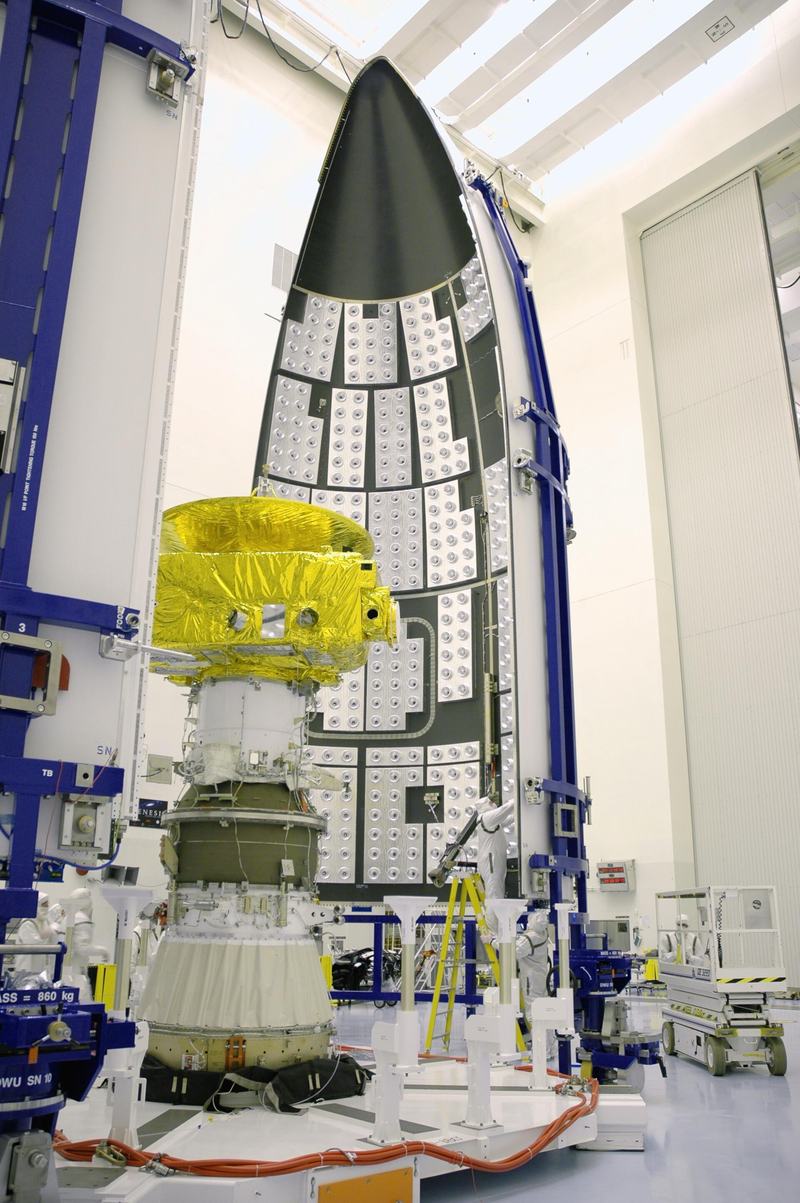

The spacecraft also carries a quiet tribute to the person who started this whole story from the other direction. About 30 grams of Clyde Tombaugh's ashes are aboard New Horizons, commemorating his discovery of Pluto in 1930 — meaning the astronomer who found the first known resident of this distant region is, in a small way, still traveling through it.
A Snowman at the Far Edge
New Horizons did not stop at Pluto. 486958 Arrokoth became the furthest object in the Solar System ever visited by a spacecraft when New Horizons flew past it on 1 January 2019, extending humanity's direct reach deep into the classical Kuiper belt for the first time.
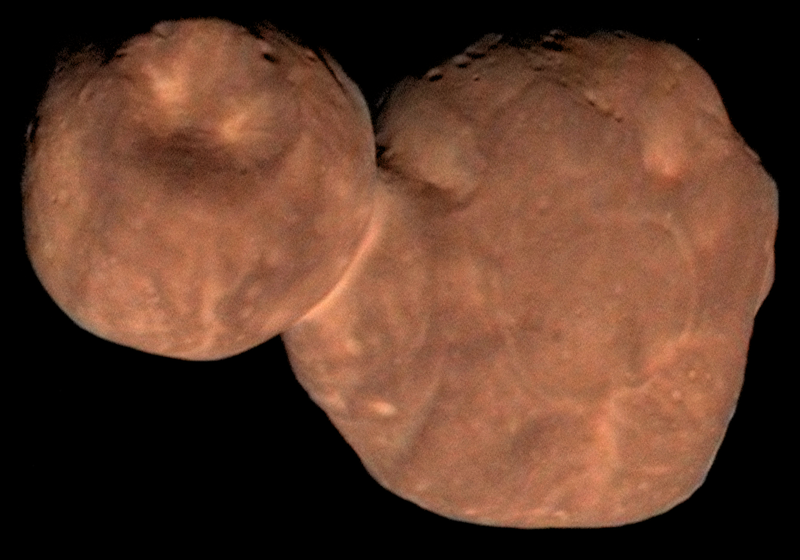

What the flyby found was stranger than a simple frozen rock. Arrokoth is a contact-binary "snowman" shape, 34.5 km across its longest axis and about 13.8 km thick, formed of two lobes: the larger Wenu Lobus at about 20.1 km across and the smaller, roughly spherical Weeyo Lobus at about 15.0 km across. Two separate bodies drifted together gently enough, early in the Solar System's history, to fuse rather than shatter — a shape that could only have survived undisturbed in a region as quiet and cold as the Kuiper belt.