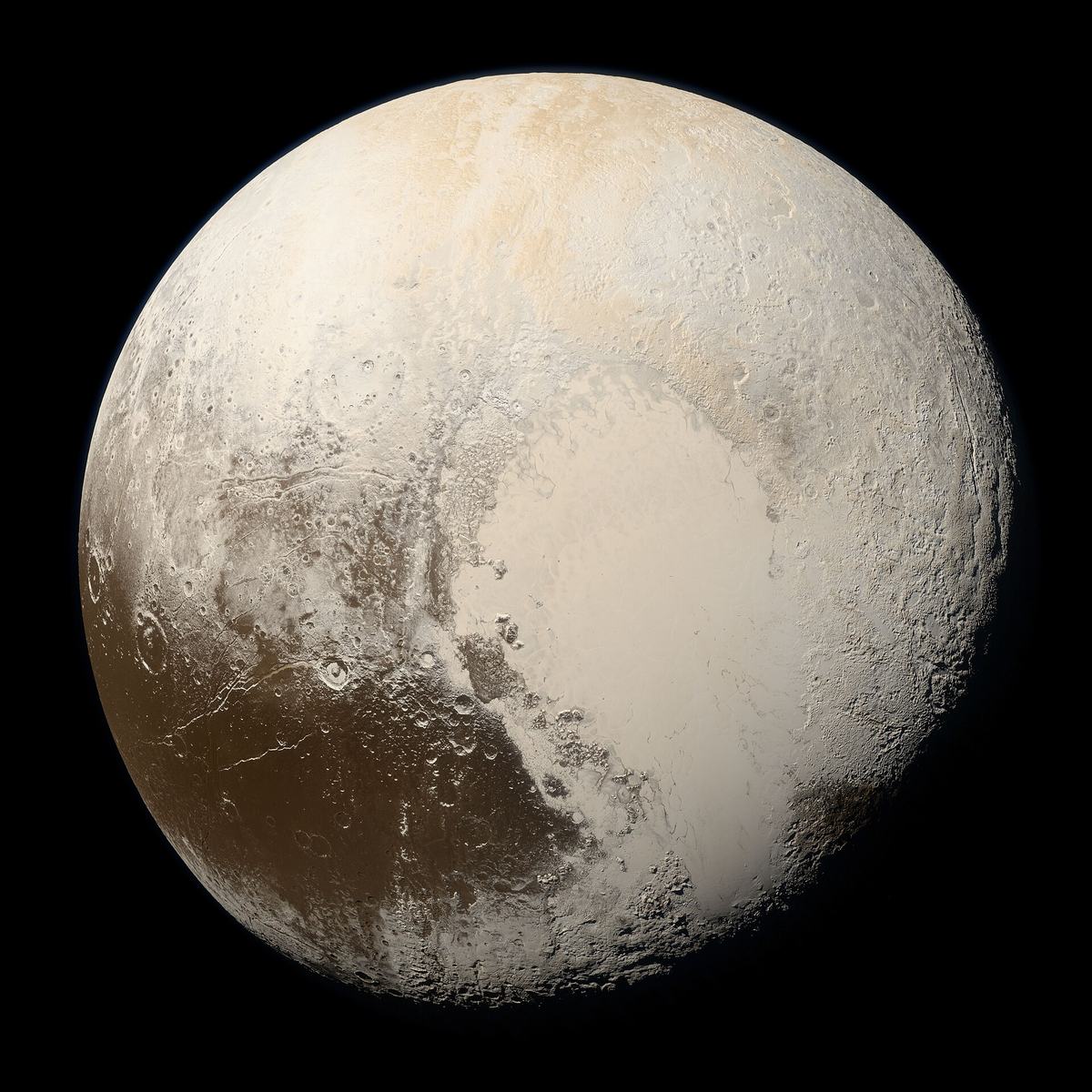
When NASA's New Horizons spacecraft finally photographed Pluto up close, it found something nobody expected: no impact craters. None that the spacecraft could see, anyway, and that absence is itself a fact — it means Pluto's surface is less than 10 million years old, a geological infant compared to the ancient, crater-pocked worlds nearby.
Pluto is a dwarf planet in the Kuiper belt, the ring of icy bodies that begins beyond Neptune's orbit. It sits so far out that sunlight, after crossing the inner Solar System in minutes, needs 5.5 hours to reach it at its orbital distance of 39.5 AU. That remoteness is exactly why Pluto kept its secrets for so long — and why the story of finding it, naming it, demoting it, and finally visiting it is worth more than five minutes of your time.
A Year of Comparing Photographs
Pluto's discovery was less a eureka moment than a slow, methodical grind. Starting April 6, 1929, astronomer Clyde Tombaugh used Lowell Observatory's 13-inch astrograph to photograph the same patch of sky several nights apart, then compared the plates for anything that had moved against the fixed background of stars. It was tedious work by design: a planet would shift position between exposures, while stars would not.
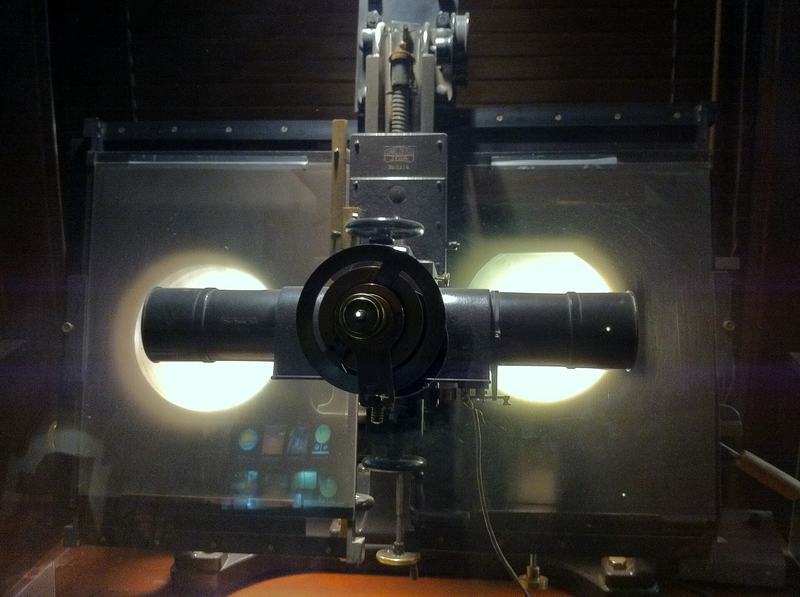

The method paid off. It was at Lowell in 1930 that Tombaugh discovered Pluto, closing out a search that the observatory's founder, Percival Lowell, had begun decades earlier looking for a hypothesized "Planet X." Tombaugh got there by patience and a magnifying comparator, not by luck.
An Eleven-Year-Old Named It
The naming was decided by committee, but the winning suggestion came from a child. The name Pluto was suggested by Venetia Burney, an eleven-year-old schoolgirl in Oxford, England, who was interested in classical mythology. She proposed it to her family after hearing about the new discovery, and the name stuck ahead of every alternative Lowell's staff had considered — a fitting choice for a small, faint world named for the god of the underworld, cold and distant from the Sun.
From Ninth Planet to Dwarf Planet
For most of the 20th century, Pluto was simply the ninth planet. That changed in 2006. Pluto was regarded as a planet for decades until the "dwarf planet" concept was adopted by the International Astronomical Union that year — and today Pluto is considered the prototypical example of the category, the world the definition was built around.
The reasoning behind the demotion comes down to neighborhood control. One reason Pluto was reclassified is that its mass is only 0.07 times the combined mass of the other objects sharing its orbital zone, whereas Earth's mass is 1.7 million times the remaining mass in its orbit. Earth has overwhelmingly cleared its lane around the Sun; Pluto, by that same measure, has not come close to clearing its own. That single ratio is the difference between "planet" and "dwarf planet" in the IAU's rulebook.
A Small World, Even Among Dwarfs
Once you set the classification debate aside, Pluto's numbers speak for themselves. Its diameter is 2,376.6 km and its mass is 17.7% that of the Moon (0.22% that of Earth), yet its surface area is slightly bigger than Russia — a reminder that even a small sphere unrolls into a lot of ground when you're standing on it rather than looking at it from space.
Pluto isn't even the largest object of its kind in the outer Solar System, but it still dwarfs objects closer to home: Pluto is more than twice the diameter and a dozen times the mass of Ceres, the largest object in the asteroid belt. Two worlds, both eventually filed under "dwarf planet," separated by a gulf in size that the shared label doesn't hint at.
Charon: A Moon Almost as Big as Its Planet
Pluto's largest moon came from a blink comparator too, decades later. Charon was discovered by U.S. Naval Observatory astronomer James Christy using the 1.55-meter telescope at the Naval Observatory's Flagstaff Station, on June 22, 1978, while he was examining highly magnified images of Pluto on photographic plates taken two months earlier.
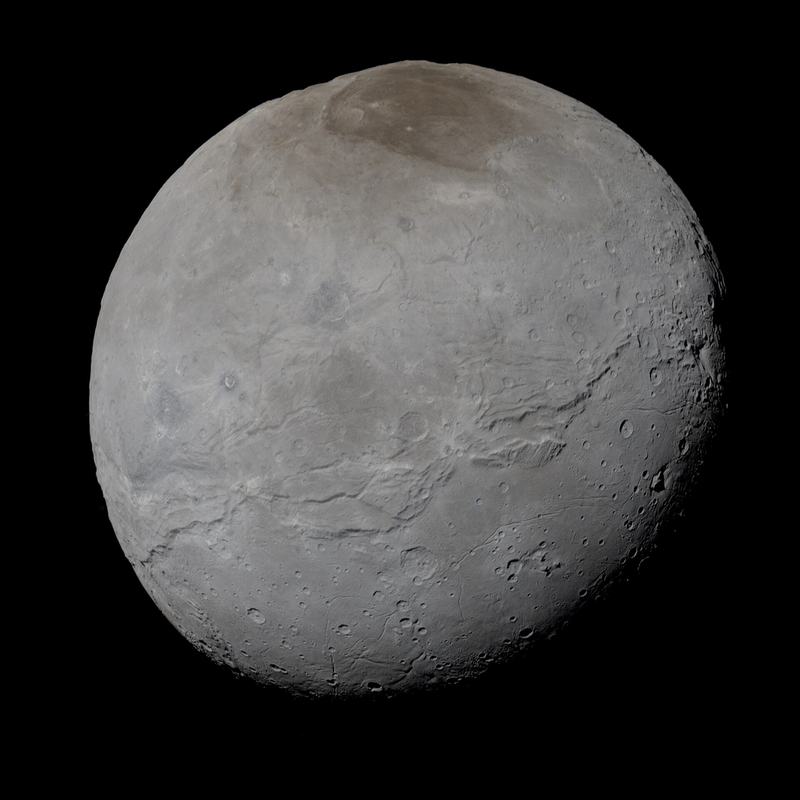

What made the discovery remarkable wasn't just the moon itself but its size. Charon's diameter is 1,212 kilometres, just over half that of Pluto — proportionally enormous next to the world it orbits, which is exactly why it stood out to Christy in those magnified plates rather than staying hidden.
Christy named the moon Charon as a scientific-sounding version of his wife Charlene's nickname, "Char," after first suggesting "Oz" on June 24, 1978. The mythological reading came later — Charon is the ferryman who carries souls across the river Styx to the underworld ruled by Pluto — but the astronomer's first inspiration was much closer to home.
A Day That Matches Its Moon's Orbit
Pluto and Charon are locked together in an unusually tight rhythm. Pluto's rotation period, its day, is equal to 6.387 Earth days. Separately, Charon and Pluto orbit each other every 6.387 days. Those two numbers are not a coincidence: Pluto keeps the same face turned toward Charon at all times, just as Charon keeps the same face turned toward Pluto, both bodies mutually tidally locked to a shared rhythm.
That slow spin comes with an extreme tilt. Pluto rotates on its side with an axial tilt of 120 degrees, making its seasonal variation extreme: at its solstices, one-fourth of its surface is in continuous daylight while another fourth is in continuous darkness. A Plutonian pole can spend decades never seeing the Sun at all, then swing around to nothing but daylight.
A Young, Thin-Aired World
Which brings the story back to that missing cratering. Pluto has no craters that were visible to New Horizons, indicating that its surface is less than 10 million years old — geologically new by Solar System standards, meaning something has kept resurfacing it long after the era when most worlds simply accumulated impact scars.
The air above that young surface is barely there at all. According to measurements by New Horizons, Pluto's surface atmospheric pressure is about 1 Pa, roughly one million to 100,000 times less than Earth's atmospheric pressure. It's less an atmosphere than a haze clinging to the ice, thick enough to matter scientifically but far too thin to feel like air in any familiar sense.
New Horizons: The Only Visit So Far
Everything New Horizons found, it found on a single pass. The spacecraft launched on January 19, 2006, at a speed of about 16.26 km/s relative to the Sun, and was the fastest human-made object, by average speed with respect to Earth, ever launched from Earth — it needed every bit of that speed for a decade-long journey to a target 39.5 AU away.
.jpg)
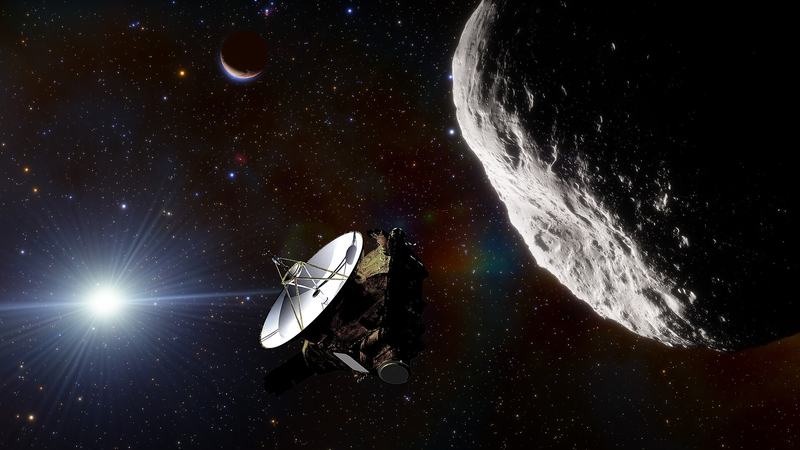
On July 14, 2015, the New Horizons space probe flew by Pluto and its five moons — the flyby behind every close-up image and precise measurement in this article, from the missing craters to Charon's true size. Fittingly, about 30 grams of Clyde Tombaugh's ashes are aboard the spacecraft, to commemorate his discovery of Pluto in 1930 — the man who found Pluto with a magnifying comparator got to ride along, decades later, on the mission that finally revealed what he'd found.