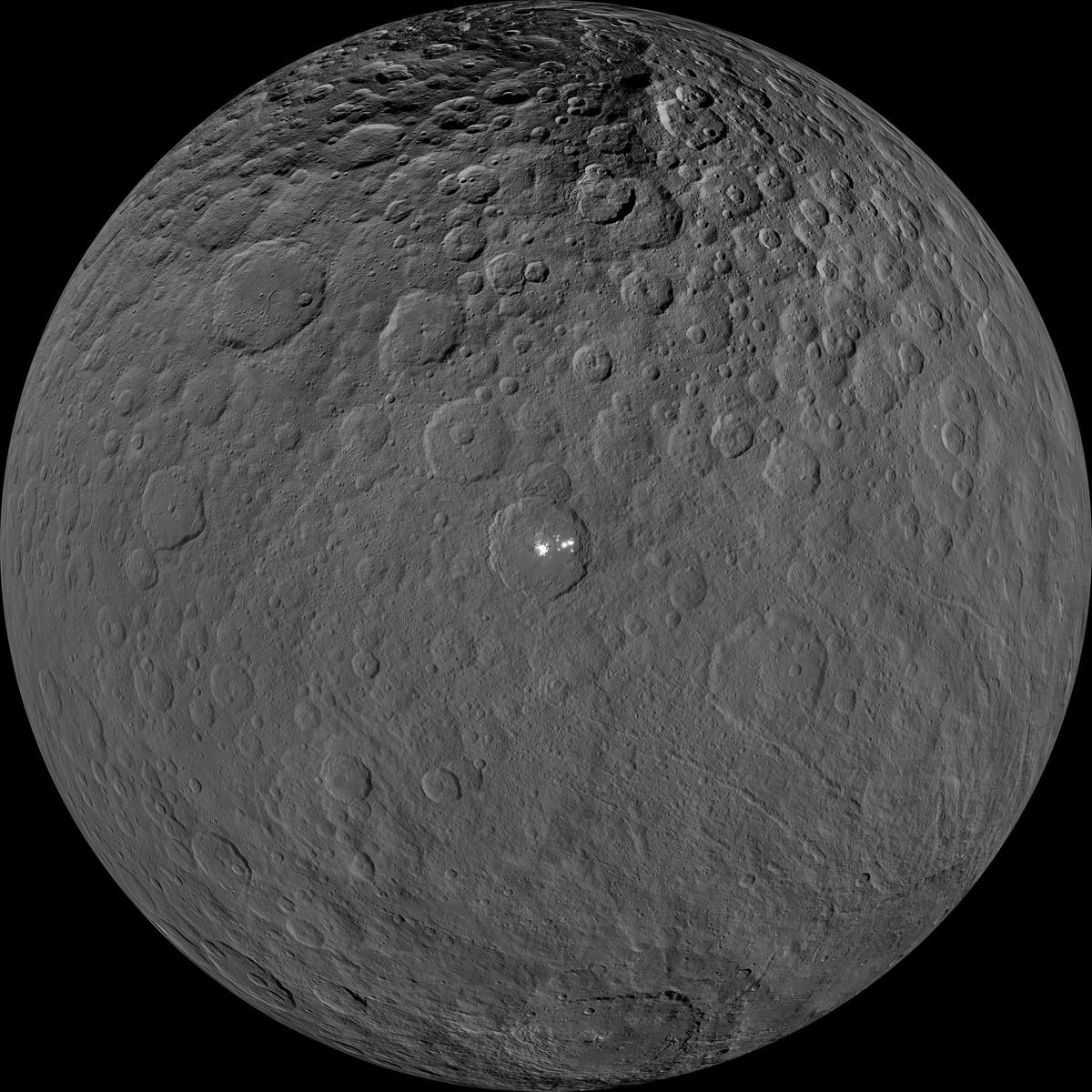
Ceres is a dwarf planet in the main asteroid belt between Mars and Jupiter. It was the first object identified in the asteroid belt, discovered on January 1, 1801 by Giuseppe Piazzi at Palermo Astronomical Observatory in Sicily, and originally announced as a new planet. For decades astronomers genuinely believed they'd found a missing world between Mars and Jupiter — and in a sense, more than two centuries later, that turned out to be closer to the truth than anyone expected.
Ceres was later classified as an asteroid, then as the only confirmed dwarf planet within the asteroid belt and the largest asteroid-belt object without a moon. It is also the only recognized dwarf planet in the Solar System whose orbit lies within that of Neptune — every other dwarf planet lives out in the cold, distant Kuiper belt, while Ceres orbits comparatively close to home.
That proximity hasn't made it easy to see. Ceres's diameter is about a quarter that of the Moon, and its apparent magnitude ranges from 6.7 to 9.3, too dim to be seen by the naked eye except under extremely dark skies. It took two centuries and a dedicated spacecraft mission to reveal what kind of world this actually is.
A Discovery Almost Missed to Illness
Piazzi observed Ceres 24 times, with the final sighting on February 11, 1801 when illness interrupted his work. He announced the discovery on January 24, 1801 in letters to fellow astronomers Barnaba Oriani and Johann Bode — word of a new "planet" spreading across Europe by letter before anyone else could confirm the sighting. Piazzi's proposed name for his discovery was Ceres Ferdinandea, after the Roman goddess of agriculture and King Ferdinand III of Sicily, his monarch and patron. The "Ferdinandea" half didn't survive; the "Ceres" half became permanent.
A Small World on a Fast Clock
Ceres orbits the Sun once every 4.6 Earth years, near the middle of the asteroid belt between Mars and Jupiter. Physically, Ceres dominates its neighborhood. It is the largest asteroid in the main asteroid belt, with a mean diameter of 939.4 km and a mass of 9.38x10^20 kg, as measured by the Dawn spacecraft. Ceres makes up 40% of the estimated total mass of the asteroid belt and has three and a half times the mass of the next-largest asteroid, Vesta, yet it has only one seventy-eighth the mass of the Moon — a giant among asteroids, and still a lightweight compared to a true planetary satellite.
Half Water, By Volume
Ceres's low density hints at what it's actually made of. It has a density of 2.16 g/cm3, suggesting about a quarter of its mass is water ice; overall, Ceres is approximately 50% water by volume, compared to just 0.1% for Earth. That is a staggering amount of water locked into a body barely a quarter the size of the Moon — more, proportionally, than almost anywhere else nearby in the Solar System.
Most of Ceres's near surface is rich in carbon, at approximately 20% by mass, and organic compounds were detected in the Ernutet crater, with at least eleven other regions identified as candidates for their presence. Water and carbon-rich chemistry in the same small world is exactly the kind of combination that makes astrobiologists pay attention.
A Crust Too Strong for Its Own Craters
Ceres's surface tells a story about impacts that never quite fit the model. Models predicted Ceres should have 10 to 15 craters larger than 400 km in diameter, yet the largest confirmed crater, Kerwan Basin, is only 284 km across. Something has been erasing the biggest scars. The largest single geographical feature on Ceres is Vendimia Planitia, a flattened ancient basin 800 km across — likely the ghost of one of those missing giant craters, smoothed out over time rather than preserved as a bowl.
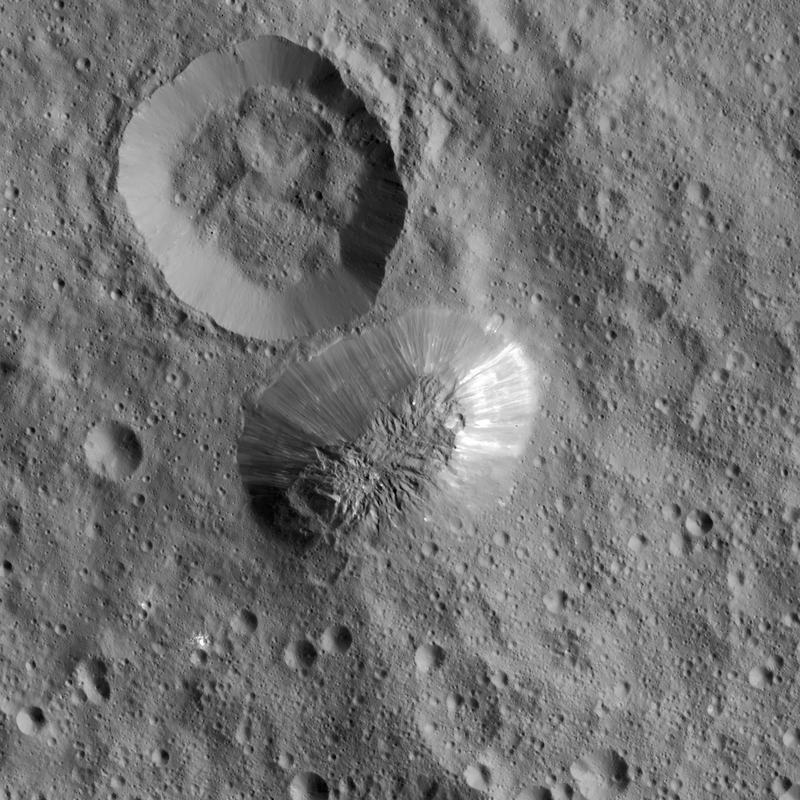

That smoothing points toward cryovolcanism. Ceres has one prominent mountain, Ahuna Mons, an apparent cryovolcano with a maximum estimated age of 240 million years based on how few craters it has — young enough, on a geological timescale, to mean Ceres was still actively resurfacing itself long after the Solar System itself had formed.
The Bright Spots That Puzzled a Spacecraft
.jpg)
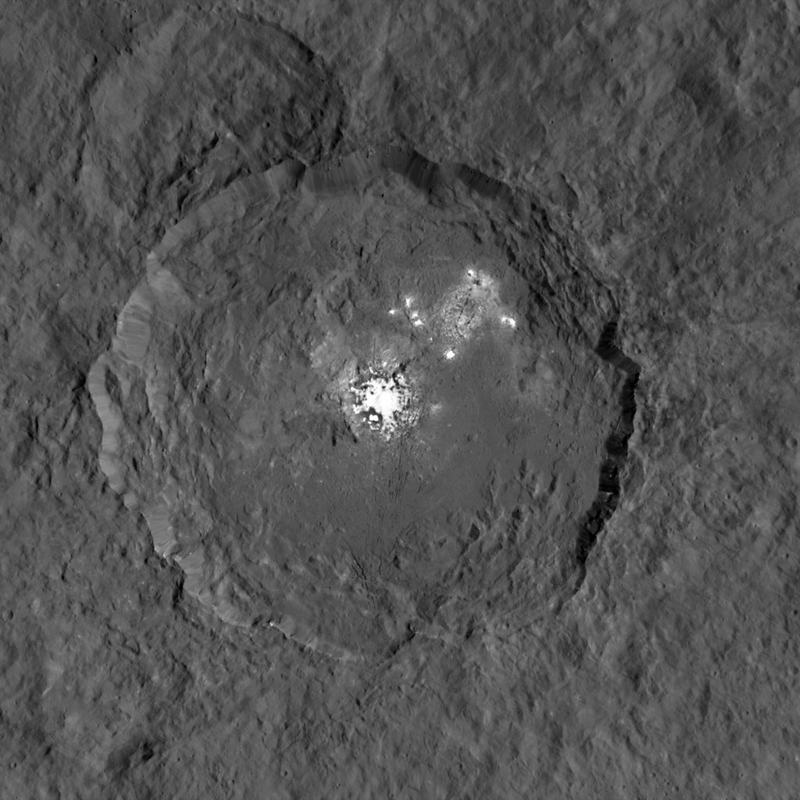
Nowhere is that activity more visible than in Ceres's famous bright spots. Dawn observed hundreds of bright spots on Ceres, the brightest located in the middle of the 80-km-wide Occator Crater, which has a central pit 9 to 10 km wide partially filled by a dome. The brightest feature at the center of Occator crater is named Cerealia Facula, and the crater's impact is estimated to have occurred about 20 to 24.5 million years ago — recent enough that whatever process created the bright spot may still be active today. Scientists reported that the bright spots, including those in Occator, may be related to a type of salt, particularly a form of brine containing magnesium sulfate hexahydrite; the bright material on the crater floor was found to have a dominant composition of sodium carbonates, aluminium phyllosilicates, and ammonium chloride.
In 2017, the Dawn spacecraft confirmed that Ceres has a transient atmosphere of water vapour — a thin, temporary haze rising and falling as ice near the surface sublimates. A small, rocky-looking dwarf planet, it turns out, occasionally breathes.
A Fossil From the Solar System's First Days
All of this makes more sense once you consider Ceres's age. Ceres is a surviving protoplanet that formed 4.56 billion years ago, one of only three, alongside Pallas and Vesta, still remaining in the inner Solar System after the rest either merged into planets, were shattered in collisions, or were ejected by Jupiter. It is one of the few surviving building blocks from the earliest days of planet formation, essentially untouched by ever becoming part of something bigger.
That deep age and abundant water together make Ceres more interesting than its small size would suggest. Ceres has the most water of any body in the inner Solar System after Earth, and its likely subsurface brine pockets could provide habitats for life — a genuine possibility for astrobiology, sitting quietly in the middle of the asteroid belt rather than out among the icy moons usually associated with the search for life.
The Mission That Finally Got a Close Look
.jpg)
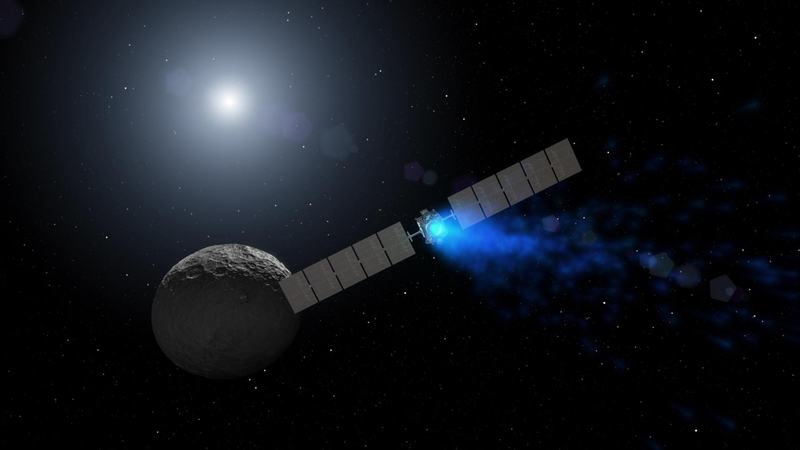
Nearly all of what we now know about Ceres came from a single spacecraft. Dawn, the first space mission to visit either Vesta or Ceres, launched on September 27, 2007, entered orbit around Vesta on July 16, 2011, and entered orbit around Ceres on March 6, 2015. It holds a unique distinction in space exploration: Dawn is the first mission to study a dwarf planet, arriving at Ceres a few months before the New Horizons probe arrived at Pluto in July 2015 — two dwarf planets getting their first close-up visits within months of each other, after more than two centuries of being seen only as points of light.