Enceladus is the sixth-largest moon of Saturn and the 18th largest in the Solar System, about 500 km in diameter, about a tenth of that of Saturn's largest moon, Titan. It's a small world by any planetary standard, only one-seventh the diameter of Earth's own Moon. And yet this small, icy body is one of the most active places in the entire outer Solar System.
Enceladus is covered by clean, freshly deposited snow hundreds of meters thick, making it one of the most reflective bodies of the Solar System. Consequently, its surface temperature at noon reaches only -198°C, far colder than a light-absorbing body would be — the moon is so good at bouncing sunlight back into space that it barely warms up at all, even standing right in the light.
That icy brilliance turns out to be the surface symptom of something much stranger happening underneath: a hidden ocean, active geysers, and a direct, ongoing role in building one of Saturn's rings.
A Quiet Dot for Two Centuries
Enceladus was discovered on August 28, 1789 by William Herschel, but little was known about it until Voyager 1 and Voyager 2 flew by Saturn in 1980 and 1981. Herschel made the discovery during the first use of his new 1.2-metre, 40-foot telescope, then the largest in the world, at Observatory House in Slough, England — a genuinely cutting-edge instrument, and still barely enough to resolve Enceladus as more than a point of light.
For more than two centuries after that, Enceladus stayed largely a mystery. It took spacecraft actually visiting the Saturn system to reveal what the moon was really doing.
The Moon That Builds Saturn's Outermost Ring
Enceladus orbits within the densest part of Saturn's E ring, the outermost of Saturn's major rings, and is the main source of the ring's material. That's an unusual role for a moon to play: rather than simply orbiting within a ring, Enceladus is actively supplying it. Saturn's E ring is unstable, with a lifespan of only 10,000 to 1 million years, so its particles must be constantly replenished — meaning that without an active source, the ring would essentially not exist within the astronomically short window we happen to be observing it.
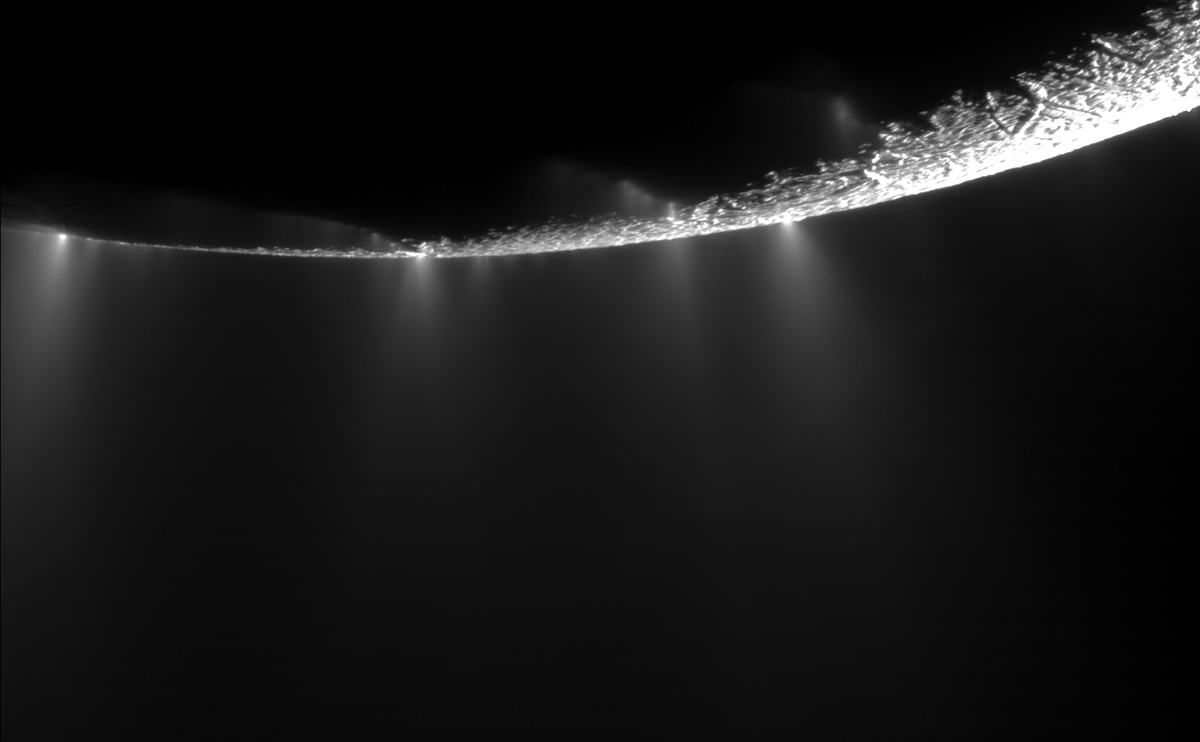
Cassini's first two close flybys in 2005 confirmed Enceladus as the source of the E ring's particles, and in November 2005 Cassini directly imaged geyser-like jets of icy particles rising from the moon's south polar region. It was the first direct visual proof that a small icy moon could actively feed material into one of a planet's rings.
Enceladus orbits Saturn every 32.9 hours, fast enough for its motion to be observed over a single night, and is in a 2:1 orbital resonance with Dione, completing two orbits around Saturn for every one orbit Dione completes. That resonance is not incidental — it is part of what keeps Enceladus's orbit slightly eccentric, and that eccentricity is part of what keeps the moon's interior warm enough to stay geologically active at all.
An Ocean Erupting Into Space
Jets from Enceladus's south pole move about 250 kg of water vapour every second at speeds up to 2,189 km/h into space — a firehose of material launched directly off an icy moon and into the vacuum beyond it. That water comes from a genuine subsurface ocean: Enceladus's ocean probably lies beneath an ice shelf about 30 to 40 kilometres thick, sealed away from the vacuum above except where it vents through the moon's fractured south pole.
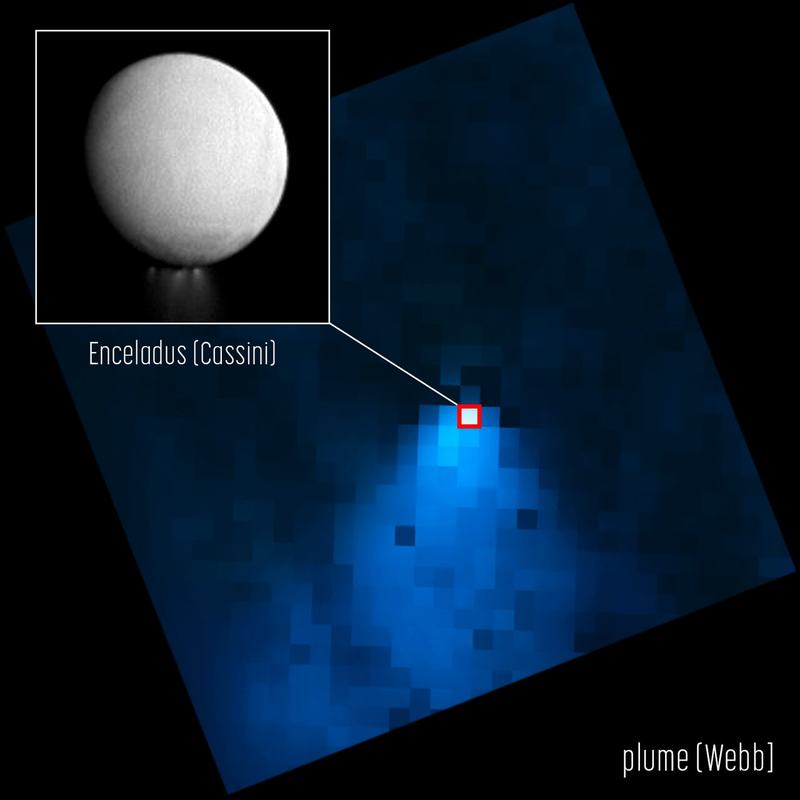
The plumes aren't just water. Cassini detected traces of simple and complex organic compounds in material from Enceladus's plumes, including benzene and macromolecular organics as large as 200 atomic mass units and at least 15 carbon atoms in size — complex carbon chemistry, found not on a planet, but sprayed directly out of a small moon's interior where a spacecraft could fly through it and sample it.
Heat That Shouldn't Be There
None of this activity is possible without a serious heat source, and Enceladus has one scientists still can't fully explain. A warm region was found near Enceladus's south pole with temperatures of 85 to 90 K, and small areas as high as 157 K, far too warm to be explained by sunlight alone. Something inside the moon is generating heat well beyond what its size and orbit should produce.
Data from Cassini's infrared spectrometer measured the internal heat generated by Enceladus's south polar terrain at about 4.7 gigawatts, a figure that is challenging to explain from tidal heating alone, leaving the main source of heat a mystery. One 2017 explanation offers a partial answer: a computer simulation using Cassini data indicates that friction heat from sliding rock fragments within Enceladus's permeable, fragmented core could keep its underground ocean warm for up to billions of years — the moon's rocky interior grinding against itself like a slow, perpetual furnace.
Four Stripes, One Erupting World
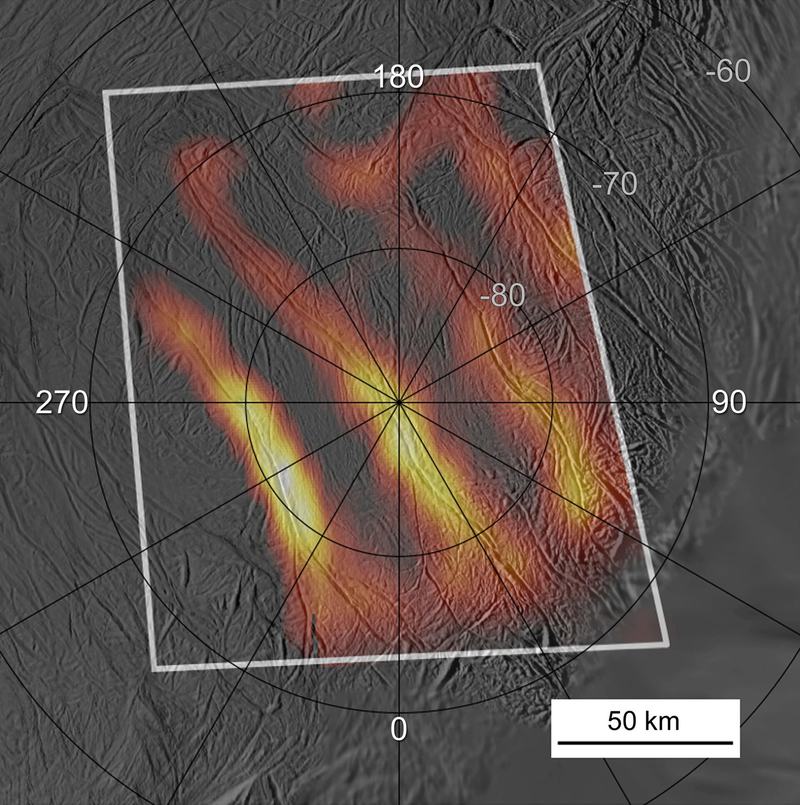

The clearest signature of all this activity is written right across Enceladus's south pole. The moon's four "tiger stripe" fractures were first observed on May 20, 2005 by Cassini's Imaging Science Subsystem camera, and each one is a genuine geological feature in its own right: each tiger stripe depression is on average 130 km long, 2 km wide, and 500 metres deep, flanked by ridges that average 100 metres tall.
The four tiger stripes are officially named Alexandria, Cairo, Baghdad, and Damascus Sulci; Baghdad and Damascus are the most volcanically active, while Alexandria is the least active. It's from fractures like these that Enceladus's plumes actually erupt — cracks in an otherwise pristine icy shell, venting straight from the ocean below into open space.
That pristine shell is precisely why Enceladus looks the way it does from a distance. The fresh, clean ice that dominates its surface makes Enceladus the most reflective body in the Solar System, with a visual geometric albedo of 1.38 and bolometric Bond albedo of 0.81 — a coat of surface material so bright and so constantly renewed by fallout from its own plumes that it outshines every other object we know of in the Solar System.
The Mission That Made It All Possible
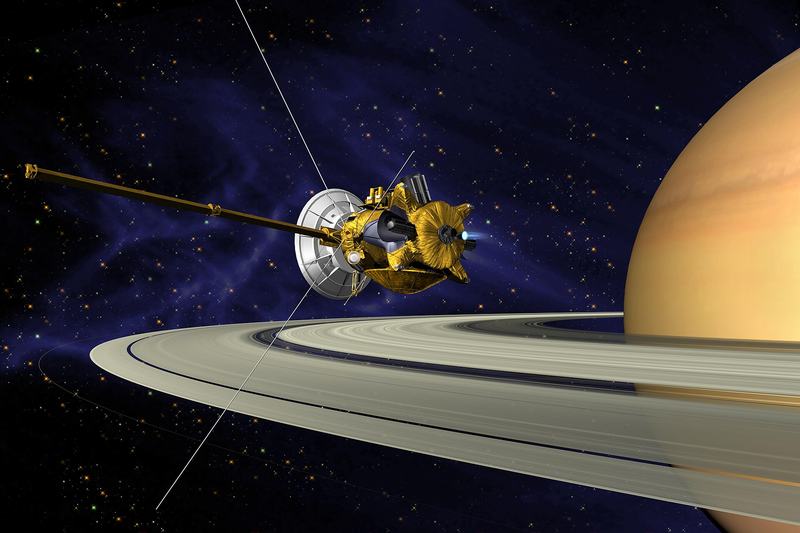

None of these discoveries would have been possible without the Cassini spacecraft, which was the fourth space probe to visit Saturn and the first to enter its orbit, where it stayed from 2004 to 2017. Thirteen years of close, repeated flybys turned Enceladus from a dim, distant dot into one of the best-documented ocean worlds in the Solar System — and one of the most promising places to keep looking for whatever else might be happening in its hidden sea.