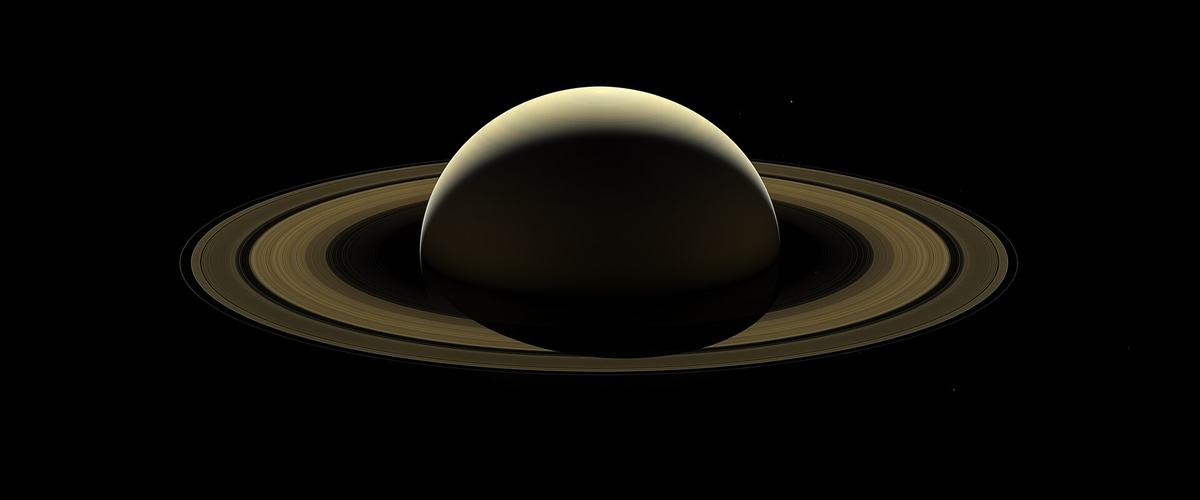
Cassini-Huygens became the first spacecraft ever to orbit Saturn, and it didn't leave after a quick look around. The joint NASA-ESA mission stayed in that orbit for 13 years, turning what had been brief flyby glimpses of the ringed planet into more than a decade of continuous, close-up study.
The mission launched on October 15, 1997, and spent almost 7 years cruising through the solar system before finally settling into Saturn's orbit on July 1, 2004. Altogether, Cassini operated for nearly 20 years, making it one of the longest-serving spacecraft NASA has ever sent to another world.
This guide gathers what made the mission so remarkable: a lander that beat its own worst-case expectations, an icy moon spraying possible ingredients for life into space, and rings that turned out to be shockingly young compared with the planet they circle.
A Giant Among Robotic Explorers
Cassini and Huygens together formed the third-largest uncrewed interplanetary spacecraft ever launched, trailing only the two Phobos probes the Soviet Union sent toward Mars. That ranking stood for decades, until NASA's Europa Clipper took over as the new third-largest craft following its 2024 launch.
Carrying that much mass meant carrying that much capability: cameras, spectrometers, radar, and enough instruments to keep scientists occupied with new data long after the spacecraft itself was gone. Building and flying something on that scale was, in its own right, proof that huge, multi-decade planetary missions could actually work.
The Huygens Probe Meets Titan
Huygens took its name from Christiaan Huygens, the Dutch astronomer who found Titan on March 25, 1655. More than three centuries later, the ESA-built lander carrying his name finally reached the hazy surface of that same moon.
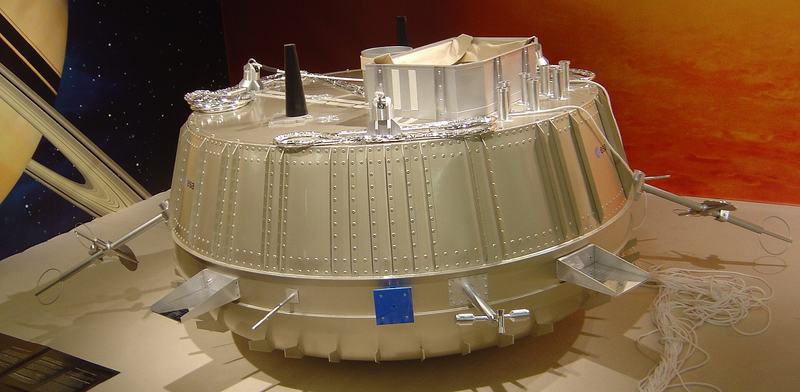

Getting there took careful engineering under real limits. Huygens' batteries and other onboard systems were built to last 153 minutes in total: roughly a 2.5-hour trip down through Titan's thick atmosphere, plus at least 3 more minutes of operation once it landed. Mission engineers were wary of promising much beyond that; they figured the probe might return no more than about 30 minutes of usable data after touchdown.
Huygens actually beat that modest bar, but it still lost data along the way. One of its transmission channels never switched on during the descent, so mission control ended up with only 350 of the 700 surface images that had been planned.
Two Mission Phases, Dozens of Flybys
Cassini's tour of the Saturn system unfolded in distinct chapters, each with its own tally of close encounters. During the four-year nominal mission, which ran until July 2008, the spacecraft completed 74 unique orbits of Saturn and swung past Titan 45 separate times, on some passes coming within 950 kilometers of the moon's surface.
Once that phase wrapped up, NASA extended the mission for two more years under the name Equinox Mission. Its schedule stayed nearly as busy: 26 further close passes by Titan, 7 by Enceladus, and one flyby apiece past the icy moons Dione, Rhea and Helene.
Enceladus: An Icy Moon Spraying Ingredients for Life
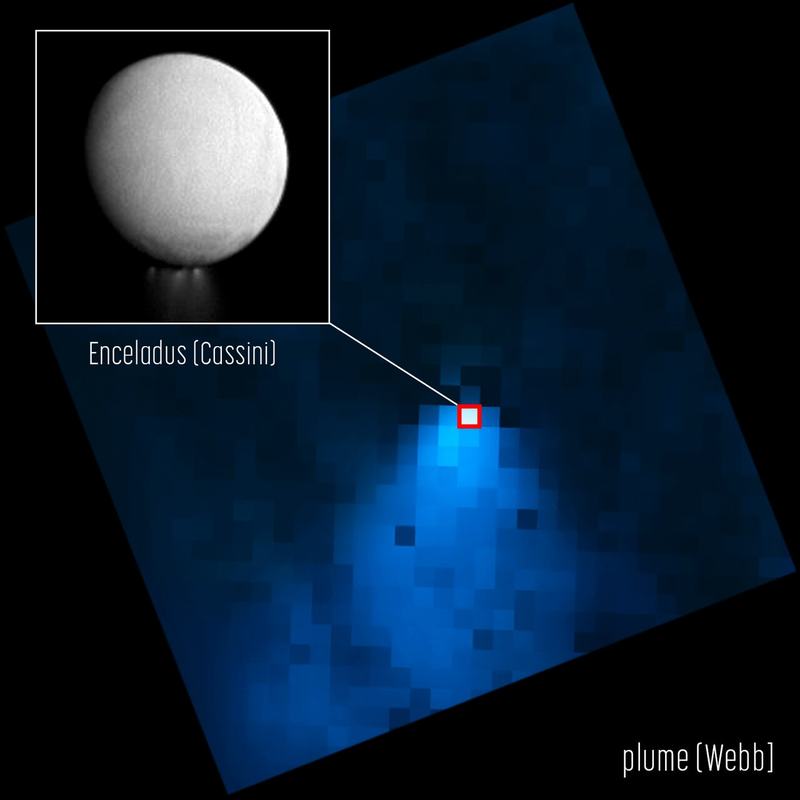
Saturn's moon Enceladus measures only about 500 kilometers across — roughly a tenth of the diameter of Titan, the system's largest moon — yet it became one of Cassini's biggest scientific surprises. Small as it is, Enceladus vents plumes of ice and vapor into space from cracks near its south pole.
Those plumes come from a genuinely cold world. Even at local noon, Enceladus's surface only warms to about -198°C, far colder than a plain sunlit, light-absorbing surface would be expected to reach — a sign that whatever is heating this moon isn't coming from the distant Sun.
What made the plumes so interesting was their chemistry. Analysis tied to Cassini's data turned up several previously undetected compounds inside them, including hydrogen cyanide, additions considered important building blocks toward habitability. A small ice-covered moon spraying out chemistry linked to the raw materials of life was not on anyone's original list of expected mission highlights.
Saturn's Rings: Named After Their Discoverer, Younger Than Expected


In 1675, astronomer Giovanni Domenico Cassini worked out that Saturn's ring wasn't one continuous sheet at all — it was actually several narrower rings with gaps running between them. The widest of those gaps still carries his name today, the Cassini Division.
Three centuries later, the spacecraft that inherited his name delivered a twist he never could have anticipated. Data gathered by Cassini suggested the rings are surprisingly young, likely formed no more than 100 million years ago and possibly as recently as 10 million years ago. A structure that looks like a permanent fixture of the Saturn system may, geologically speaking, be a fairly recent addition.
Titan's Thick, Stormy Atmosphere
Titan holds a record no other moon in the solar system can claim: among all of them, only its atmosphere presses down harder than Earth's does, with a surface pressure of 1.448 atmospheres. It also ranks as one of just two moons — the other being Neptune's Triton — with air dense enough to generate its own clouds, hazes and weather.
That thick, hazy covering is exactly what kept Titan's ground hidden from view until Huygens dropped through it, and it's why this moon still stands out as one of the most weather-active places found anywhere beyond Earth.
The Grand Finale
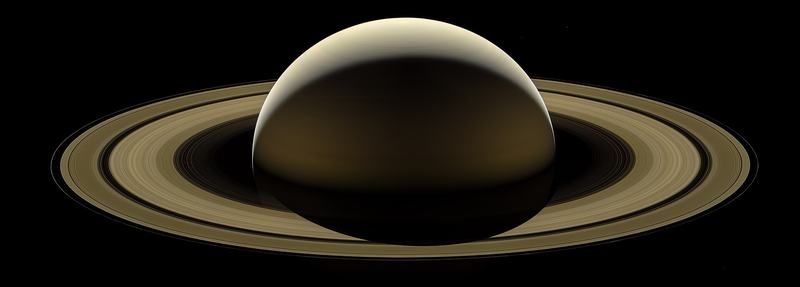

In 2017, a final close pass by Titan bent Cassini's trajectory so sharply that its next approach to Saturn came within just 3,000 kilometers of the planet's cloud tops, passing nearer to Saturn than the innermost D ring. Mission planners used that maneuver to send the aging spacecraft diving repeatedly through the narrow gap between Saturn and its rings, gathering close-up readings no orbiter had ever managed before.
The mission's actual end came fast. Cassini is estimated to have burned up in Saturn's atmosphere about 45 seconds after ground controllers received its last transmission, closing out a mission whose data scientists are still combing through today.