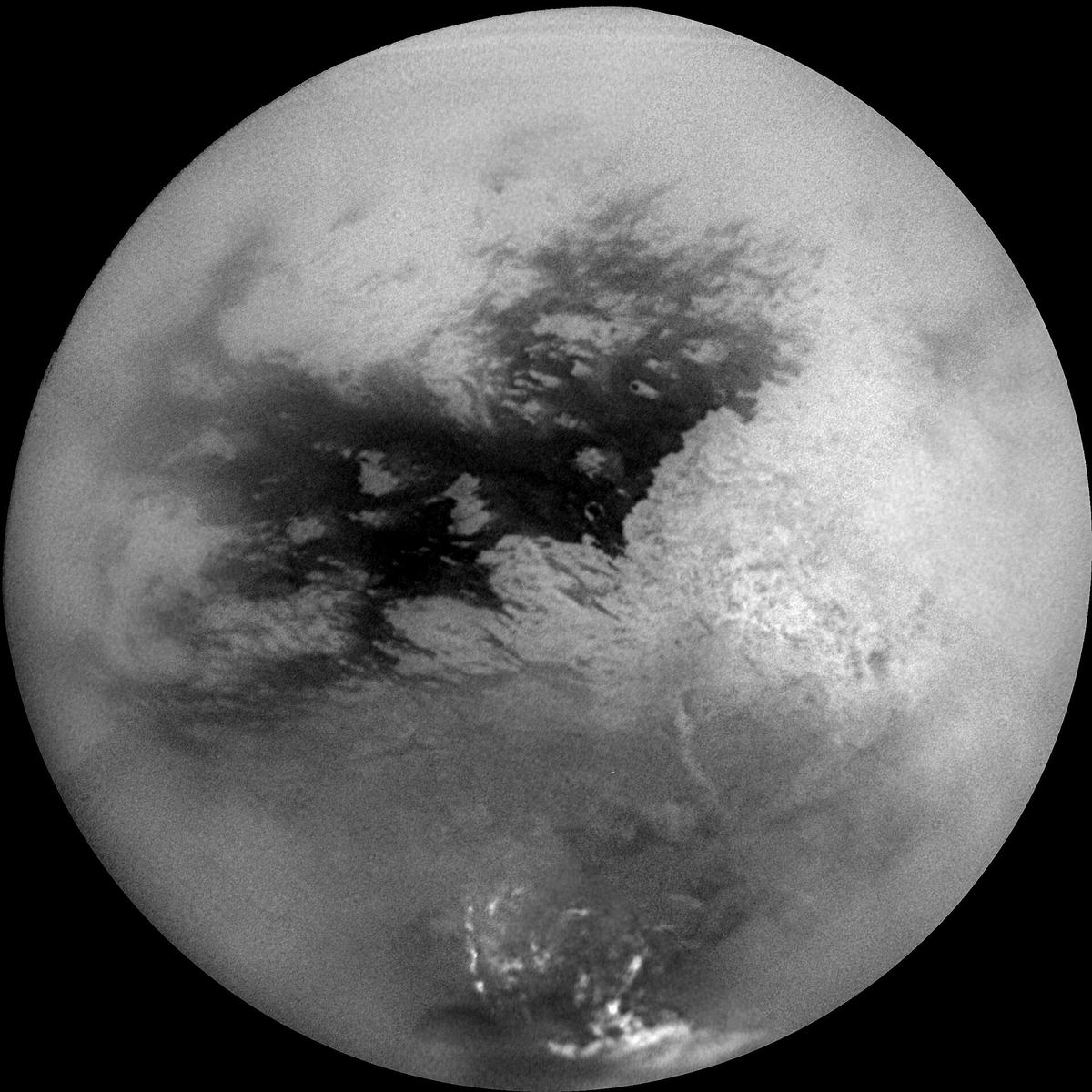
Every other moon in the Solar System is essentially airless rock or ice, exposed directly to the vacuum of space. Titan is not. Saturn's largest moon is the only moon known to have a dense atmosphere — denser than Earth's — and the only known object in the Solar System besides Earth with clear evidence of stable bodies of surface liquid. It has seas, weather, and a hydrological cycle, just built from different materials than ours.
Titan orbits Saturn at 20 Saturn radii, or 1.2 million km, out from the planet's apparent surface. Seen from the ground there, Saturn is a spectacular sight: disregarding its rings, the planet spans an arc of 5.09 degrees in Titan's sky, more than ten times as large as the Moon appears from Earth. It is a moon that looks like it belongs on a very different kind of world — and in several ways, it does.
That combination of scale, atmosphere, and standing liquid has made Titan one of the most closely studied bodies in the outer Solar System, and it is about to get a visitor: NASA's Dragonfly rotorcraft, due to arrive there in the mid-2030s.
A Moon Built on a Planetary Scale
Titan is 48.16% larger in diameter than Earth's Moon and 80% more massive — numbers that put it firmly in the "planet-like moon" category rather than an ordinary satellite. At 5,149.46 km across, it is 6% larger than the planet Mercury and 50% larger than Earth's Moon, making it the tenth-largest object known in the Solar System, including the Sun itself.
Size comparisons with Mercury only go so far, though. Titan is the second-largest moon in the Solar System after Jupiter's Ganymede and is physically larger than Mercury, yet it's only 40% as massive as that planet. The reason is composition: Mercury is mostly iron and rock, while Titan is mostly ice, which is far less dense. Bulk and mass, in other words, tell very different stories depending on what a world is actually made of.
Titan's real size was misjudged for decades. Before Voyager 1 arrived in 1980, astronomers thought Titan was slightly larger than Ganymede and therefore the largest moon in the Solar System. The mistake came from Titan's own atmosphere: a dense, opaque haze layer sitting 100 to 200 km above the surface made the moon appear bigger than it actually is, until a spacecraft got close enough to measure it directly.
An Atmosphere Thicker Than Earth's
That haze is no accident of measurement — it is the signature of a genuinely substantial atmosphere. Titan is the only moon in the Solar System with an atmosphere denser than Earth's, with a surface pressure of 1.448 atm, and it's one of only two moons whose atmospheres are thick enough to support clouds, hazes, and weather, the other being Neptune's moon Triton.
That atmosphere comes at a cost to sunlight. Titan receives only about 1% as much sunlight as Earth to begin with, simply because of its distance from the Sun, but before that faint light even reaches the ground, roughly 90% of it is absorbed by the thick atmosphere. The surface ends up with just 0.1% of the light level Earth receives — a permanent, hazy twilight rather than daylight as we would recognize it. Fittingly, the surface itself is bitterly cold, holding at about 94 K, or -179.2 degrees Celsius.
Seas Bigger Than the Caspian
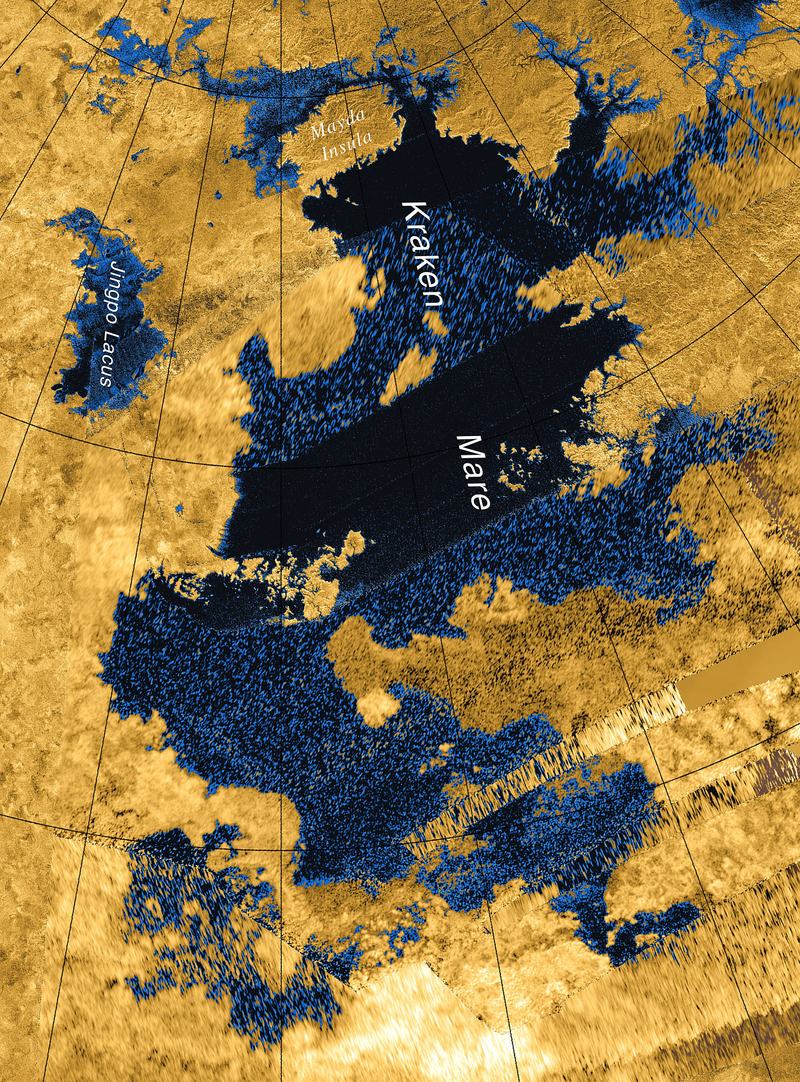

The most striking result of Titan's atmosphere and cold is what collects on the surface: liquid, in quantities large enough to call seas. Kraken Mare, at 500,000 km2, is thought to be the largest body of liquid on Titan. It covers an area slightly bigger than the Caspian Sea on Earth, making it the largest known lake anywhere in the Solar System. Cassini radar altimeter data show that its main body is at least 100 metres deep and likely deeper than 300 metres — a genuine sea, not a puddle.
Kraken Mare doesn't stand alone. Near Titan's north pole, it shares the map with Ligeia Mare, the second-largest sea, and Punga Mare; together the three cumulatively account for roughly 80% of Titan's total sea and lake coverage, totaling 691,000 km2 combined. These are not bodies of water in the Earth sense — the liquid is methane and ethane, stable at Titan's deep-freeze surface temperature the way water is stable on Earth — but the geography is eerily familiar: coastlines, depth variation, drainage patterns, all shaped by a completely different liquid.
The Farthest Landing a Spacecraft Has Ever Made
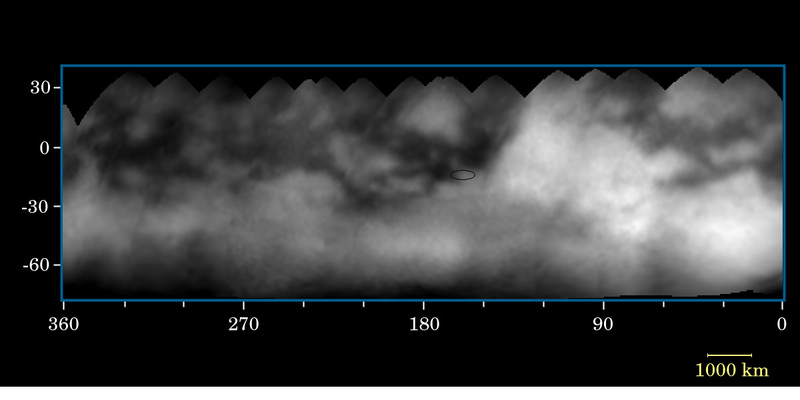
Titan's atmosphere hid these features from view for most of the 20th century, which is part of why it took a dedicated mission to reveal them. The Cassini spacecraft launched on October 15, 1997 and entered orbit around Saturn on July 1, 2004, where it stayed for 13 years, mapping Titan's surface by radar since haze blocked direct imaging.
.png)
Cassini carried a passenger built specifically for Titan: the European Huygens probe. Huygens touched down on Titan on January 14, 2005, and to this day, Titan is the most distant body from Earth to have a space probe land on its surface. The landing itself was almost gentle — Huygens hit with an impact speed similar to dropping a ball on Earth from a height of about 1 metre, making a dent just 12 cm deep before bouncing and sliding 30 to 40 cm across the surface. For a probe that had just descended through the atmosphere of a moon roughly 1.2 billion km from home, it was a remarkably soft touchdown.
What Huygens and Cassini together revealed was a surface that, despite Titan's age, looks surprisingly young. Titan has existed since the Solar System's formation, but its surface is much younger, between 100 million and 1 billion years old — evidence of ongoing geological and atmospheric processes that keep erasing and remaking the terrain, much like Earth's weather and plate tectonics do here.
A Moon With a Resonant Neighbor
Titan's gravity reaches beyond its own orbit. The small, irregularly shaped moon Hyperion is locked in a 3:4 orbital resonance with Titan — meaning Hyperion completes three orbits of Saturn for every four that Titan completes. That gravitational relationship is thought to be part of why Hyperion tumbles chaotically instead of settling into the kind of stable, synchronized rotation most large moons have; Titan's steady, massive presence nearby effectively locks the orbital rhythm while leaving Hyperion's spin unconstrained.
The Next Visitor: A Drone for an Alien Sky
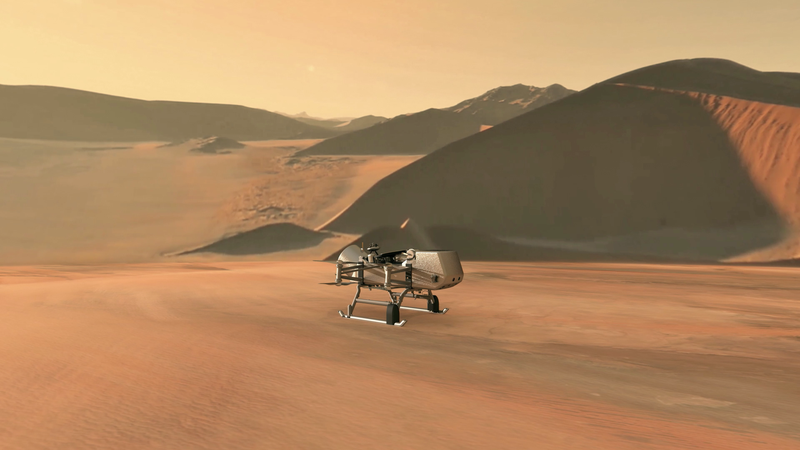

Titan's thick atmosphere, long treated as an obstacle to studying its surface, is about to become an asset. NASA's Dragonfly mission, an eight-rotor rotorcraft, is scheduled to launch in July 2028 and arrive at Titan in the mid-2030s, where it intends to make the first powered and fully controlled atmospheric flight on any natural satellite. Rather than being confined to a single landing site like Huygens, Dragonfly will fly from location to location, using Titan's dense air and low gravity to make repeated, controlled flights something no other planetary mission has attempted.
Each of Dragonfly's eight rotors is 1.35 metres in diameter, and the rotor configuration is designed so the mission can tolerate the loss of at least one rotor or motor without ending the mission. It is a level of built-in redundancy that reflects just how much NASA is banking on Titan's atmosphere behaving as expected — thick enough to fly through, but still an alien sky nobody has flown in before.