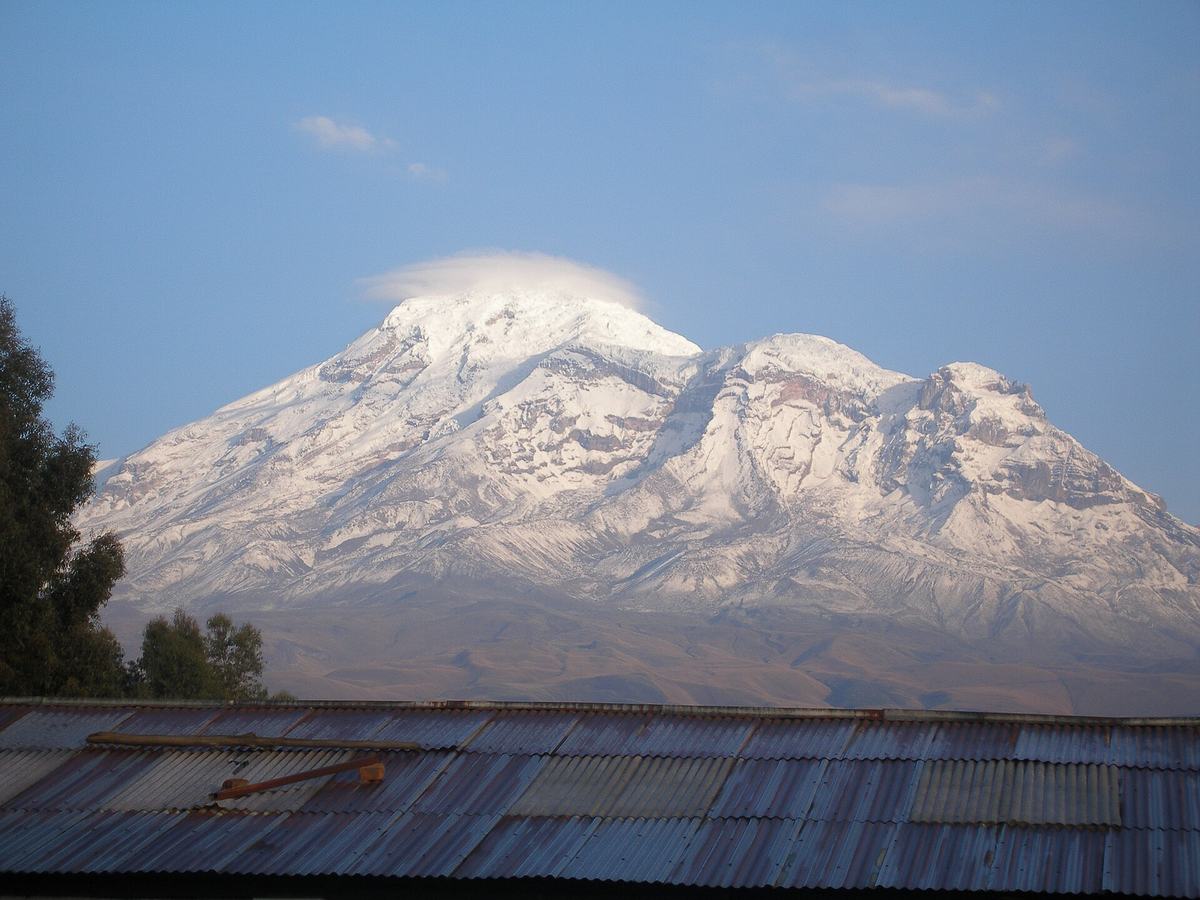
Stand on the summit of Mount Everest and you are, by the usual measure, as high as anyone gets. But climb Chimborazo in Ecuador instead, and you end up 6,384.4 km from Earth's center — farther out than Everest, because Earth itself bulges in your favor. Rotation flattens the planet at the poles and swells it at the equator, adding a full 43 km to Earth's diameter there compared with pole to pole. Even the deepest trench and the tallest mountain barely register against that bulge: the Mariana Trench trims the planet's average radius by just 0.17%, and Everest adds back only 0.14%.
Earth looks static in a photograph, but almost nothing about it is standing still. Its crust splits, slides, and gets swallowed back into the mantle on a schedule measured in tens of millions of years. Its interior runs hot enough to melt rock and cool enough to hold a solid inner core. Its magnetic field, quietly weakening as you read this, is the only thing standing between the atmosphere and a sky full of unfiltered solar wind. Even the planet's ending is already sketched out, on a timeline of billions of years.
Not Quite Round, and Not Quite Still
The bulge is only the most obvious way Earth deviates from a perfect sphere. Rotation stretches the planet into an ellipsoid, and gravity plus rotation together decide where "farthest from center" and "highest above sea level" stop being the same question — which is exactly why Chimborazo, nowhere near the world's tallest mountains, still wins a category Everest can't touch.
Underneath that shape, the surface itself is temporary. The oldest oceanic crust on Earth, found in the Western Pacific, is only about 200 million years old — young next to the planet itself. Continental crust ages far better: the oldest dated continental crust is 4,030 million years old, and zircon crystals have survived from crust as old as 4,400 million years. The seafloor is essentially disposable, constantly created at ridges and destroyed at subduction zones, while scraps of continent can persist for nearly the age of the planet itself.
A Moon Born From a Bad Collision
Earth's surface didn't just shift into its current shape gradually — some of the planet's defining features trace back to a single catastrophic event. The leading hypothesis for the Moon's origin is that a Mars-sized object called Theia, carrying about 10% of Earth's mass, collided with the young Earth, and the Moon accreted from the debris thrown off by the impact. An object roughly a tenth as massive as Earth itself slamming into the newly formed planet is not a subtle beginning for a natural satellite.
Earth recovered from that violence remarkably fast, at least on geological timescales. Zircon grains from Western Australia, dated to as far back as 4.4 billion years ago, show that continental crust and liquid water already existed within just 140-160 million years of Earth's formation. A planet that had recently absorbed a Mars-sized impactor was already growing solid ground and pooling liquid water within a geological eyeblink.
A Crust That Never Stops Moving
That churn happens at a pace easy to underestimate. Tectonic plates creep along at roughly fingernail-growth speed — 10 to 40 mm a year — at the Mid-Atlantic Ridge, and at hair-growth speed, about 160 mm a year, for the Nazca Plate. Among the fastest movers anywhere, the Cocos Plate advances at 75 mm a year and the Pacific Plate at 52-69 mm a year. None of that sounds dramatic on a human timescale, but compounded over 200 million years, fingernail-speed motion is enough to open and close entire oceans.
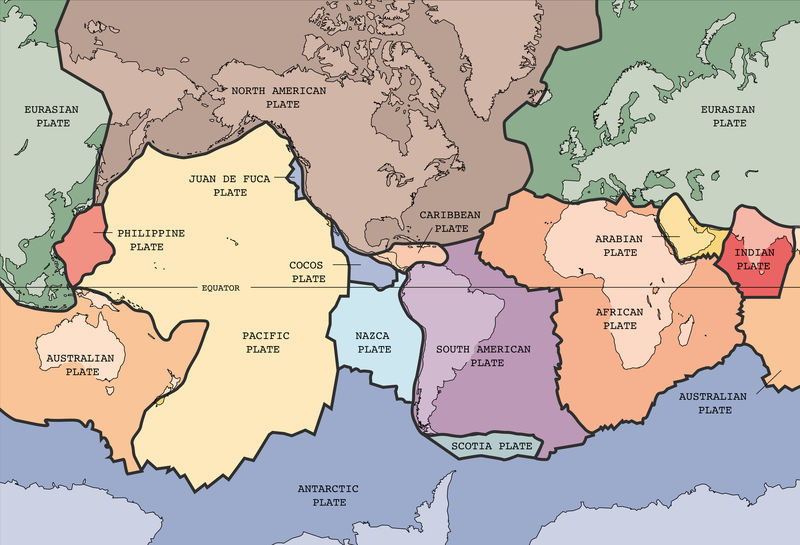

That patient motion is also why Earth's surface keeps recycling itself while the continents it carries drift almost unchanged for billions of years — two very different clocks running inside the same planet.
A Shield That's Already Fading
Plate tectonics isn't the only slow-motion process shaping Earth's habitability. The planet's magnetic field was established by 3.5 billion years ago, at a time when the solar wind was roughly 100 times stronger than it is today. That field is thought to have kept the young atmosphere from being stripped away entirely — which is probably what happened to the atmosphere of Mars.
The shield isn't static, either. Earth's magnetic dipole moment is currently fading at nearly 6% per century, though it remains stronger than its long-term average. Reversals have happened before: the most recent full flip of the magnetic poles occurred approximately 700,000 years ago. A field that can weaken by single-digit percentages per century, and occasionally flip its polarity outright, is doing a much less steady job of shielding the planet than "invisible force field" suggests.
A Magnetic Bubble Bigger Than It Looks
Zoom out from the surface and the field's real shape appears: a bubble around the whole planet, squashed on the side facing the Sun. Solar wind pressure compresses that sunward side down to about 65,000 km, and farther out, the bow shock — the shockwave where the solar wind first slams into the field — sits about 90,000 km from Earth and is only about 17 km thick.
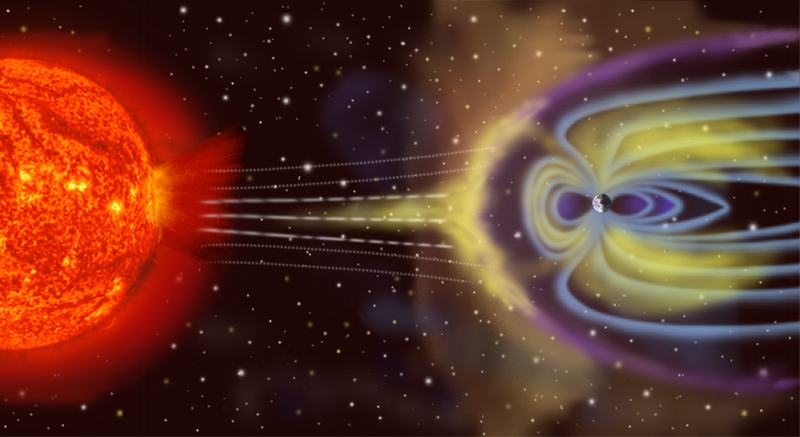

Earth's magnetosphere feels enormous from the ground, but in planetary terms it's modest. Jupiter's magnetosphere is stronger than Earth's by an order of magnitude, and its magnetic moment is roughly 18,000 times larger. The bubble that quietly protects every satellite and astronaut in near-Earth space would be a rounding error next to Jupiter's.
The Furnace at the Center
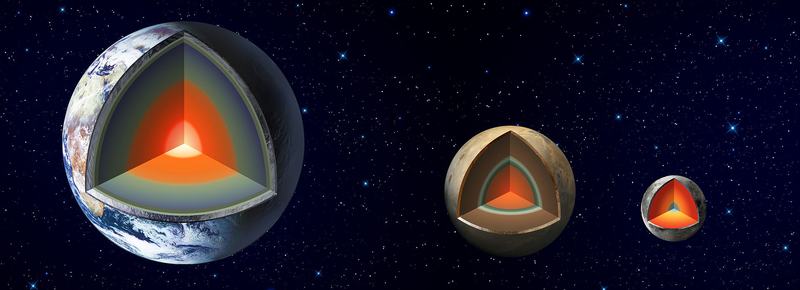
None of this — the crust, the field, the atmosphere — would exist without the heat driving it from within. At Earth's center, temperatures may reach up to 6,000°C, and pressure may reach up to 360 GPa, about 52 million psi. All of that heat has to go somewhere: Earth constantly radiates energy from its interior into space, a global total of 4.42×10^13 watts, or a mean of 87 milliwatts for every square meter of surface.
_-_Artist%27s_Concept.jpg)
It's a modest number per square meter — you'd never feel it standing outside — but multiplied across the entire planet, it's the same engine that drives mantle convection, keeps the outer core liquid, and ultimately powers the magnetic field protecting everything above it.
An Orbital Companion Nobody Talks About
Earth doesn't just have one Moon; it also has quieter travel companions most people never hear about. A trojan asteroid, designated 2010 TK7, librates around the L4 Lagrange point — a gravitationally stable spot leading Earth in its orbit around the Sun.
It's a reminder that "orbiting Earth" and "orbiting the Sun alongside Earth" aren't the same category, and that the neighborhood immediately around our planet is more crowded — and stranger — than the single, familiar Moon suggests.
An Expiration Date, Billions of Years Away
Everything described so far assumes a Sun that behaves the way it does today, and that assumption has a shelf life. The Sun is gradually brightening: its luminosity will rise 10% over the next 1.1 billion years and 40% over the next 3.5 billion years. That isn't a minor adjustment. As the Sun brightens, Earth's mean temperature could reach 100°C within 1.5 billion years, and all ocean water may evaporate and be lost to space within an estimated 1.6 to 3 billion years.
The final act comes later still. In about 5 billion years, the Sun will swell into a red giant, expanding to roughly 1 AU — about 250 times its current radius. Long before that happens, the ocean water first evidenced in those 4.4-billion-year-old Australian zircon grains will already be gone. Earth's slow-motion processes — the crust recycling, the field weakening, the interior cooling — are, in the end, all running against a much larger, equally slow-motion clock.