Every star that formed with roughly a third to eight times the mass of the Sun is destined to become a red giant. It is not a rare or exotic object — it is simply what an ordinary star turns into once it runs low on the hydrogen fuel packed into its core. The outer layers puff outward, the surface cools, and a once-modest star turns into something that can outshine and outsize almost everything nearby.
Red giants matter because they show us our own future. In several billion years, the Sun will pass through this same stage, and the change in its size will be dramatic enough to redraw the inner Solar System. Along the way, red giants also produce some of the strangest physics in stellar astronomy, including an internal explosion that briefly outshines an entire galaxy without destroying the star that hosts it.
What Makes a Star "Giant"
A red giant is a bright, evolved star that started out somewhere between roughly a third and eight times the Sun's mass, now passing through a late stage of its life. Despite the name, "red" is relative: red-giant-branch stars typically have surface temperatures of 3,000 to 4,000 kelvin, noticeably cooler than the Sun's roughly 6,000 kelvin, and that lower temperature is what shifts their light toward the red end of the spectrum. What truly sets them apart is size — their radii can reach roughly 200 times that of the Sun.

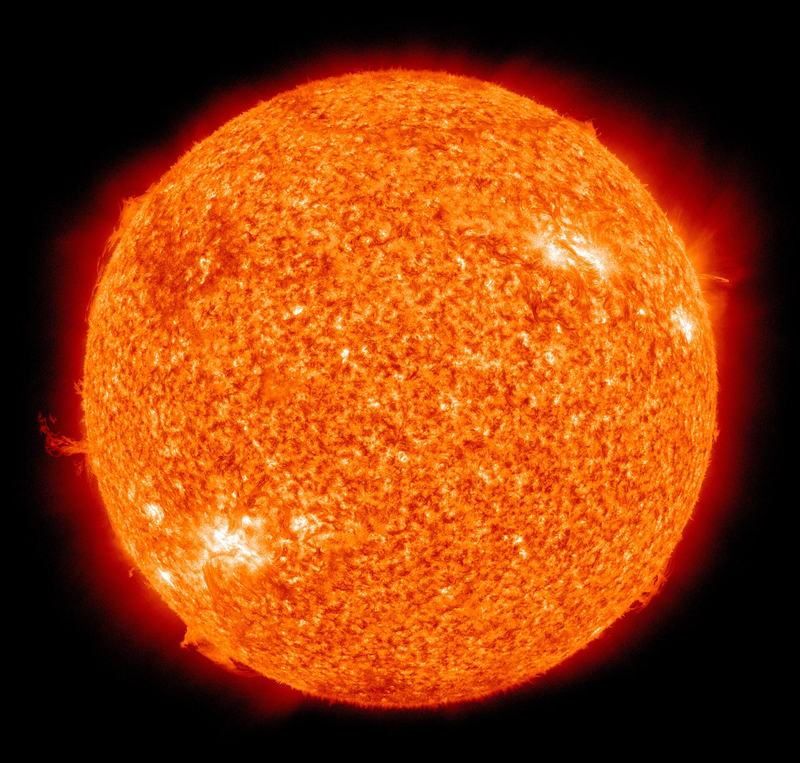
Red giants also look different up close than ordinary stars do. The Sun's visible surface is covered with a huge number of small convective cells, the bubbling pattern known as granulation. A red giant's surface, by contrast, is dominated by only a handful of enormous convective cells, and the churning of these oversized cells is part of why red giants tend to vary noticeably in brightness.
The Sun's Retirement Plan
The Sun itself is on a fixed schedule. In roughly 4 to 7 billion years, hydrogen fusion in its core will taper off, the core will contract and heat up, and the outer layers will expand in response — the transformation into a red giant. From that point, a star with the Sun's mass will spend roughly a billion years as a red giant altogether, almost all of it climbing what astronomers call the red-giant branch.

The scale of the expansion is hard to overstate. The Sun is expected to grow to more than 200 times its present-day radius — about 256 times its current size, or roughly 1.2 astronomical units — large enough to engulf Mercury, Venus, and likely Earth. Before it gets there, the Sun will have shed a substantial fraction of itself: it is projected to lose 38% of its mass as it grows, before eventually contracting into a white dwarf. Curiously, if anything is still orbiting farther out by then, conditions may briefly turn favorable rather than hostile — a habitable zone between 7 and 22 astronomical units could persist for roughly another billion years after the red-giant stage.
A Star That Swells to the Size of an Orbit
Stars that survive the red-giant branch and go on to fuse helium enter a further stage called the asymptotic giant branch, or AGB. Here the swelling continues even further: an AGB star's radius can reach as much as one astronomical unit, around 215 times the Sun's current radius — meaning the star's surface would sit roughly where Earth orbits today.
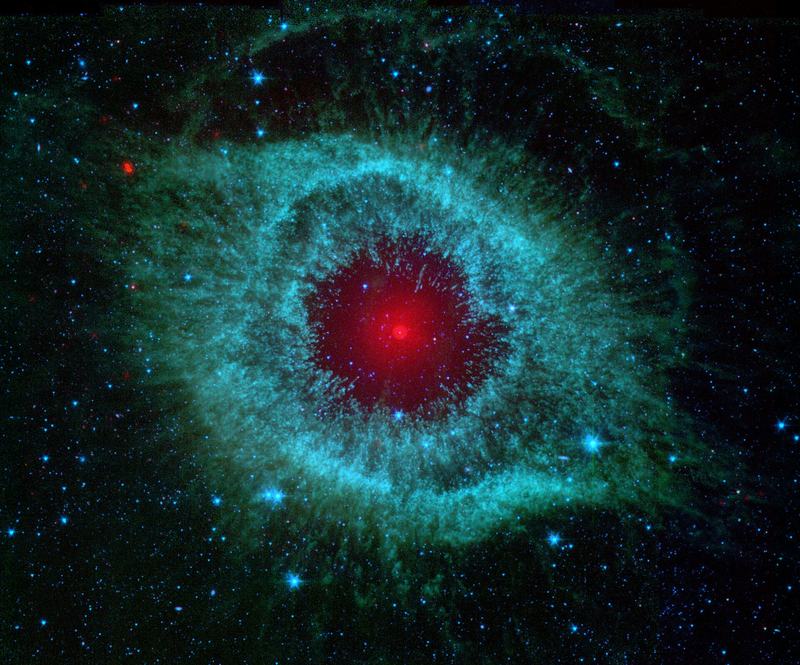

This stage does not last, and the star pays a steep price for its size. An AGB star can shed 50 to 70% of its total mass through vigorous stellar winds, blowing its own outer layers into space. What remains behind, once the envelope is gone, is a compact, exposed core — the seed of the white dwarf the star is heading toward.
A Sudden, Galaxy-Bright Flash
Not every red giant fades quietly toward a white dwarf. Stars with between 0.8 and 2.0 times the Sun's mass undergo a violent but short-lived event called a helium flash, in which helium in the core suddenly fuses into carbon in a runaway reaction. The flash itself lasts only a few minutes, yet during that brief window it produces energy at a rate comparable to an entire galaxy the size of the Milky Way.
Despite that staggering output, a helium flash does not tear the star apart. Because the energy is absorbed almost entirely by the star's own degenerate core and outer layers rather than escaping outward, a star with the Sun's mass releases only about 0.3% as much total energy in a helium flash as a type Ia supernova gives off. It is a genuinely galaxy-scale burst of power that leaves barely a mark on the star's outward appearance.
Betelgeuse, the Giant Next Door
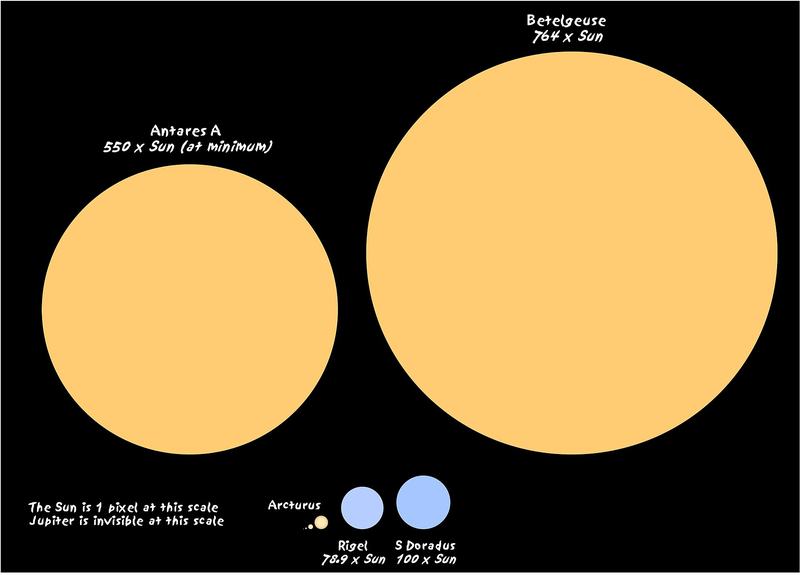
A familiar red giant in the night sky is Betelgeuse, the bright reddish star marking Orion's shoulder — though it is technically a step beyond a normal red giant, in the red supergiant category. Its radius falls somewhere in the range of 640 to 764 solar radii, so large that dropping it into the middle of the Solar System in place of the Sun would swallow up the paths traced by Mercury, Venus, Earth, and Mars.
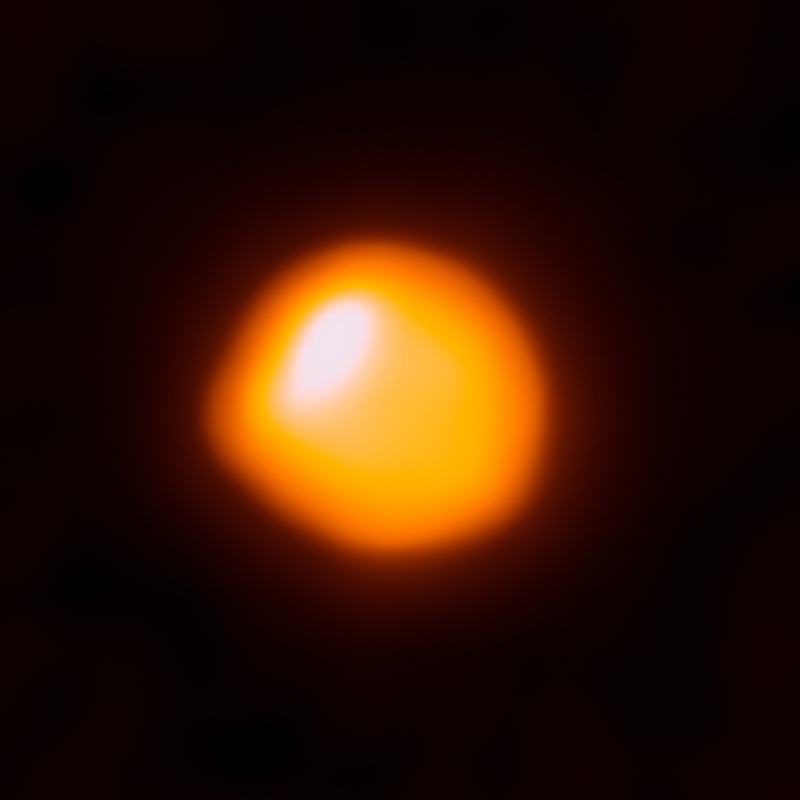

Betelgeuse is also a preview of a much faster ending. It is less than 10 million years old, young by stellar standards, but its unusually large mass has pushed it through its life cycle at a sprint. Astronomers expect it to end in a supernova, quite possibly within the next 100,000 years — a blink of an eye on cosmic timescales, even if it is much too soon to circle a date on any calendar.
Timing the Stars
A star's mass decides almost everything about how quickly it reaches the red-giant stage and how long it stays there. Some low-mass stars keep shining for trillions of years — a span exceeding the current age of the universe itself — while the most massive stars burn out and die after only a few million years, a difference of roughly a million-fold in stellar lifespans depending on how much mass a star started with.
That variation is also useful to scientists, not just dramatic. Researchers have modeled the age-dependent brightness of a feature called the red-giant-branch bump — a subtle pause in a star's climb up the red-giant branch — for star ages between 2 and 12 billion years. Because that brightness shifts in a predictable way with a cluster's age, it gives astronomers a tool for working out how old a globular star cluster actually is, simply by measuring where the bump falls.