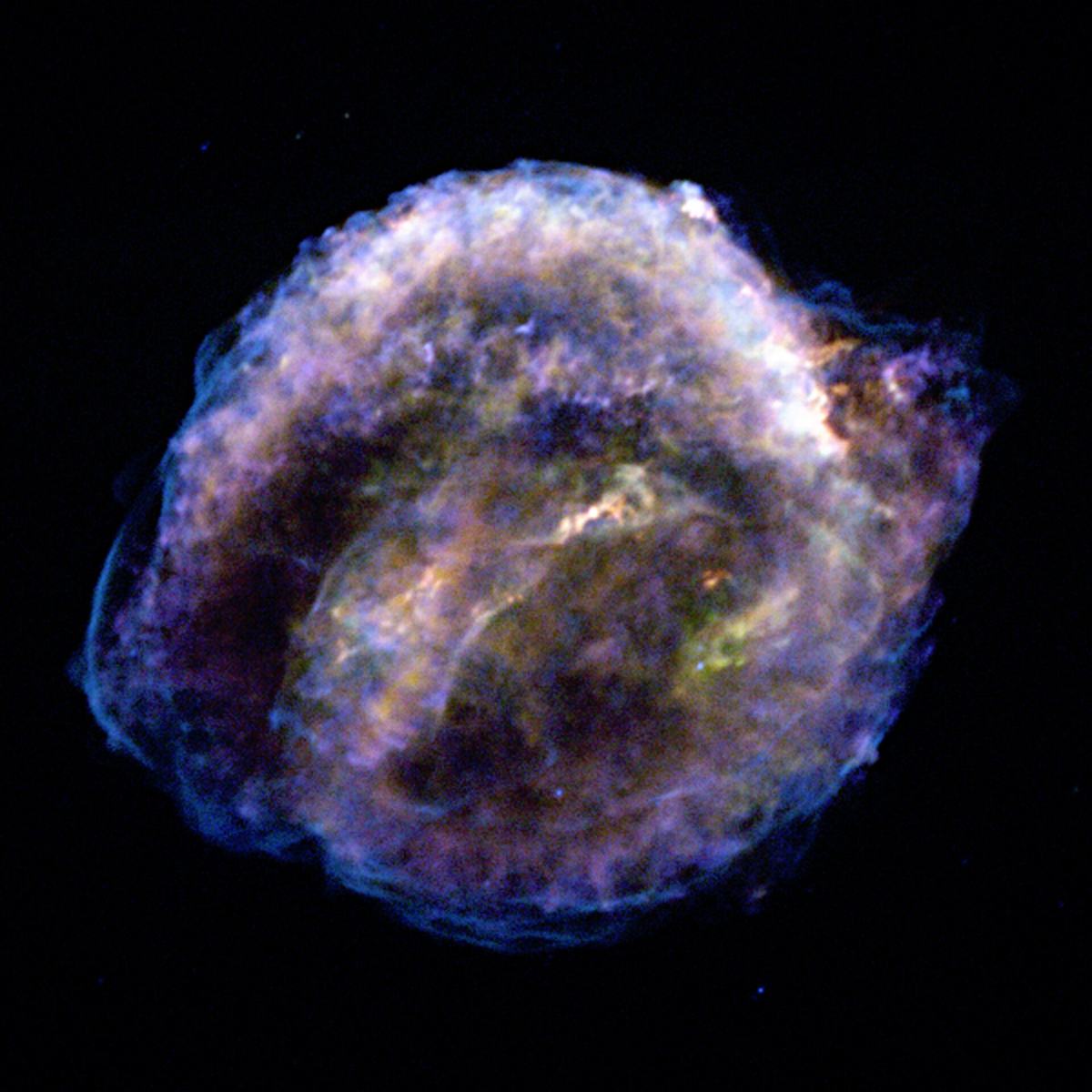
A star does not fade quietly when it detonates. At its peak, a supernova can appear about 3,000 million times brighter than the Sun would if the two were placed at the same distance from an observer -- a flash violent enough to be tracked from other galaxies for months.
Astronomers sort these explosions into two broad families: some come from the sudden, runaway re-ignition of a burnt-out star called a white dwarf, while others mark the final collapse of a massive star's core. Both processes end the same way, in a blast that seeds space with new elements and often leaves behind a strange, compact corpse.
What follows is not the general outline every article repeats. It is a set of specific, sourced numbers: how fast the wreckage flies, how far away the faintest ones have been measured, and what has actually been found hiding inside the remnants.
How a Runaway White Dwarf Detonates
A white dwarf is a burnt-out stellar core so dense that only electron pressure keeps it from collapsing further. If it slowly pulls in gas from a companion star, its mass can creep up toward the Chandrasekhar limit, about 1.44 times the Sun's mass -- the point past which electron degeneracy pressure can no longer hold the star up against its own gravity.
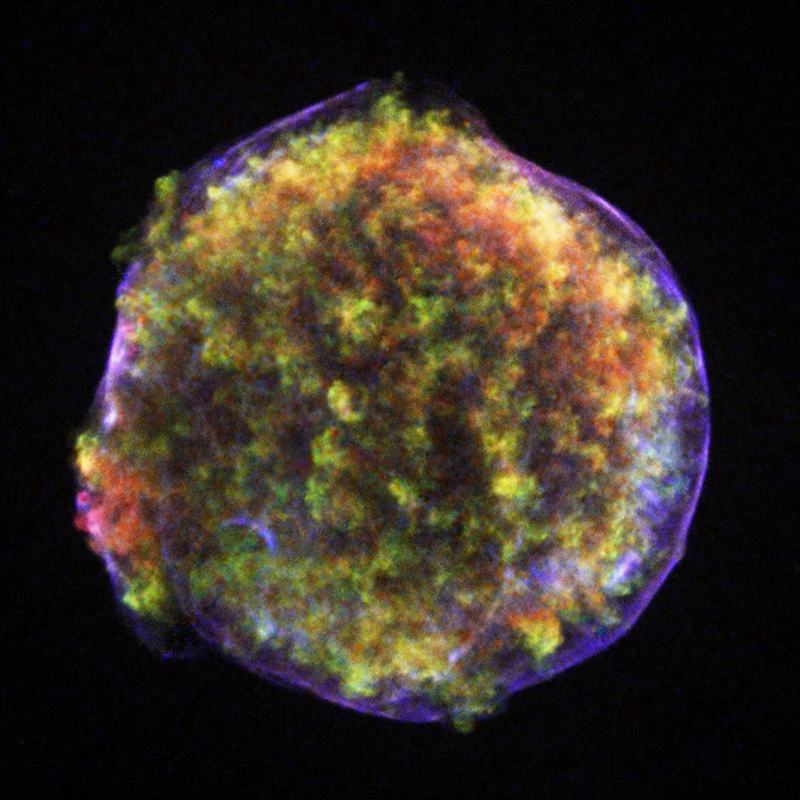

Once ignition begins, the star does not just collapse; it detonates. Matter is blown outward at 5,000 to 20,000 kilometers per second, roughly 6% of the speed of light. Some of that wreckage keeps expanding for centuries: a double-degenerate event, in which two white dwarfs merge rather than one slowly feeding off a companion, can explain why G1.9+0.3, the youngest known supernova remnant in our galaxy, has kept growing brighter and larger for decades after it formed.
Watching a Star Explode in Real Time
Supernovae are common enough that professional and amateur sky surveys turned up more than 200 new ones in a single year, 2012 -- and SN 2012fr, spotted that October, ranked among the brightest of that year's haul.
That brightness is what makes the 3,000-million figure more than an abstraction: astronomers can compare an exploding star's light directly against the Sun's, at matched distance, and get a real ratio rather than a rough impression. Watching a single object swing from invisible to briefly outshining its own galaxy is part of why supernova hunts keep expanding.
A Thousand-Year-Old Blast, Measured to the Kilometer
Some supernovae are old enough to have been recorded by historians rather than telescopes, yet their debris can still be measured with modern precision. The remnant of SN 1006 -- an explosion bright enough to draw attention across the medieval world -- sits about 2.17 (plus or minus 0.08) kiloparsecs from Earth, a distance pinned down by tracking the slow drift of its glowing filaments across decades of images.
That distance measurement lets astronomers work backward to a calculated peak brightness for the original explosion, and the result lines up with the middle of the range of brightness estimates recorded by observers who watched the actual event unfold long before telescopes existed.
The Supernovae That Don't Finish the Job
Not every white-dwarf explosion destroys its star completely. Astronomers have identified more than 30 unusually weak "mini-supernovae" -- blasts feeble enough that the white dwarf at their center might survive rather than being wiped out.
One of these, SN 2012Z, sits in the host galaxy NGC 1309, about 110 million light-years away. Comparing it with a similarly weak event, SN 2008ha, shows just how wide this stripped-down class can vary: SN 2012Z ranks among the more powerful of these underpowered blasts, while SN 2008ha ranks among the weakest. The pattern was not a surprise after the fact -- back in 2009, researchers had already proposed that this kind of event comes from a white dwarf paired with a helium-star companion, years before SN 2012Z gave them a chance to test the idea directly.
The Brightest Explosion Ever Recorded
Not all supernovae are faint or nearby. ASASSN-15lh, the most luminous supernova ever recorded, lies about 3.82 billion light-years from Earth. First detected in June 2015, it peaked at roughly 570 billion times the Sun's luminosity -- twice the bolometric output of any other known supernova.
A single stellar explosion briefly outshining hundreds of billions of Suns is a useful reminder of just how much energy is locked inside an ordinary-looking star before it goes off.
Hunting the Neutron Star Hidden in SN 1987A
SN 1987A remains the benchmark nearby supernova of the modern era. Astronomers place it roughly 51.4 kiloparsecs away -- about 168,000 light-years -- which makes it the nearest stellar explosion anyone has documented since Johannes Kepler tracked one back in 1604, close enough, and recent enough, that instruments across the planet could study it in detail.
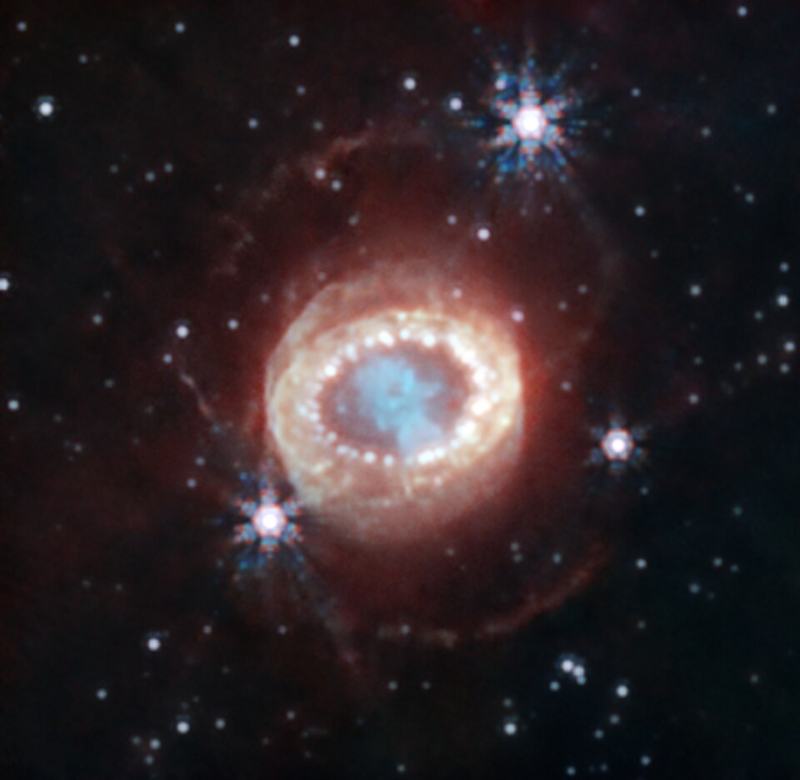
Theory predicted the collapsing core should have left a neutron star behind, but for decades no one could confirm one was actually there. That changed in 2019, when astronomers using the Atacama Large Millimeter Array reported indirect evidence of a collapsed neutron star inside the remnant. Whatever survived the blast is expected to resemble typical neutron stars elsewhere: objects with a radius of roughly 10 kilometers packing in about 1.4 times the Sun's mass.
A Name from 1931 and a Star First Seen in 1054
The word "supernova" itself is barely a century old. Walter Baade and Fritz Zwicky get the credit: the pair introduced the term while lecturing on astrophysics in 1931, borrowing the "nova" astronomers already used for a brightening star and adding the "super" once they realized these events were something categorically bigger.
One of the objects that helped make that distinction obvious sits inside the Crab Nebula -- the wreckage of a supernova that Chinese astronomers recorded in AD 1054.
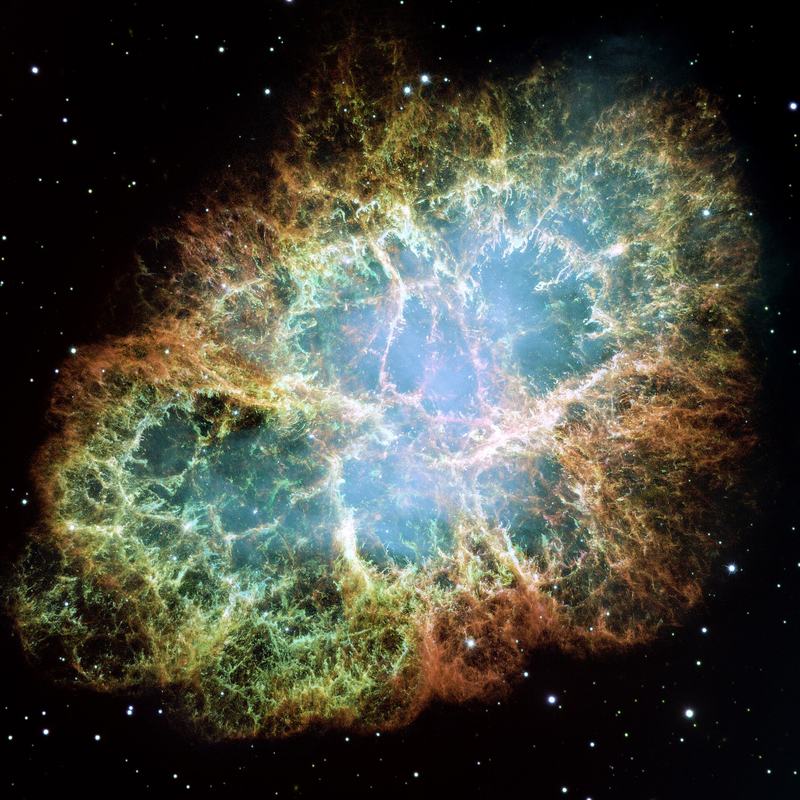

At its center lies the Crab Pulsar, a neutron star only 28 to 30 kilometers across that spins 30.2 times every second -- the compact leftover of an explosion bright enough that observers on the other side of the planet wrote it down without a telescope, centuries before Baade and Zwicky gave the phenomenon its name.
Sources
- ESO: The Rise and Fall of a Supernova
- arXiv: The SN 1006 Remnant — Optical Proper Motions, Deep Imaging, Distance, and Brightness at Maximum
- arXiv: Young Remnants of Type Ia Supernovae and Their Progenitors — SNR G1.9+0.3
- ScienceDaily: Hubble Finds Supernova Star System Linked to Potential 'Zombie Star'
- Wikipedia: Supernova
- Wikipedia: Type Ia supernova
- Wikipedia: SN 1987A
- Wikipedia: Neutron star
- Wikipedia: Crab Nebula