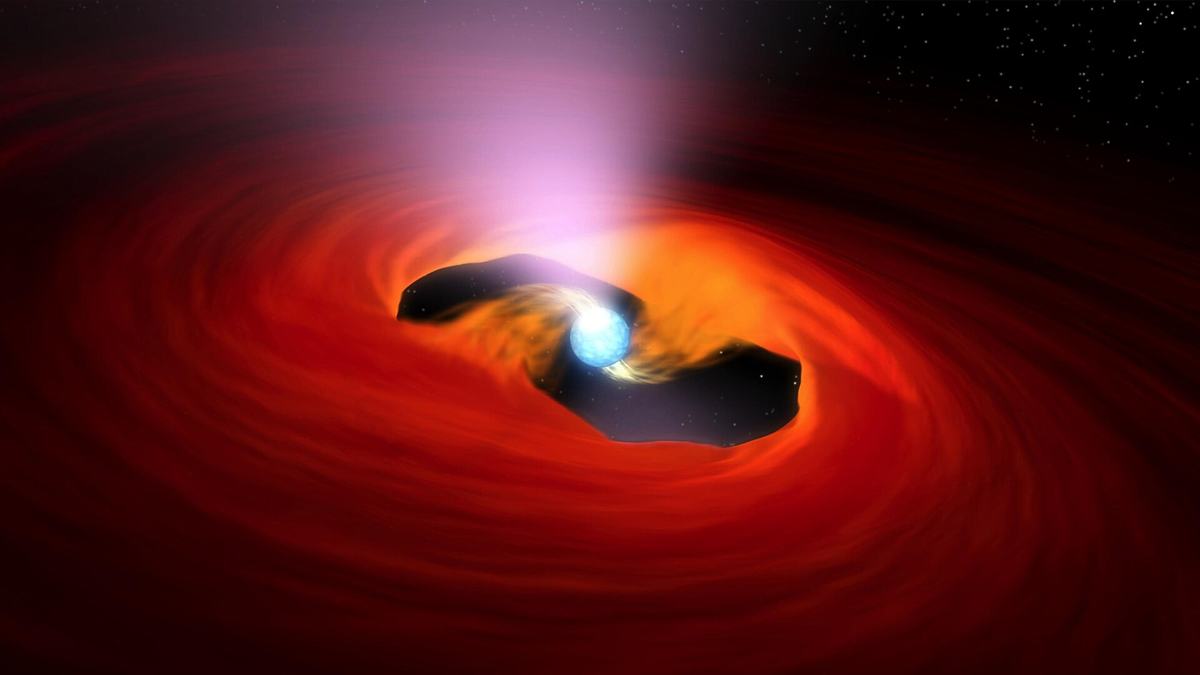
Scoop out a single teaspoon of neutron star material and it would outweigh the Great Pyramid of Giza roughly 900 times over. Nothing about that sentence is an exaggeration — it is simply what happens when a dying star's core gets crushed past the point where atoms can hold their shape.
A neutron star is what remains after a massive star collapses. It is not a planet, not a normal star, and not quite a black hole — it sits in the narrow zone just before gravity wins completely. Astronomers have been finding stranger and stranger examples of them ever since Jocelyn Bell Burnell's discovery, from stars that spin faster than a kitchen blender to stars whose magnetic fields could scramble a credit card from halfway to the Moon.
A Star Crushed to the Size of a City
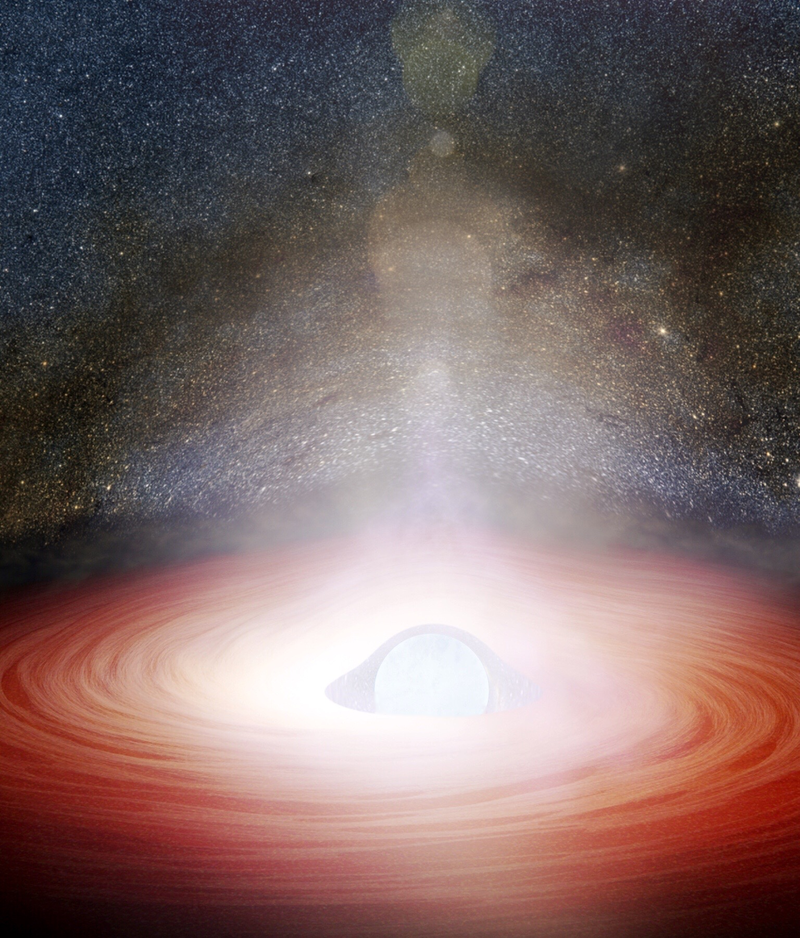

Take a star with about 1.4 times the mass of the Sun and squeeze it down into a sphere only around 10 kilometers (6 miles) across, and you get a neutron star. That is roughly the width of a small city, holding the mass of a star that once burned for millions of years across a diameter you could drive across in a few minutes.
The crushing is so extreme that ordinary matter cannot survive it. Protons and electrons get forced together into neutrons, which is where the object gets its name. The result is so dense that a single teaspoon of it would outweigh the Great Pyramid of Giza roughly 900 times over — a fact that stops sounding abstract the moment you try to picture a teaspoon that heavy sitting on a kitchen table.
The Point Where Even a Neutron Star Gives Up
Neutron stars have a weight limit, and crossing it means becoming a black hole instead. The 2017 merger event GW170817, believed to have collapsed into a black hole soon after impact, let astronomers use its gravitational-wave signal to pin that ceiling down to about 2.17 solar masses for a non-spinning neutron star.
Real neutron stars get remarkably close to that edge. The most massive one confirmed so far, a pulsar cataloged as PSR J0952-0607, weighs in at an estimated 2.35 solar masses, with the true figure uncertain by about 0.17 in either direction. That puts it right at the boundary where a slightly heavier version of the same object would stop being a star at all.
Some of These Things Spin Faster Than a Blender
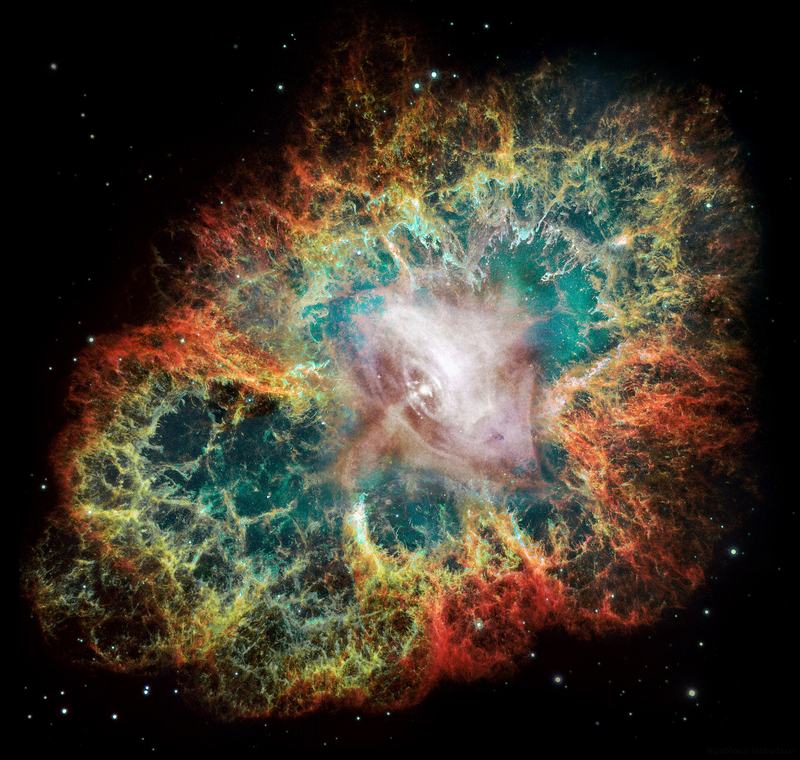

Because a collapsing star keeps most of its original spin while shrinking to a fraction of its former size, neutron stars end up rotating at speeds that have no everyday comparison. The record holder, a pulsar named PSR J1748-2446ad, completes 716 rotations every second — that works out to 42,960 revolutions per minute, with material at its surface moving at roughly a quarter of the speed of light.
Spinning neutron stars that beam radiation toward Earth are called pulsars, because from our vantage point the beam looks like a rhythmic pulse, similar to a lighthouse sweeping past a ship. A typical one is only about 30 kilometers across yet still manages to spin hundreds of times a second while firing that beam of radio waves — and sometimes X-rays — out into space.
A Chart Recorder, 57 Tennis Courts, and an Overlooked Discovery
Pulsars were found almost by accident. A Cambridge PhD student named Jocelyn Bell helped build a radio telescope that covered just under two hectares of ground, about the same area as 57 tennis courts. Instead of a screen, it produced its results the analog way: pen-on-paper chart recordings that stretched more than 30 metres every single day, which she had to comb through by hand.
Buried in that paper was a signal too regular to be noise. Bell and her supervisor, Antony Hewish, published the discovery in the journal Nature, and the find eventually won a Nobel Prize — but when the 1974 Nobel Prize in Physics was awarded for it, the honor went to Hewish and his colleague Martin Ryle, not to Bell herself, a decision still debated by physicists today.
Pulsar-hunting has come a long way since a stack of paper printouts. Astronomers have now catalogued more than 2,600 of them, mostly within the Milky Way, and use them to search for low-frequency gravitational waves, map the structure of the galaxy, and test Einstein's general theory of relativity. Australia's Parkes radio telescope, which made its first pulsar observation in 1968, later appeared alongside an image of a pulsar on the country's first $50 banknote — a rare case of a scientific instrument making it onto the currency.
Magnetars: The Strongest Magnets in the Universe
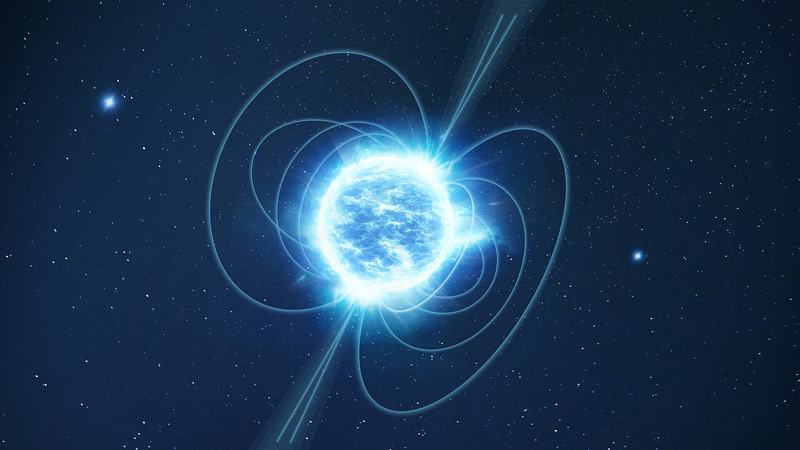

Some neutron stars take the extremes even further. Magnetars are a subclass with magnetic fields so powerful that ordinary physics starts to bend around them, and as of July 2021 astronomers had confirmed 24 of them.
The scale of that magnetism is difficult to overstate. Positioned halfway between Earth and the Moon — whose average separation is 384,400 kilometers (238,900 miles) — a magnetar's field could still erase the data on every credit card's magnetic stripe on the planet. Getting anywhere close to one in real life would be a very bad idea, and thankfully the nearest known magnetars are nowhere near that close.
When Two of Them Collide
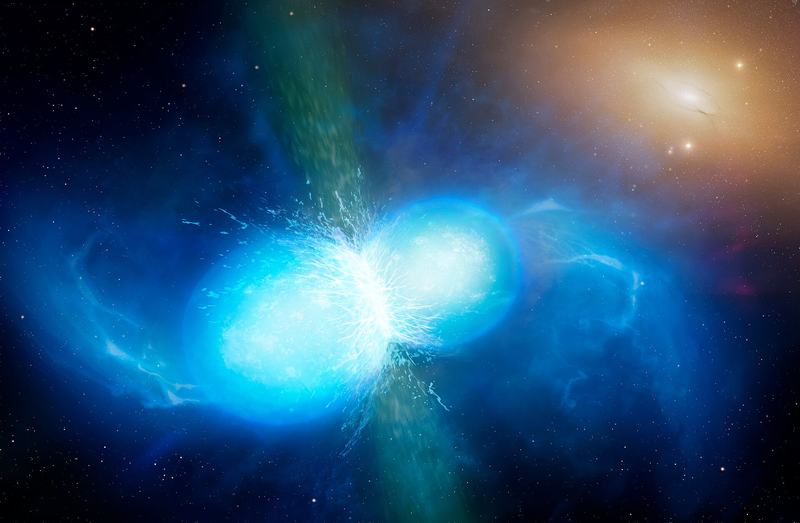

Neutron stars occasionally orbit each other closely enough to spiral in and merge, and the result is one of the most violent events astronomers can observe. Gravitational waves from just such a collision, named GW170817, reached the LIGO and Virgo observatories on 17 August 2017; the source was two neutron stars merging inside NGC 4993, a galaxy in the constellation Hydra roughly 140 million light-years from Earth.
That merger was not a one-off. A gamma-ray burst called GRB150101B, suspected to be a similar merger event, was traced to a location far more distant from Earth — roughly 1.7 billion light-years away — suggesting these collisions happen more often across the universe than any single detection could show. Each merger is thought to forge heavy elements that no ordinary star can produce, seeding the universe with material that eventually ends up in planets, and possibly in jewelry.
Strange Company: An Alien Scare and an Album Cover
Neutron stars have left their mark well beyond astronomy journals. The first confirmed planets outside our own solar system were found in 1992, and they were not orbiting an ordinary star at all — they were circling the pulsar PSR B1257+12, a discovery that surprised researchers who had been searching for planets around Sun-like stars.
Decades earlier, the very first pulsar signal was so precisely regular that scientists briefly wondered whether it might be an artificial beacon. It wasn't, but a chart of its rhythmic signal went on to have an unlikely afterlife: English post-punk band Joy Division chose that pulsar chart as the artwork for Unknown Pleasures, the 1979 record that launched their debut — turning a physics readout into one of the most recognized images in rock music.