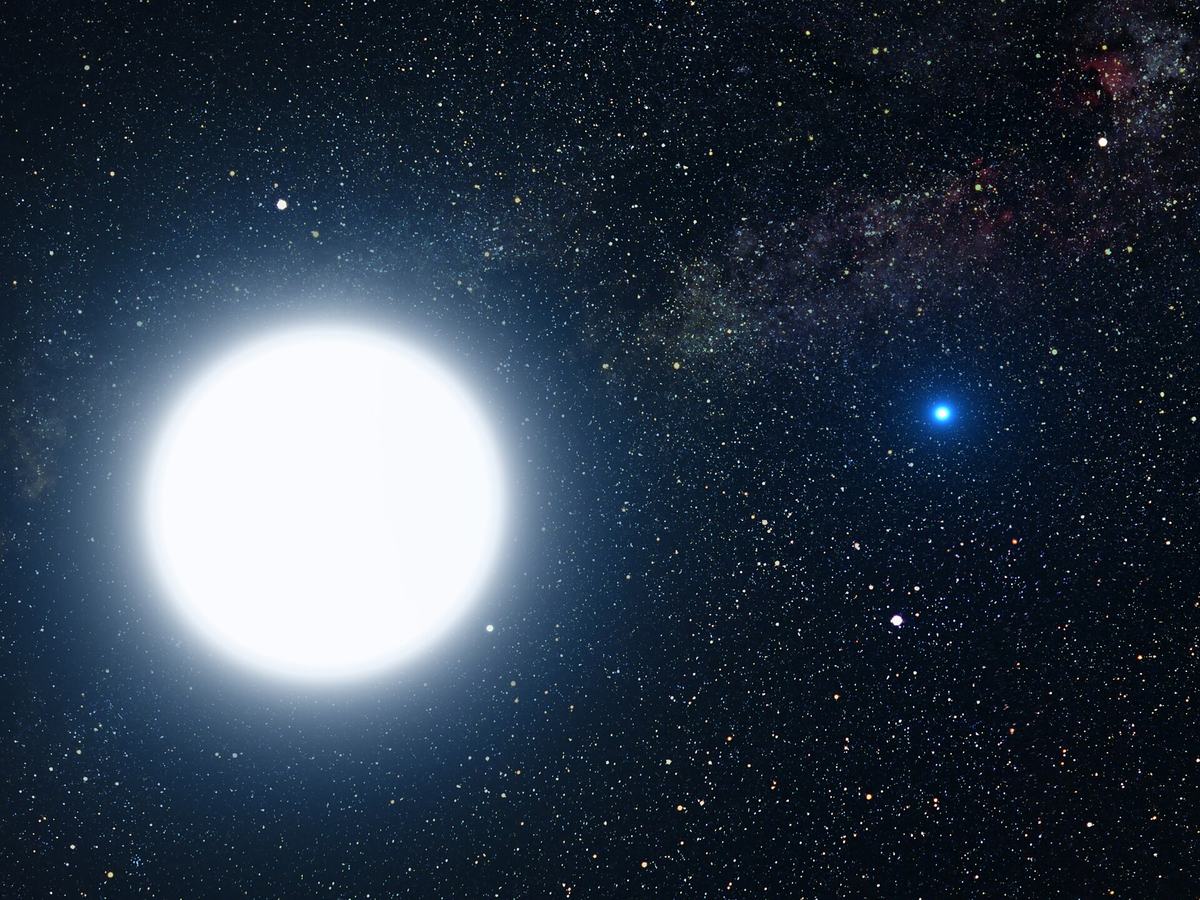
Scoop out a teaspoon of ordinary matter from a white dwarf and it would weigh about 5.5 tonnes back on Earth. That absurd density is the calling card of a white dwarf: not a young, blazing star, but the leftover core of one that has already died.
Most stars in the galaxy, including the Sun, are destined to end this way. A white dwarf is what remains after a Sun-like star burns through its fuel, sheds its outer layers, and leaves behind a compact, slowly cooling ember. Studying these objects has revealed some of the strangest physics in the universe, from matter held up by quantum rules instead of heat to stars stealing gas from planets orbiting them.

The Death That Leaves a Corpse Behind
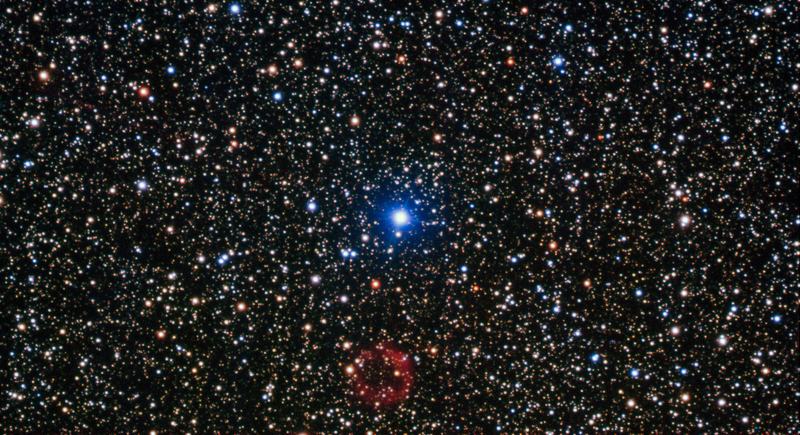
Stars spend most of their lives fusing hydrogen at their core, and the Sun is no exception. Eventually that fuel runs out, and the outer layers of the star drift away into space, exposing a burnt-out core underneath — the white dwarf.
Our own Sun will follow this path. In roughly 5 billion years it will swell into a red giant large enough to swallow Mercury and Venus, and very likely Earth along with them, before settling down as a white dwarf. What is left behind no longer generates energy through fusion; it simply radiates away the heat it already has, fading over unimaginable stretches of time.
Matter Squeezed Past Its Limits
A white dwarf's density is not a minor curiosity — it defines what the object is. Cubic-centimeter samples of white dwarf material can weigh anywhere between 100,000 and 100,000,000 grams, depending on the star, which is why that single teaspoon of material tips the scale at 5.5 tonnes.

At that scale, atoms themselves get rearranged. Inside a white dwarf, neighboring atomic nuclei sit only about 1.2×10⁻¹² meters apart, well inside the 5.3×10⁻¹¹ meter Bohr radius that roughly measures a hydrogen atom. What keeps the star from collapsing further isn't heat or ordinary gas pressure — it's electron degeneracy pressure, the same quantum effect that ultimately caps how massive a white dwarf can be.
The Star Hiding Next to Its Brighter Twin
The closest known white dwarf is also one of the most famous, simply because of its neighbor. Sirius B is the smaller partner in the Sirius binary system, sitting just 8.6 light years from us — near enough that its discovery became a genuine detective story.
Sirius B itself was caught in the act on 31 January 1862, when the US-based astronomer and telescope builder Alvan Graham Clark spotted a faint point of light beside the glare of its brighter neighbor. More than a century later, the Hipparcos satellite pinned down the system's distance directly through parallax, measuring 2.637 parsecs, or 8.601 light-years, a 20% improvement in precision over what had come before.
Extreme Even by White Dwarf Standards
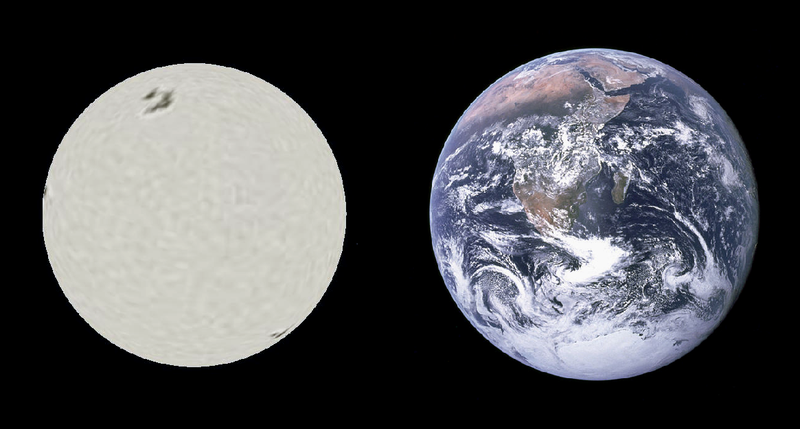
Not all white dwarfs fit a single mold. ZTF J1901+1458 ranks among the smallest and most massive ever found: it packs more than 1.3 times the Sun's mass into a sphere only 2,140 kilometers across, a radius that falls between the Moon's and Mercury's. Squeezing that much mass into so little space pushes the object close to the edge of what a white dwarf can be before collapsing further.
More ordinary examples show the typical range. Procyon B and van Maanen's Star each carry a fraction of the Sun's mass — 0.6 and 0.7 solar masses respectively — packed into radii of only about 0.012 and 0.011 times the Sun's radius. Small variations in mass among white dwarfs translate into meaningful differences in size, since more massive ones are actually more compact.

A Limit With a Nobel Prize Attached
There is a hard ceiling on how much mass a white dwarf can carry. A non-rotating white dwarf tops out at about 1.44 times the Sun's mass, a threshold known as the Chandrasekhar limit; past that point, degeneracy pressure from the electrons simply cannot hold the star up against its own gravity. Subrahmanyan Chandrasekhar worked out this model in 1931 and was awarded the 1983 Nobel Prize in Physics for his work on how stars evolve.
That 1.44 figure assumes simplified Newtonian gravity. Once general relativity and realistic corrections to the interactions between charged particles are included, the same calculation instead settles on a slightly lower limit of around 1.38 solar masses — a reminder that even a textbook constant depends on how carefully you do the math.
A White Dwarf Caught Eating a Planet
One particular white dwarf offered astronomers a front-row seat to a slow-motion planetary crime. The star is small but ferociously hot, blistering at 28 000 degrees Celsius, five times hotter than the Sun. A giant planet still orbits it, but at such close range that it completes a full circuit in just 10 days, and the white dwarf's high-energy light is steadily stripping away the planet's atmosphere.
Most of that escaping gas simply disperses into space, but some of it spirals into a disc funneling material onto the white dwarf at a rate of 3,000 tonnes per second. The doomed planet sits about 1,500 light years from Earth, in the constellation Cancer.
When a White Dwarf Explodes Instead of Fading
Not every white dwarf ends quietly. If one pulls in enough extra matter from a companion star, it can be driven toward catastrophe rather than gradual cooling, triggering a Type Ia supernova. For decades this was mostly theoretical, but the case was closed in 2014, when the supernova SN 2014J was observed in the nearby galaxy Messier 82, giving astronomers direct evidence that a white dwarf really was the source.
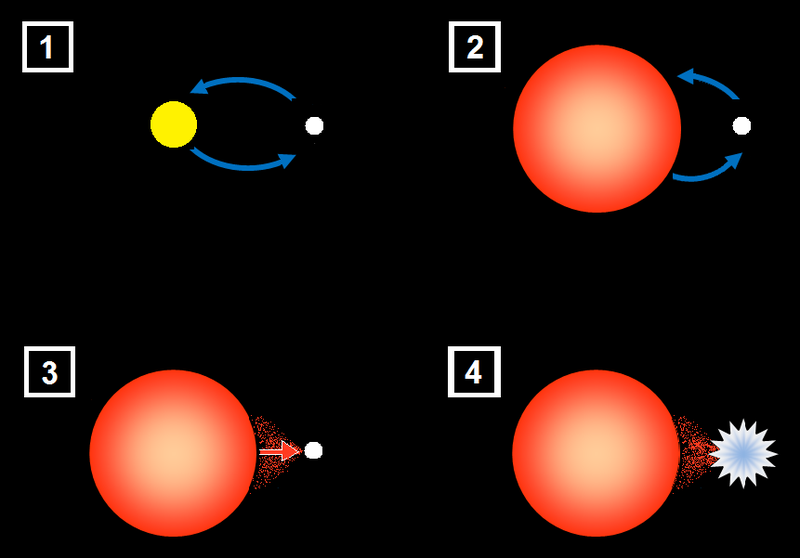

The explosion itself is violent almost beyond imagining. Debris gets hurled outward at velocities between 5,000 and 20,000 kilometers per second — around 6% of the speed of light — a pace that turns what used to be a quietly cooling stellar corpse into a brief, catastrophic burst of energy.