A light-year sounds like it should measure time. It doesn't. It is a fixed length: exactly 9,460,730,472,580.8 kilometres, or roughly 9.46 trillion kilometres (5.88 trillion miles). The International Astronomical Union defines it precisely as the distance light travels through a vacuum in one Julian year of 365.25 days.
That precision hides two centuries of work: astronomers arguing over which calendar year to use, timing beams of light with the tools available in a given century, and extracting a sliver of a degree from a telescope pointed at a star nobody had paid much attention to. What follows is the story behind that one long number, and the units, instruments, and near-misses that got astronomers there.
None of this is trivia for its own sake. A unit built on the speed of light connects a nineteenth-century star measurement to the modern effort to map the entire observable universe, and the same handful of ideas — angles, parallax, and the constant speed of light — keep resurfacing at every scale in between.
The Professional's Unit: The Parsec
Ask a working astronomer for a distance and "light-years" is not always what comes back. Professionals mostly reach for the parsec instead: one parsec works out to about 3.26 light-years, equal to 206,265 astronomical units. In everyday units, that is close to 30.9 trillion kilometres, or, converted to miles, about 19.2 trillion of them.


The name hints at how the unit is built. Picture a slim triangle stretching into space: one leg is exactly one astronomical unit long, and the angle at its far, narrow vertex measures one arcsecond. The length of the long leg, by definition, is a parsec. It is a distance defined through an angle rather than measured in a straight line, which is exactly why it turned out to be so useful for cataloguing stars: any telescope that can measure a tiny shift in a star's position against the background sky can turn that shift straight into a distance, without ever needing to send anything out there to check.
The Star That Started It All
Before anyone could pin down a light-year with any confidence, someone first had to prove that a star's distance could be measured directly at all. That happened in 1838, when German astronomer Friedrich Wilhelm Bessel turned his attention to a faint star called 61 Cygni. His trigonometric calculations, based on the star's parallax of 0.314 arcseconds, put its distance at 660,000 astronomical units.
Bessel then translated that abstract figure into something far more vivid: light itself needs 10.3 years to cross the gap separating Earth from that star. His 3.5-parsec result for 61 Cygni stands as the first successful published direct measurement of an object beyond the Solar System — the moment interstellar distances stopped being pure guesswork and became something a telescope could actually pin down.
A Word Born in Germany
The unit's name is younger than the measurement that inspired it. The word light-year only entered the language in 1851, when it turned up in a German popular-astronomy article written by Otto Ule. It caught on quickly as a way to translate Bessel's kind of number into something a general reader could feel — swapping arcseconds and astronomical units for a much more intuitive idea: how long light itself would take to make the trip. Decades later, professional astronomy went the other direction and settled on the angle-based parsec instead, leaving the light-year as the version meant for everyone else.
How Fast Is Fast?
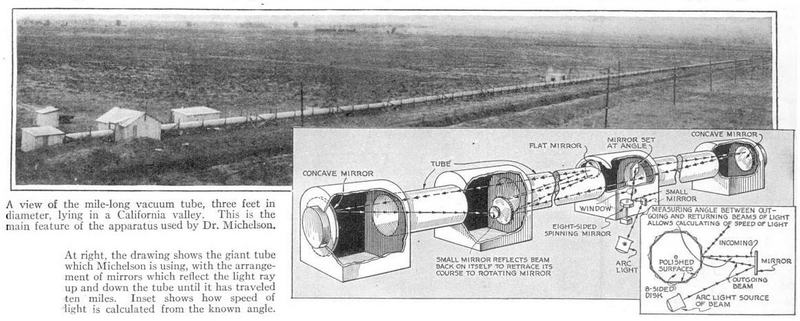
A light-year only makes sense once you accept just how fast light moves. A light-second, the distance light covers in a single second, equals exactly 299,792,458 metres — just 1/31,557,600 of a full light-year. Reaching that number took generations of work: in 1676, Ole Rømer became the first person to put a real number on light's speed, and he pulled it off using nothing but an astronomical measurement, with no stopwatch anywhere near the light itself.

Even at that speed, distance still costs real time in ways people have felt directly. During the Apollo 8 mission, the first crewed flight to orbit the Moon, ground control had to wait at least 3 seconds after every question before an answer could arrive, simply because of how long the radio signal took to make the round trip at the speed of light. Stretch that same kind of delay across trillions of kilometres instead, and it becomes obvious why astronomers eventually needed a unit built entirely around how far light itself can travel, rather than trying to keep reusing kilometres.
A Universe of Almost Incomprehensible Scale
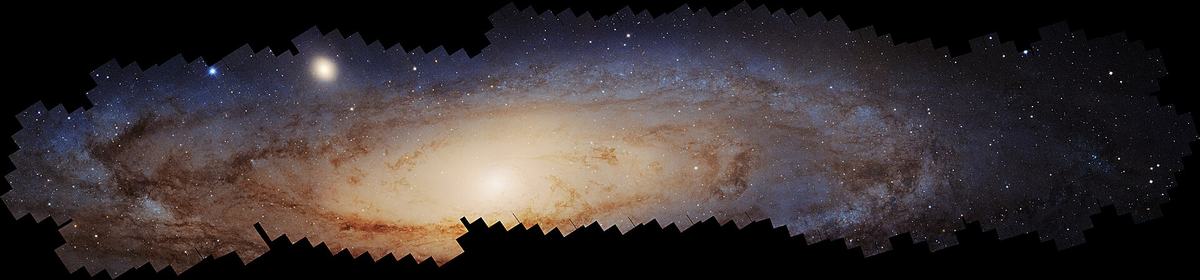
Once astronomers had a working ruler, the numbers it produced grew large fast. Nearly every star a person can pick out with the unaided eye lies no farther than a few hundred parsecs from the Sun; a handful of the faintest of those naked-eye stars stretch out to a few thousand parsecs, and beyond them the Andromeda Galaxy sits at over 700,000 parsecs away.
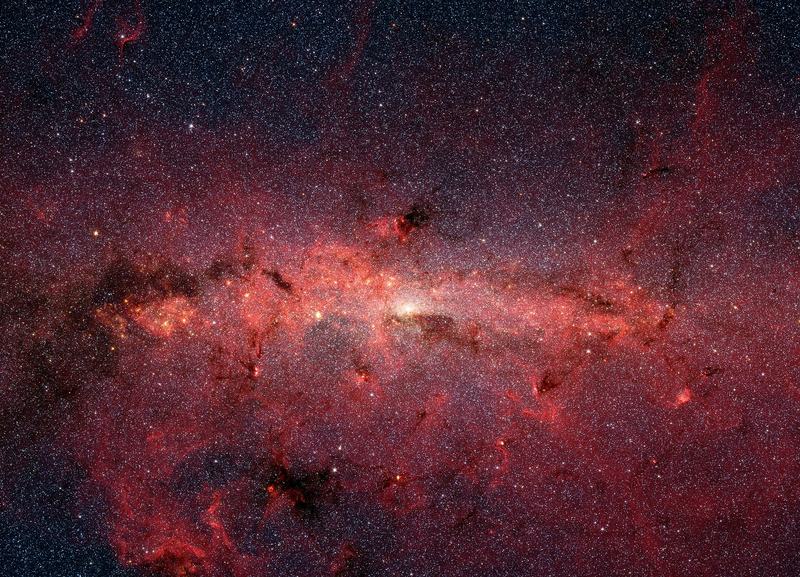

Zoom out to our own galaxy and the scale keeps climbing. The Milky Way's D25 diameter is estimated at 26.8 ± 1.1 kiloparsecs, or around 87,400 ± 3,600 light-years, yet its disk is only about 1,000 light-years thick through the spiral arms — a shape far wider than it is tall. Some structures dwarf even that: the Hercules–Corona Borealis Great Wall has been the largest known structure in the universe since November 2013, spanning roughly 3 gigaparsecs, about 9.8 billion light-years, across.
Measuring What We Cannot Reach
None of these figures come from a single tape measure stretched across the galaxy. Astronomers build up distance in steps, a method nicknamed the cosmic distance ladder, and each rung carries its own error bars. Cepheid variable stars, one of those rungs, are not flawless distance markers: they carry roughly a 7% error for nearby galaxies, rising to as much as 15% for the most distant ones measured this way.
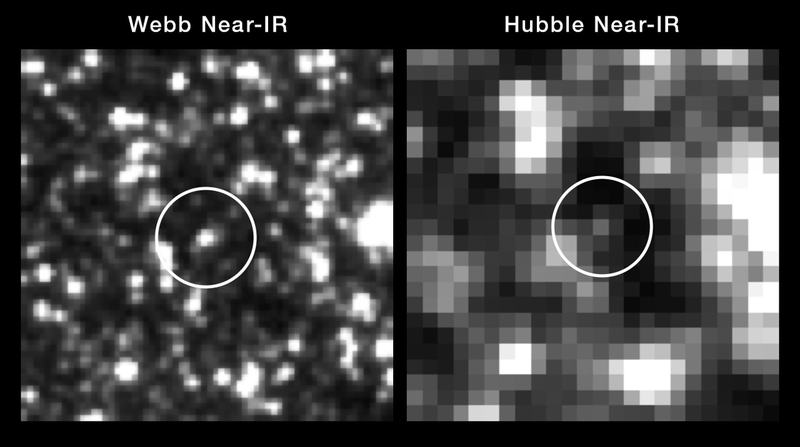
Type Ia supernovae extend the ladder much further outward. They rank among its most accurate tools, because their explosions can rival an entire galaxy in brightness — bright enough to be seen roughly 500 times farther away than Cepheid variables, which is exactly why supernovae, and not individual stars, do the heavy lifting once astronomers look past our immediate galactic neighbourhood. Closer to home, a geometric measurement placed the distance from the Sun to the Milky Way's own centre at Ro = 8.0 ± 0.4 kiloparsecs, described as the most accurate primary distance figure for the galactic centre, with minimal systematic uncertainty.
Every rung of that ladder, from an 1838 parallax measurement of a dim star to a modern geometric fix on the galaxy's own centre, exists for the same reason: the distances out there are too large for anything except light itself to measure them.