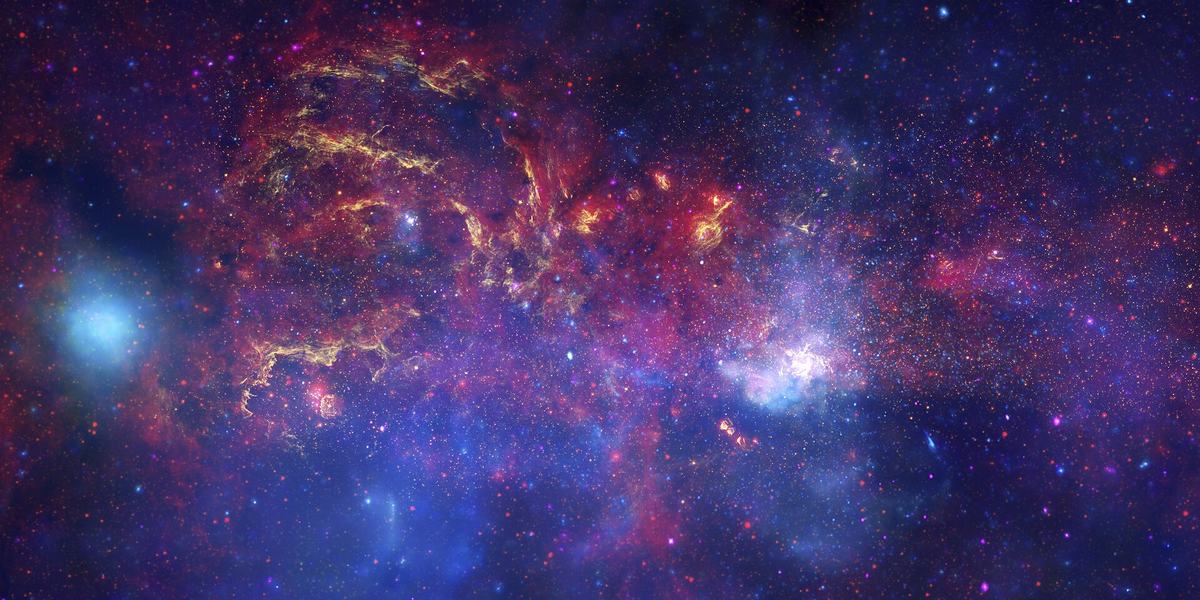
The Milky Way is a barred spiral galaxy with a D25 isophotal diameter estimated at 26.8 ± 1.1 kiloparsecs (87,400 ± 3,600 light-years) — and yet it is only about 1,000 light-years thick at the spiral arms. Flatten a disc that wide down to that thickness and the proportions get strange fast: the galaxy we live inside is far closer to a sheet than a sphere.
It holds an estimated 100 to 400 billion stars and at least that many planets, all orbiting a common center that astronomers only managed to photograph directly in 2022. Between the visible disc and the invisible material that surrounds it, the Milky Way is stranger, and larger, than the calm band of light it appears to be from a dark backyard.

Where We Actually Sit
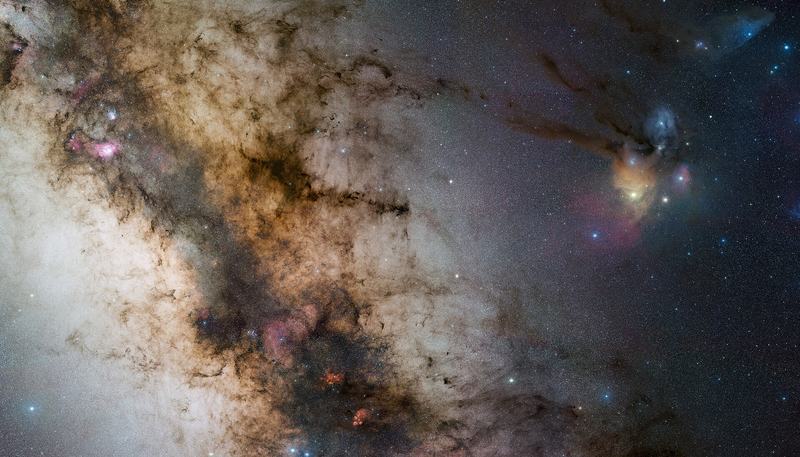
The Solar System is located at a radius of about 27,000 light-years (8.3 kpc) from the Galactic Center, on the inner edge of the Orion Arm, one of the spiral-shaped concentrations of gas and dust that wind through the disc. That places us well out from the crowded center and short of the true edge — a fairly ordinary address in a galaxy of hundreds of billions of stars.
Away from the central bulge or outer rim, the typical stellar orbital speed is between 200 and 220 km/s. Every star in that middle zone, including the Sun, is circling the Galactic Center at roughly that pace, all locked into the same long, silent orbit.
A Black Hole We Finally Photographed
The stars in the innermost 10,000 light-years of the Milky Way form a bulge and one or more bars that radiate from the bulge, and at the very center of that bulge sits something stranger than stars. The concentration of mass there is best explained as a supermassive black hole (SMBH) with an estimated mass of 4.1 to 4.5 million times the mass of the Sun — an object astronomers inferred from the motion of nearby stars decades before they ever saw it directly.
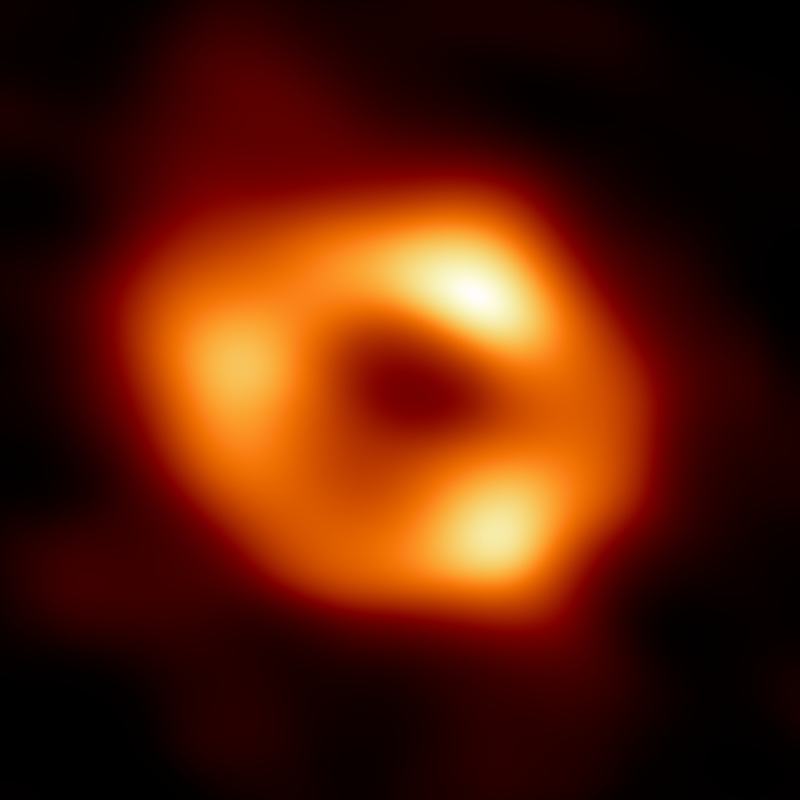
That changed on May 12, 2022, when the first image of Sagittarius A* was released by the Event Horizon Telescope Collaboration. It is the second confirmed image of a black hole ever produced, after Messier 87's supermassive black hole in 2019 — meaning humanity has now directly imaged precisely two black holes, and one of them is the one at the center of our own galaxy.
Stars pass remarkably close to it. As of 2020, the star S4714 is the record holder for closest approach to Sagittarius A*, at about 12.6 AU (1.88 billion km) — almost as close as Saturn gets to the Sun — while traveling at about 8% of the speed of light. A star swinging that near a supermassive black hole, at a meaningful fraction of light speed, is the kind of extreme physics that only happens at a galaxy's core.
Two Arms, Not Four
For decades, illustrations of the Milky Way showed four major spiral arms. Infrared surveys have complicated that picture: this evidence suggests that the Milky Way possesses only two major stellar arms, the Perseus arm and the Scutum–Centaurus arm, with the others reduced to minor structures. The Scutum–Centaurus Arm still stands out clearly in the data — it contains approximately 30% more red giants than would be expected in the absence of a spiral arm, a density signature that visible light alone doesn't reveal as cleanly.
The bar at the galaxy's center took its own path to recognition. Astronomers first conjectured in the 1960s that the Milky Way is a barred spiral galaxy rather than an ordinary spiral galaxy, but it took decades to confirm. These conjectures were confirmed by Spitzer Space Telescope observations in 2005, which showed the Milky Way's central bar to be larger than previously thought — a feature hiding in plain sight, obscured by the same dust that hides so much of the galactic center from visible-light telescopes.
An Old, Slow-Spinning Halo
Beyond the disc, the Milky Way carries a halo of much older stars behind it. In the stellar halo, stars tend to be old, with most greater than 12 billion years old, and they move very differently from disc stars: the halo stars have an observed radial velocity dispersion of about 200 kilometres per second, but a low average velocity of rotation of about 50 km/s. Disc stars orbit together in a fast, orderly stream; halo stars drift in a slow, scattered swarm that has barely organized itself in over 12 billion years.
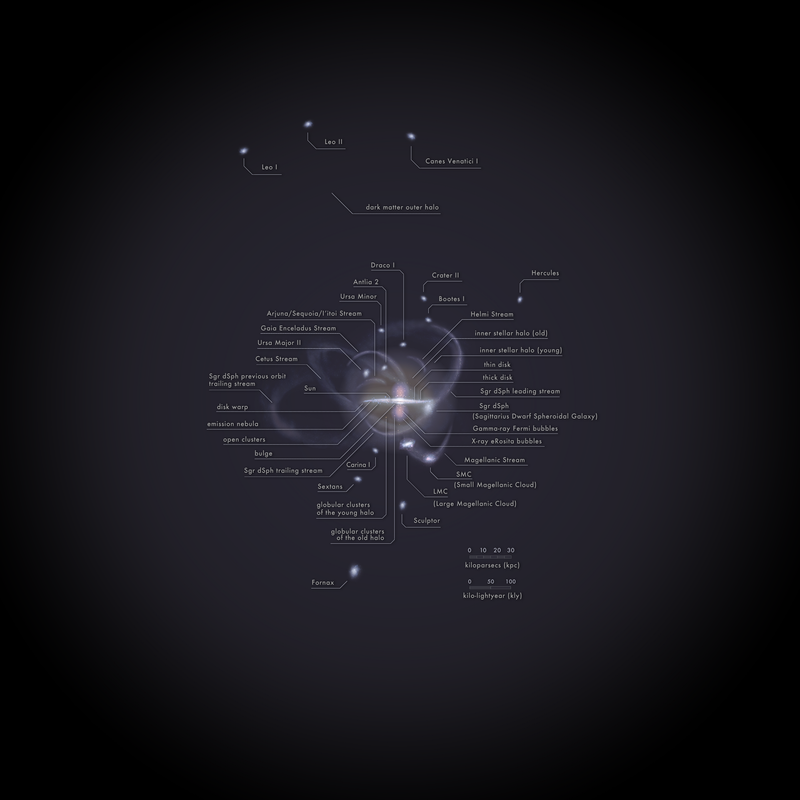

Recent simulations suggest that a dark matter area around the Milky Way, also containing some visible stars, may extend up to a diameter of almost 2 million light-years (613 kpc). Counting only what glows, the Milky Way is around 87,400 light-years across; counting what its gravity actually controls, it may stretch nearly 2 million light-years. Using that wider, 200 kpc cutoff to define the galaxy, the Milky Way is approximately 0.88 trillion times the mass of the Sun in total (8.8×10^11 solar masses) — the overwhelming majority of it invisible.
A Satellite That Rippled the Galaxy
The Milky Way is not alone even within its own gravitational reach. The Sagittarius Dwarf Spheroidal Galaxy, a satellite of the Milky Way, is roughly 10,000 light-years in diameter and is currently about 80,380 light-years from Earth, travelling in a polar orbit at a distance of about 50,000 light-years from the core of the Milky Way. It is a small companion, looping over the galaxy's poles rather than through its disc.
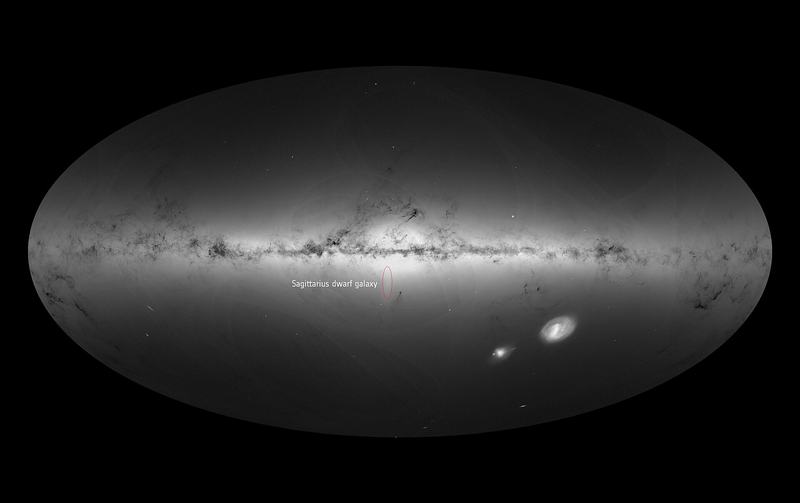

Small as it is, this satellite has left a mark on the entire galaxy. In 2018, the Gaia project of the European Space Agency showed that the Sagittarius Dwarf Spheroidal Galaxy had caused perturbations in a set of stars near the Milky Way's core, causing unexpected rippling movements of the stars, triggered when it moved through the Milky Way between 300 and 900 million years ago. A dwarf galaxy a fraction of the Milky Way's size passed close enough, hundreds of millions of years ago, to set stars near our own galactic core rippling — and the ripple was still detectable when Gaia looked for it.
Every Star, Mapped Twice
The scale of what astronomers now know about the Milky Way owes a great deal to a single spacecraft. The Gaia mission has expanded the number of observed stars in the Milky Way from about 2 million in the 1990s to 2 billion — a thousandfold jump in one generation of astronomy, and still only a small fraction of the 100 to 400 billion stars the galaxy is thought to hold.
A Slow Collision Already Underway
The Milky Way's long-term future is already written into its neighbors' motion. The Andromeda–Milky Way collision is a galactic collision that may occur in about 4.5 billion years between the two largest galaxies in the Local Group, and the Andromeda Galaxy is approaching the Milky Way at about 110 kilometres per second, as indicated by blueshift.
When it happens, the two galaxies will pass through each other with surprisingly little direct contact. The Andromeda Galaxy contains about 1 trillion (10^12) stars and the Milky Way about 300 billion (3×10^11), and even so, the chance of two stars colliding is negligible because of the huge distances between the stars. Two galaxies of that scale will pass through each other, and the merger's real drama will unfold almost entirely in empty space.